Browse · harp
Printjmc
algebra junior
Problem
A sequence of squares is made of identical square tiles. The edge of each square is one tile length longer than the edge of the previous square. The first three squares are shown. How many more tiles does the seventh square require than the sixth? 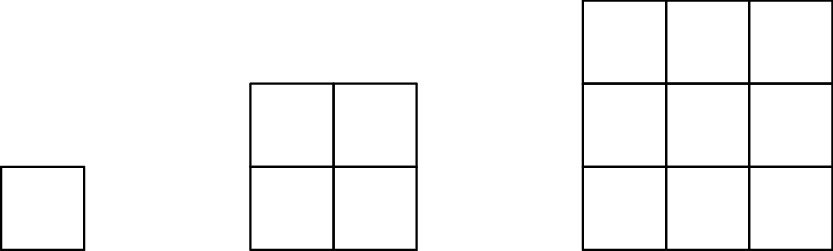
(A)
(B)
(C)
(D)
Solution
The first square has a sidelength of , the second square , and so on. The seventh square has and is made of unit tiles. The sixth square has and is made of unit tiles. The seventh square has more tiles than the sixth square.
Final answer
C