Browse · MathNet
PrintIranian Mathematical Olympiad
Iran counting and probability
Problem
Arash and Babak play the following game on a table. Starting with Arash, he in his turns colors number of -shaped trominos on the table (rotation and reflection are allowed). Also, Babak in his turns colors one square from the table. Every cell of the table can be colored at most once and a player who can not color the cells in his turn will lose. Find all values of for which Arash has a winning strategy.
Solution
We claim that Arash has a winning strategy if and only if .
First of all, it is obvious if , then Arash can not color trominos in his first turn and he will lose. Indeed, there are not disjoint trominos in the table.
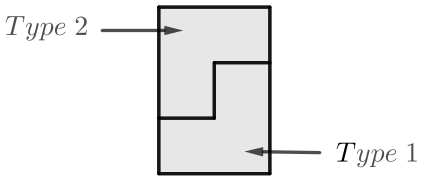
Next, we shall prove that for every , Arash has a winning strategy. We can partition the table into number of rectangles (intersection of two consecutive columns and three consecutive rows). We count the rectangles in such a way that the rectangles filling the left columns have numbers (from top to bottom), then the rectangles filling the third and fourth column have numbers , etc. We consider two different trominos in each table, as in the figure below.
Now if , Arash will color the trominos of type 1 in all the rectangles and then trominos of type 2 in rectangles of numbers . It is easy to find that after Arash's turn, every square has a colored cell. So, Babak can not color any square in his turn and Arash will win.
If , Arash in his first turn colors the trominos of type 1 in rectangles . For the next turns, suppose that Babak has filled some square and now this is Arash's turn. If he can find disjoint trominos not intersecting rectangles , he will color them. In the case that there is not disjoint trominos, let be the maximal number such trominos (). Now, he will color trominos without intersection with rectangles , and also color trominos in rectangles . After this step, there would be no uncolored square left in the table and so Babak will lose the game. ■
First of all, it is obvious if , then Arash can not color trominos in his first turn and he will lose. Indeed, there are not disjoint trominos in the table.
Next, we shall prove that for every , Arash has a winning strategy. We can partition the table into number of rectangles (intersection of two consecutive columns and three consecutive rows). We count the rectangles in such a way that the rectangles filling the left columns have numbers (from top to bottom), then the rectangles filling the third and fourth column have numbers , etc. We consider two different trominos in each table, as in the figure below.
Now if , Arash will color the trominos of type 1 in all the rectangles and then trominos of type 2 in rectangles of numbers . It is easy to find that after Arash's turn, every square has a colored cell. So, Babak can not color any square in his turn and Arash will win.
If , Arash in his first turn colors the trominos of type 1 in rectangles . For the next turns, suppose that Babak has filled some square and now this is Arash's turn. If he can find disjoint trominos not intersecting rectangles , he will color them. In the case that there is not disjoint trominos, let be the maximal number such trominos (). Now, he will color trominos without intersection with rectangles , and also color trominos in rectangles . After this step, there would be no uncolored square left in the table and so Babak will lose the game. ■
Final answer
All integers k with k ≤ 1400×467 (i.e., k ≤ 653800)
Techniques
Games / greedy algorithmsColoring schemes, extremal arguments