Browse · MathNet
PrintCroatian Mathematical Olympiad
Croatia geometry
Problem
Let be an acute-angled triangle such that . Point is the midpoint of the shorter arc of the circumcircle of the triangle . Point is the incentre of the triangle , and point is the reflection of across the line . Line intersects the circumcircle of the triangle at the point which lies on the shorter arc . Prove that holds. (Romania 2017)
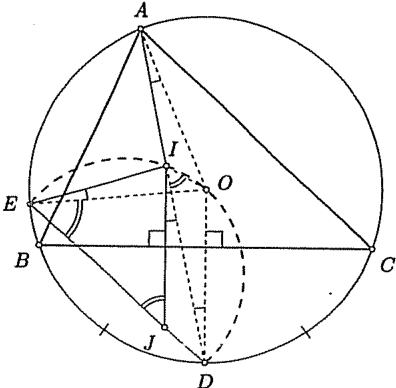
Solution
Let be the circumcentre of the triangle .
Point lies on the angle bisector of . Therefore , and are collinear. Lines and are parallel, since they are both perpendicular to .
We will prove the claim by showing that the triangles and are congruent.
First we show that the triangles and are similar. Note that . To show similarity, we need to prove that , i.e. We have and , where and denote the incircle and the circumcircle radii, respectively. Therefore, the right-hand side of (1) equals . The left-hand side product , is in fact the power of point with respect to the circumcircle of the triangle and equals . Now it suffices to verify that , which holds because of Euler's theorem which expresses the distance between the incentre and the circumcentre using this exact formula.
Therefore, we can conclude that the triangles and are similar. This means that , and follows. Since lines and are parallel, we have , and since we have . Now having we conclude that points , , and are concyclic.
From this we have , and from the proven similarity we have . It follows that . Since and the side is mutual, we conclude that the triangles and are congruent.
Point lies on the angle bisector of . Therefore , and are collinear. Lines and are parallel, since they are both perpendicular to .
We will prove the claim by showing that the triangles and are congruent.
First we show that the triangles and are similar. Note that . To show similarity, we need to prove that , i.e. We have and , where and denote the incircle and the circumcircle radii, respectively. Therefore, the right-hand side of (1) equals . The left-hand side product , is in fact the power of point with respect to the circumcircle of the triangle and equals . Now it suffices to verify that , which holds because of Euler's theorem which expresses the distance between the incentre and the circumcentre using this exact formula.
Therefore, we can conclude that the triangles and are similar. This means that , and follows. Since lines and are parallel, we have , and since we have . Now having we conclude that points , , and are concyclic.
From this we have , and from the proven similarity we have . It follows that . Since and the side is mutual, we conclude that the triangles and are congruent.
Techniques
Triangle centers: centroid, incenter, circumcenter, orthocenter, Euler line, nine-point circleRadical axis theoremAngle chasing