Browse · MathNet
PrintXXIX Rioplatense Mathematical Olympiad
Argentina geometry
Problem
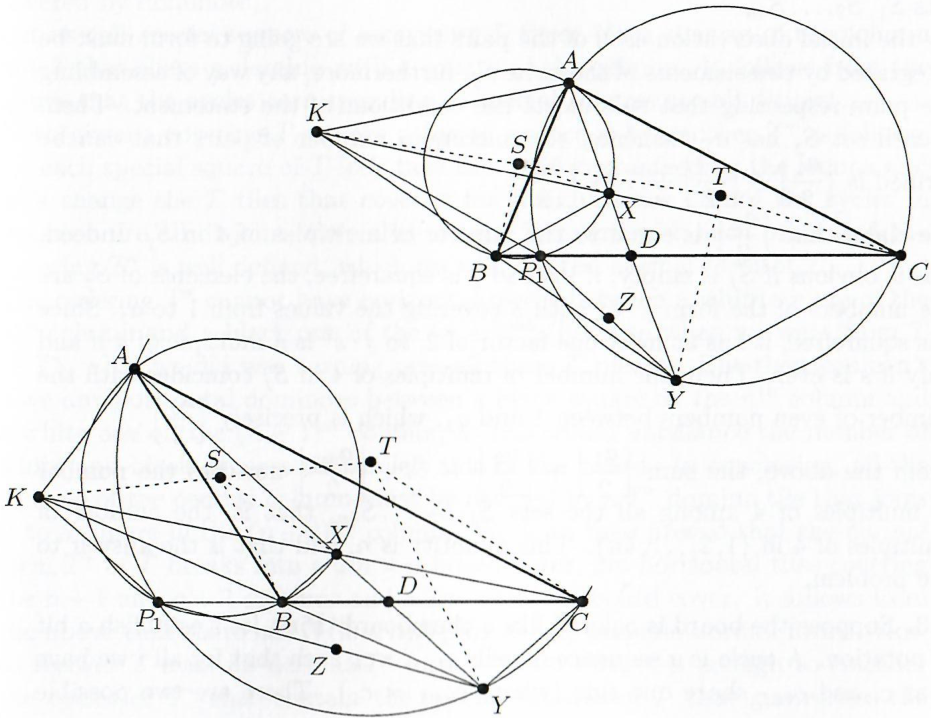
Let be a triangle with . On the angle bisector of , two points and are marked such that is between and , and is parallel to . Let be the reflection of with respect to . Let be the point of intersection of lines and . If lines and intersect at , prove that .
Solution
Let be the point where the circumcircle of intersects for the second time. Let be the foot of the bisector of . Clearly, is interior to the circumcircle of and by power of a point, we have that Since and are parallel, , from where it is easily obtained that and as is external to segments and , is cyclic. For the two possible positions (see the diagrams below), using the cyclic quadrilaterals and we have that . Then , and are collinear, and is the point where intersects , from where and and are cyclic. Now let and be the circumcenters of and respectively. Let us note that and , from where the line is the perpendicular bisector of . The problem then becomes equivalent to proving that , , and are collinear. But let us note that since , by central angle we have that , and since and are isosceles, these triangles are similar. Now, since and are parallel, we have by Thales that . Then the dilation centered at that sends to also sends to . Let be the image of after applying this same dilation, we have that and are similar, and since both and are in the same half plane as with respect to we have that . Then , and are collinear and .
Techniques
Cyclic quadrilateralsHomothetyRadical axis theoremAngle chasingTriangle centers: centroid, incenter, circumcenter, orthocenter, Euler line, nine-point circle