Browse · MathNet
Print63rd Czech and Slovak Mathematical Olympiad
Czech Republic geometry
Problem
We are given two circles and in the plane, with . Find the locus of points which do not lie on the line and possess the following property: The segments and intersect successively the circles and in such points whose distances to the line are the same. (Jaromír Šimša)
Solution
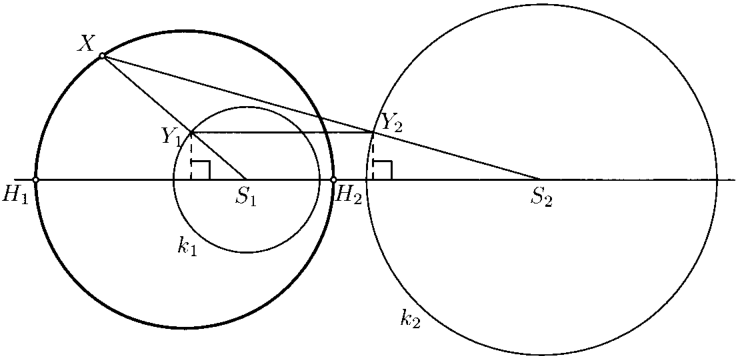
In the first part of our solution, we will assume that is any point with the required property. It is clear that lies in the exteriors of the circles and and that the points , and are vertices of a triangle whose sides , are intersected successively by the circles and in such points , which lie on the same line parallel to (Fig. 1). Since the triangles and are similar (by theorem AA), it holds which can be rewritten, because of the equalities as an equation for lengths of the segments and : Since the points and are fixed as well as the ratio , the locus of points
Fig. 1
satisfying equation (3) is a circle of Apollonius (which evidently becomes a straight line if the ratio equals 1). As known for the case when , there are exactly two solutions and of the equation (3) that lie on the line and form a diameter of the resulting circle of Apollonius. For our situation, let us add the fact that the points and are centres of both homotheties of the initially given circles and .
In the second part of our solution, we will conversely assume that is a point of the circle of Apollonius given by the equation (3) and that lies outside of the line , i.e. and . In view of the condition that , the whole circle of Apollonius (with diameter ) lies in the exteriors of the circles and . Indeed, the last fact follows from a known position of the homothety centres and on the line : If for example , then the diameter contains the diameter of , while the diameter of and the diameter are disjoint. (See also Remark below.)
The proven property implies that is a triangle with and . Thus there are points and lying on the segments and , respectively. Since the equalities (2) are valid again, it is possible to transform the equation (3) to equation (1). Consequently, the triangles and are similar (now by SAS theorem) and hence . Therefore the distances of and to the line are equal which proves the required property of the point .
Answer. If , the locus of points is the circle of Apollonius which is given by the above equation (3), excepting the two points on the line . If , the locus is the perpendicular bisector of the segment , with exception of the midpoint of .
Fig. 1
Fig. 1
satisfying equation (3) is a circle of Apollonius (which evidently becomes a straight line if the ratio equals 1). As known for the case when , there are exactly two solutions and of the equation (3) that lie on the line and form a diameter of the resulting circle of Apollonius. For our situation, let us add the fact that the points and are centres of both homotheties of the initially given circles and .
In the second part of our solution, we will conversely assume that is a point of the circle of Apollonius given by the equation (3) and that lies outside of the line , i.e. and . In view of the condition that , the whole circle of Apollonius (with diameter ) lies in the exteriors of the circles and . Indeed, the last fact follows from a known position of the homothety centres and on the line : If for example , then the diameter contains the diameter of , while the diameter of and the diameter are disjoint. (See also Remark below.)
The proven property implies that is a triangle with and . Thus there are points and lying on the segments and , respectively. Since the equalities (2) are valid again, it is possible to transform the equation (3) to equation (1). Consequently, the triangles and are similar (now by SAS theorem) and hence . Therefore the distances of and to the line are equal which proves the required property of the point .
Answer. If , the locus of points is the circle of Apollonius which is given by the above equation (3), excepting the two points on the line . If , the locus is the perpendicular bisector of the segment , with exception of the midpoint of .
Fig. 1
Final answer
If the radii are unequal, the locus is the circle of Apollonius for the two centers with distance ratio equal to the ratio of the radii, excluding the two homothety centers on the line of centers. If the radii are equal, the locus is the perpendicular bisector of the segment joining the centers, excluding its midpoint.
Techniques
Circle of ApolloniusHomothetyConstructions and lociAngle chasing