Browse · MathNet
PrintUSA IMO 2003
United States 2003 geometry
Problem
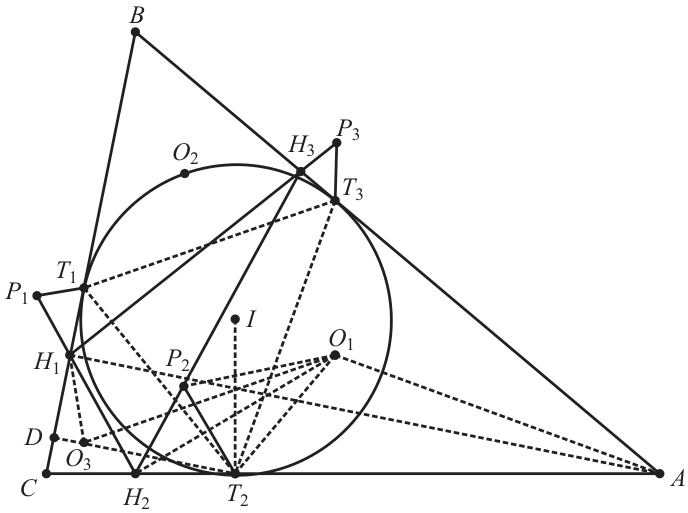
Let , , and be the altitudes of an acute scalene triangle . The incircle of triangle is tangent to , , and at , and , respectively. For , let be the point on line (where ) such that is an acute isosceles triangle with . Prove that the circumcircles of triangles , , pass through a common point.
Solution
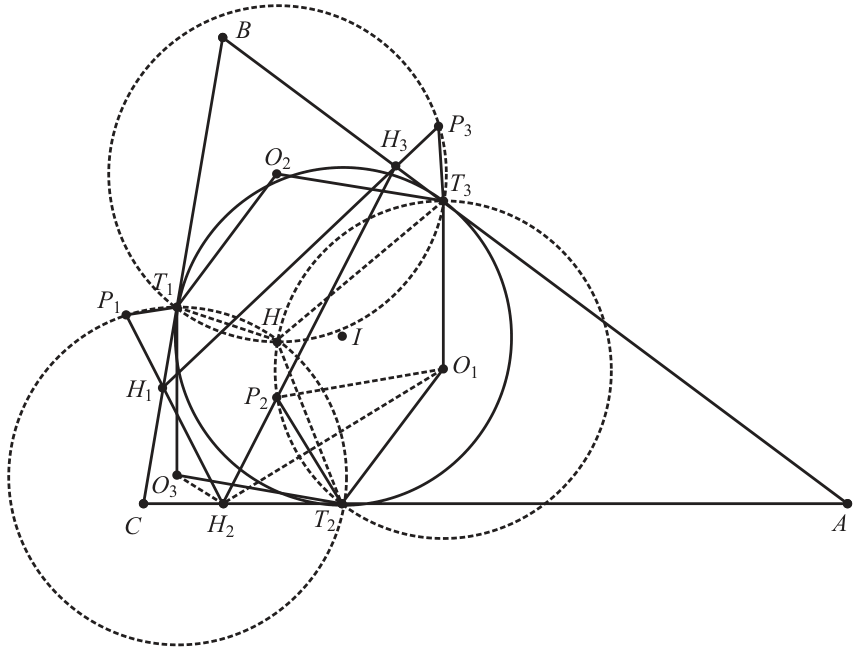
First Solution. (By Po-Ru Loh) We begin by showing that points , and lie on a cyclic. We will prove this by establishing . To find , observe that triangles and are similar. Indeed, quadrilateral
is cyclic so , and likewise . Now, and are corresponding incenters of similar triangles, so it follows that triangles and are also similar, and hence are related by a spiral similarity about . Thus, and It follows that another spiral similarity about takes triangle to triangle . Hence . We wish to show that as well, or in other words, . To do this, drop the altitude from to and let it intersect at . Triangles and are similar as before, with corresponding incenters and . Furthermore, and also correspond. Hence, , and so . Thus, , and it follows that .
Having shown that is cyclic, we may now write . Since triangles and are related by a spiral similarity about , we have by noting that is cyclic. Likewise, and so . Therefore, , , and of hexagon also sum to . Now let be the intersection of circles and . Then and . Therefore, and so lies on the circle as well. Hence, circles , , and share a common point, as wanted.
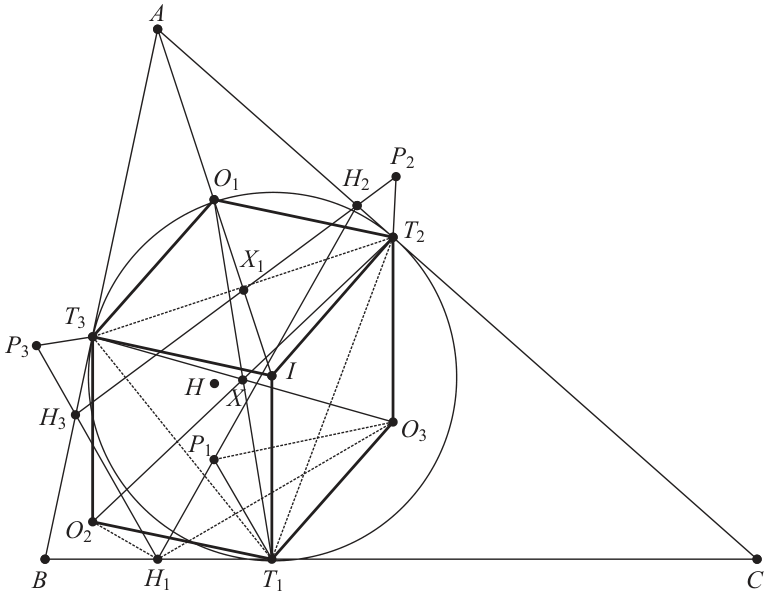
Second Solution. (By Anders Kaseorg) Note that and , so triangles and are similar with ratio . Thus, since is the incenter of triangle , . If is the intersection of segments and ,
we have , and so Hence , so is the reflection of across line , and . Therefore, , and similarly and , are rhombi with the same side length , implying that circles have the same radius . We also conclude that and , and so is a parallelogram. Hence the midpoints of and (similarly ) are the same point , and is the reflection of across . If is the reflection of across , we have , that is, is a common point of the three circumcircles.
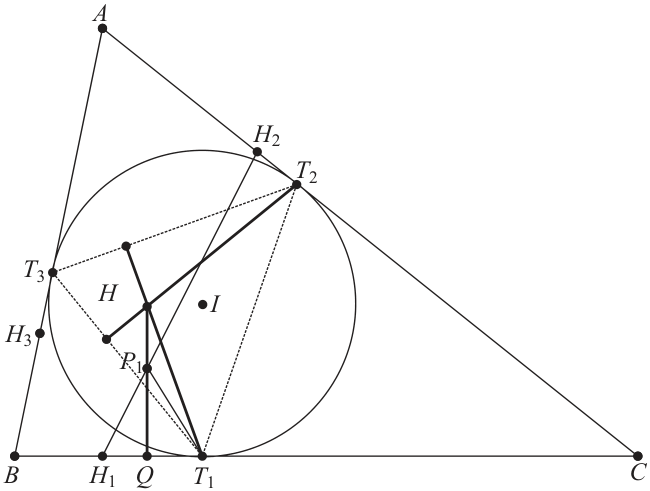
Third Solution. We use directed lengths (along line , with to as the positive direction) and directed angles modulo in this proof. (For segments not lying on line , we assume its direction as the direction of its projection on line .) We claim that , , all pass through , the orthocenter of triangle . Without loss of generality, it suffices to prove that is cyclic. If , then and the case is trivial. Let , , , , , and .
Let be the intersection of lines and . Note that (Likewise, .) Thus to prove that is cyclic is equivalent to prove that . Let and be the respective feet of perpendiculars from and to line . Because , is cyclic, and so . Thus triangles and
are similar, implying that Therefore, to prove that , we have now reduced to proving that , or Note that that is, On the other hand, applying the Law of Cosines to triangle gives or Now we calculate . Because is the orthocenter of triangle , Applying the Law of Sines to triangle and applying the Extended Law of Sines to triangle gives and consequently, Because we obtain Combining equations (1), (2), (3), and (4), we conclude that it suffices to prove that Applying the fact and applying the Law of Sines to triangle , (5) becomes By the Double-angle formulas, and and so (6) reads By the Difference-to-product formulas, the last equation reduces to which is evident.
is cyclic so , and likewise . Now, and are corresponding incenters of similar triangles, so it follows that triangles and are also similar, and hence are related by a spiral similarity about . Thus, and It follows that another spiral similarity about takes triangle to triangle . Hence . We wish to show that as well, or in other words, . To do this, drop the altitude from to and let it intersect at . Triangles and are similar as before, with corresponding incenters and . Furthermore, and also correspond. Hence, , and so . Thus, , and it follows that .
Having shown that is cyclic, we may now write . Since triangles and are related by a spiral similarity about , we have by noting that is cyclic. Likewise, and so . Therefore, , , and of hexagon also sum to . Now let be the intersection of circles and . Then and . Therefore, and so lies on the circle as well. Hence, circles , , and share a common point, as wanted.
Second Solution. (By Anders Kaseorg) Note that and , so triangles and are similar with ratio . Thus, since is the incenter of triangle , . If is the intersection of segments and ,
we have , and so Hence , so is the reflection of across line , and . Therefore, , and similarly and , are rhombi with the same side length , implying that circles have the same radius . We also conclude that and , and so is a parallelogram. Hence the midpoints of and (similarly ) are the same point , and is the reflection of across . If is the reflection of across , we have , that is, is a common point of the three circumcircles.
Third Solution. We use directed lengths (along line , with to as the positive direction) and directed angles modulo in this proof. (For segments not lying on line , we assume its direction as the direction of its projection on line .) We claim that , , all pass through , the orthocenter of triangle . Without loss of generality, it suffices to prove that is cyclic. If , then and the case is trivial. Let , , , , , and .
Let be the intersection of lines and . Note that (Likewise, .) Thus to prove that is cyclic is equivalent to prove that . Let and be the respective feet of perpendiculars from and to line . Because , is cyclic, and so . Thus triangles and
are similar, implying that Therefore, to prove that , we have now reduced to proving that , or Note that that is, On the other hand, applying the Law of Cosines to triangle gives or Now we calculate . Because is the orthocenter of triangle , Applying the Law of Sines to triangle and applying the Extended Law of Sines to triangle gives and consequently, Because we obtain Combining equations (1), (2), (3), and (4), we conclude that it suffices to prove that Applying the fact and applying the Law of Sines to triangle , (5) becomes By the Double-angle formulas, and and so (6) reads By the Difference-to-product formulas, the last equation reduces to which is evident.
Techniques
Triangle centers: centroid, incenter, circumcenter, orthocenter, Euler line, nine-point circleSpiral similarityCyclic quadrilateralsTangentsTrigonometryAngle chasing