Browse · MathNet
PrintInternational Mathematical Olympiad
China geometry
Problem
In a convex quadrilateral , the diagonal bisects neither the angle nor the angle . The point lies inside and satisfies
Prove that is a cyclic quadrilateral if and only if .
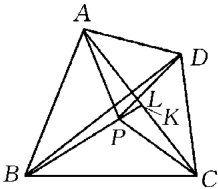
Prove that is a cyclic quadrilateral if and only if .
Solution
(i) Necessity.
Assume that is a cyclic quadrilateral. Let the circle be the circumcircle of quadrilateral . Extend and beyond to meet the circle at and respectively.
Since does not bisect and lies inside , it follows from that , , and the points and lie in the same half-plane bounded by the line . Hence . Similarly, and .
The points , , , , , lie on the circle , as mentioned above. So the points and , the points and , the points and are symmetrical with respect to the perpendicular bisector of respectively.
Since , then is on the line , or . This completes the proof of the necessity.
(ii) Sufficiency.
Lemma. Let be a fixed line and be fixed points such that and , lie in the different half-planes bounded by the line . Assume that the point lies on the line . Let be the smallest angle of rotation from the line to the line anticlockwise. Let be the smallest angle of rotation from the line to the line anticlockwise. If , then is called a good point. Prove that there are at most two good points.
Proof of the lemma
We set up a coordinate system with the line as the -axis and the perpendicular of as the -axis. Let , , , . Then , , , and . Hence
Rotate the line by anticlockwise, coinciding with . So
Moreover, since , , then after being rotated by anticlockwise becomes which is parallel to . Thus, and
Since and are not 0 at the same time, so is a good point the simultaneous equations in and . have the non-zero solutions
Let . If , it follows from that . Hence and are not parallel. Let intersect at . We have that and . Hence is not a good point. This implies , so the equation has at most two solutions.
Hence there are at most two good points.
This completes the proof of the lemma.
Let the points , , , be arranged clockwise and . Let be the point such that , , , are concyclic, where lies on the ray . Since and bisects neither nor , intersects the perpendicular bisector of at the unique point .
Let be the ray satisfying and . Together with (i), we have that , or is the intersection point of and the perpendicular bisector of , so . It follows from that .
Replace , , , by , , , . Then , , are good points. Since and , . Hence , , , is concyclic.
This completes the proof of the sufficiency.
Solution II
We may assume without loss of generality that lies in the rectangles and .
Assume that the quadrilateral is cyclic. Let the lines and meet at and respectively. It follows from the given equalities and , that the triangles , and are similar. This implies , so . Hence .
It follows from that . Since , the triangles and are similar. Hence yielding . It follows from that . Moreover, since and , the triangles and are congruent. Hence .
Assume that is a cyclic quadrilateral. Let the circle be the circumcircle of quadrilateral . Extend and beyond to meet the circle at and respectively.
Since does not bisect and lies inside , it follows from that , , and the points and lie in the same half-plane bounded by the line . Hence . Similarly, and .
The points , , , , , lie on the circle , as mentioned above. So the points and , the points and , the points and are symmetrical with respect to the perpendicular bisector of respectively.
Since , then is on the line , or . This completes the proof of the necessity.
(ii) Sufficiency.
Lemma. Let be a fixed line and be fixed points such that and , lie in the different half-planes bounded by the line . Assume that the point lies on the line . Let be the smallest angle of rotation from the line to the line anticlockwise. Let be the smallest angle of rotation from the line to the line anticlockwise. If , then is called a good point. Prove that there are at most two good points.
Proof of the lemma
We set up a coordinate system with the line as the -axis and the perpendicular of as the -axis. Let , , , . Then , , , and . Hence
Rotate the line by anticlockwise, coinciding with . So
Moreover, since , , then after being rotated by anticlockwise becomes which is parallel to . Thus, and
Since and are not 0 at the same time, so is a good point the simultaneous equations in and . have the non-zero solutions
Let . If , it follows from that . Hence and are not parallel. Let intersect at . We have that and . Hence is not a good point. This implies , so the equation has at most two solutions.
Hence there are at most two good points.
This completes the proof of the lemma.
Let the points , , , be arranged clockwise and . Let be the point such that , , , are concyclic, where lies on the ray . Since and bisects neither nor , intersects the perpendicular bisector of at the unique point .
Let be the ray satisfying and . Together with (i), we have that , or is the intersection point of and the perpendicular bisector of , so . It follows from that .
Replace , , , by , , , . Then , , are good points. Since and , . Hence , , , is concyclic.
This completes the proof of the sufficiency.
Solution II
We may assume without loss of generality that lies in the rectangles and .
Assume that the quadrilateral is cyclic. Let the lines and meet at and respectively. It follows from the given equalities and , that the triangles , and are similar. This implies , so . Hence .
It follows from that . Since , the triangles and are similar. Hence yielding . It follows from that . Moreover, since and , the triangles and are congruent. Hence .
Techniques
Cyclic quadrilateralsAngle chasingComplex numbers in geometryTrigonometryRotation