Browse · MathNet
PrintBMO 2019 Shortlist
2019 counting and probability
Problem
A town-planner has built an isolated city whose road network consists of roundabouts, each connecting exactly three roads. A series of tunnels and bridges ensure that all roads in the town meet only at roundabouts. All roads are two-way, and each roundabout is oriented clockwise. Vlad has recently passed his driving test, and is nervous about roundabouts. He starts driving from his house, and always takes the first exit at each roundabout he encounters. It turns out his journey includes every road in the town in both directions before he arrives back at the starting point in the starting direction. For what values of is this possible?

Solution
odd. In fact, the number of trajectories has the same parity as . The setting is a (multi)graph where every vertex has degree three. Each vertex has an orientation, an ordering of its incident edges. We call Vlad's possible paths trajectories, and a complete trajectory if he traverses every edge in both directions. We may assume the multigraph is connected, as otherwise a complete trajectory is certainly not possible.
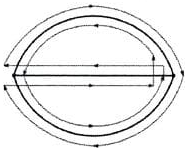
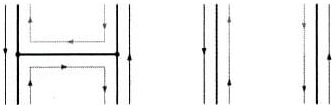
N odd (construction): There is an example when , as shown in Figure 10. Figure 10: C4: There are two 3-regular graphs on two vertices, the handcuffs and theta. The handcuffs fail since each self-loop has its own trajectory, but the theta does work for two of the four possible orientations. We now construct examples for odd by induction. Suppose we have a valid 3-regular graph on vertices, such that Vlad's trajectory is complete. This has at least two (undirected) edges, so pick two of them, and . (It does not matter if they share incident vertices.) Split both and into three, by adding two new vertices to each, and connect as in Figure 11. New vertices have degree three; other degrees are unchanged, so the graph is still 3-regular. For each edge and , pick a direction. (Both up in the figure.) These directed edges are part of the complete trajectory given by the induction hypothesis. Choose the orientations of the new vertices to preserve these two sections of the trajectory. The remaining two directed edges in the original graph will end up as partial trajectories in the new graph (see Figure 11). However, because all the new partial trajectories start and finish at the same places and in the same directions in the original graph, and no other directed edges are changed, the trajectory remains complete. The result for odd follows by induction.
N even: Split each edge in the graph into two directed edges and . Let be the set of the directed edges. Let be the permutation of which exchanges and .
Now, for each roundabout , let be the three directed edges into . The roundabout has a cyclic orientation, either or . Let describe the directed edge after in this orientation. By considering all roundabouts, is also a permutation of . Note that is directed towards , so the directed edge after in a trajectory is . So Vlad makes a complete trajectory precisely if is a cyclic permutation of . Note that the cycle type of is , and the cycle type of is . So is always an even permutation, while is an even permutation precisely when is even. However, a cyclic permutation of is always odd, since is even. So there is certainly no complete trajectory when is even.
Alternative I: We claim that in a graph with edges, and vertices, the number of trajectories, , has the same parity as . We allow degenerate cases of this statement, for example graphs that are disconnected, or trajectories that consist of only a single vertex, so that the graph that consists of vertices and no edges has precisely trajectories, and thus satisfies the given claim. This shows that cannot be even. We prove the claim by induction on . Suppose we are given a graph with edges and trajectories. Then consider any edge , and its two directions . Let be the sequence of directed edges starting from the one after in its trajectory, ending at the edge before or , whichever appears first. Similarly define starting after . and are disjoint, and may be empty. Figure 12: C4: (a) Initial trajectories. (b) After removing . We consider removing , but otherwise keep the orientations at its incident vertices the same. Then if are in different trajectories, these are the concatenations and . After removing , for each direction , instead of proceeding onto this directed edge, the relevant trajectory moves to the other trajectory. In other words, the resulting trajectory is the concatenation . So decreases by one.
Similarly, if both directions of are part of the same trajectory, this is the concatenation . Then when we remove , this splits into the two trajectories and , by an essentially identical argument. So increases by one. Thus in both cases, removing one edge changes the parity of , and so the claim follows by induction on .
In the original setting we have , , so must have the same parity as . Thus is impossible when is even.
Alternative II: An alternative is to induct on , using the following stronger claim. Claim: You can't have exactly one trajectory for even; nor exactly two trajectories for a connected graph with odd. Proof of claim: We have to check that the claim is true for . Checking requires a couple of case. Alternatively, one can argue that a single cyclic edge with no vertices (!) counts as the case . Now use strong induction by contradiction. If is even, but has exactly one trajectory, then there are no self-loops, so pick any edge , connecting vertices . Remove , then remove , and connect 's other two incident edges (which are distinct from each other and ) to form a single edge. Do the same for . Figure 13: C4: Trajectories in the old and new graphs
The effect on the trajectories is shown in Figure 13. Note that the new graph is still 3-regular. We then argue as in Proof I that this operation splits the trajectory into two. So if the new graph is connected, this contradicts the hypothesis for . Alternately, the new graph might consist of two components. Since it is 3-regular, each component has an even number of vertices. The total number of vertices is , which is 2 modulo 4, and so one of the components has a number of vertices which is a multiple of four, and a complete trajectory of this component, which also contradicts the induction hypothesis. Now suppose is odd, but the original oriented graph has exactly two trajectories. If there is a self-loop at some vertex , then one of the trajectories involves only this self-loop. So remove this vertex, and consider the other vertex connected to . Remove and join up its other two incident edges. The resulting graph corresponds to even, and has a complete trajectory, which is a contradiction.
Otherwise, there are no self-loops, but the graph is connected hence there must be one edge connecting vertices which has one trajectory in one direction, and the other trajectory in the other direction. Collapse this edge as in Figure 13, and again by the same argument as in Proof I, this merges the two trajectories, giving a complete trajectory for even, and a contradiction.
N odd (construction): There is an example when , as shown in Figure 10. Figure 10: C4: There are two 3-regular graphs on two vertices, the handcuffs and theta. The handcuffs fail since each self-loop has its own trajectory, but the theta does work for two of the four possible orientations. We now construct examples for odd by induction. Suppose we have a valid 3-regular graph on vertices, such that Vlad's trajectory is complete. This has at least two (undirected) edges, so pick two of them, and . (It does not matter if they share incident vertices.) Split both and into three, by adding two new vertices to each, and connect as in Figure 11. New vertices have degree three; other degrees are unchanged, so the graph is still 3-regular. For each edge and , pick a direction. (Both up in the figure.) These directed edges are part of the complete trajectory given by the induction hypothesis. Choose the orientations of the new vertices to preserve these two sections of the trajectory. The remaining two directed edges in the original graph will end up as partial trajectories in the new graph (see Figure 11). However, because all the new partial trajectories start and finish at the same places and in the same directions in the original graph, and no other directed edges are changed, the trajectory remains complete. The result for odd follows by induction.
N even: Split each edge in the graph into two directed edges and . Let be the set of the directed edges. Let be the permutation of which exchanges and .
Now, for each roundabout , let be the three directed edges into . The roundabout has a cyclic orientation, either or . Let describe the directed edge after in this orientation. By considering all roundabouts, is also a permutation of . Note that is directed towards , so the directed edge after in a trajectory is . So Vlad makes a complete trajectory precisely if is a cyclic permutation of . Note that the cycle type of is , and the cycle type of is . So is always an even permutation, while is an even permutation precisely when is even. However, a cyclic permutation of is always odd, since is even. So there is certainly no complete trajectory when is even.
Alternative I: We claim that in a graph with edges, and vertices, the number of trajectories, , has the same parity as . We allow degenerate cases of this statement, for example graphs that are disconnected, or trajectories that consist of only a single vertex, so that the graph that consists of vertices and no edges has precisely trajectories, and thus satisfies the given claim. This shows that cannot be even. We prove the claim by induction on . Suppose we are given a graph with edges and trajectories. Then consider any edge , and its two directions . Let be the sequence of directed edges starting from the one after in its trajectory, ending at the edge before or , whichever appears first. Similarly define starting after . and are disjoint, and may be empty. Figure 12: C4: (a) Initial trajectories. (b) After removing . We consider removing , but otherwise keep the orientations at its incident vertices the same. Then if are in different trajectories, these are the concatenations and . After removing , for each direction , instead of proceeding onto this directed edge, the relevant trajectory moves to the other trajectory. In other words, the resulting trajectory is the concatenation . So decreases by one.
Similarly, if both directions of are part of the same trajectory, this is the concatenation . Then when we remove , this splits into the two trajectories and , by an essentially identical argument. So increases by one. Thus in both cases, removing one edge changes the parity of , and so the claim follows by induction on .
In the original setting we have , , so must have the same parity as . Thus is impossible when is even.
Alternative II: An alternative is to induct on , using the following stronger claim. Claim: You can't have exactly one trajectory for even; nor exactly two trajectories for a connected graph with odd. Proof of claim: We have to check that the claim is true for . Checking requires a couple of case. Alternatively, one can argue that a single cyclic edge with no vertices (!) counts as the case . Now use strong induction by contradiction. If is even, but has exactly one trajectory, then there are no self-loops, so pick any edge , connecting vertices . Remove , then remove , and connect 's other two incident edges (which are distinct from each other and ) to form a single edge. Do the same for . Figure 13: C4: Trajectories in the old and new graphs
The effect on the trajectories is shown in Figure 13. Note that the new graph is still 3-regular. We then argue as in Proof I that this operation splits the trajectory into two. So if the new graph is connected, this contradicts the hypothesis for . Alternately, the new graph might consist of two components. Since it is 3-regular, each component has an even number of vertices. The total number of vertices is , which is 2 modulo 4, and so one of the components has a number of vertices which is a multiple of four, and a complete trajectory of this component, which also contradicts the induction hypothesis. Now suppose is odd, but the original oriented graph has exactly two trajectories. If there is a self-loop at some vertex , then one of the trajectories involves only this self-loop. So remove this vertex, and consider the other vertex connected to . Remove and join up its other two incident edges. The resulting graph corresponds to even, and has a complete trajectory, which is a contradiction.
Otherwise, there are no self-loops, but the graph is connected hence there must be one edge connecting vertices which has one trajectory in one direction, and the other trajectory in the other direction. Collapse this edge as in Figure 13, and again by the same argument as in Proof I, this merges the two trajectories, giving a complete trajectory for even, and a contradiction.
Final answer
N odd
Techniques
Graph TheoryInvariants / monovariantsInduction / smoothingPermutations / basic group theory