Browse · MathNet
PrintSlovenija 2008
Slovenia 2008 geometry
Problem
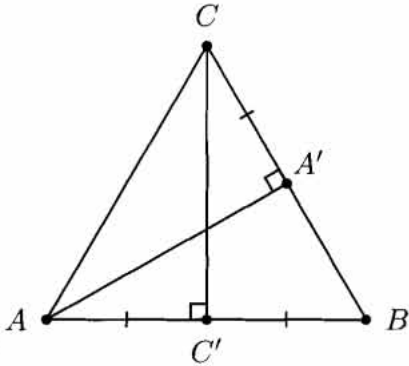
Let be an isosceles triangle with the apex at and let be the foot of the altitude from . Assuming that , prove that the triangle is equilateral.
Solution
Let be the foot of the altitude from . Since the triangle is isosceles with the apex at , we have . Since and are right triangles and , they are similar. This implies Let be the length of the side and . Then and we get the quadratic equation . The left-hand side can be factored as . Since and are positive, we have . The length of the segment is therefore equal to , and the triangle is equilateral.
Second solution
Denote the length of the side by and the length of the side by . Then and . We can now calculate the length of the altitude in two different ways, namely as the cathetus in triangles and , respectively. Let . Pythagoras's theorem for the first of the triangles implies and for the second , so or . This quadratic equation can be factored as , which implies (since and are positive the condition is never satisfied). From we conclude that the triangle is equilateral.
Second solution
Denote the length of the side by and the length of the side by . Then and . We can now calculate the length of the altitude in two different ways, namely as the cathetus in triangles and , respectively. Let . Pythagoras's theorem for the first of the triangles implies and for the second , so or . This quadratic equation can be factored as , which implies (since and are positive the condition is never satisfied). From we conclude that the triangle is equilateral.
Techniques
Angle chasingDistance chasingTriangle trigonometry