Browse · MathNet
PrintJapan Junior Mathematical Olympiad
Japan geometry
Problem
Consider a square consisting of 9 little squares of side length arranged in rows and columns as in the figure below. Let us number the little squares as indicated in the figure.
Let , , , be points chosen from the interior (not on the boundary) of the squares , , , , respectively. Denote by the sum of the areas of the intersections of the quadrilateral with the squares , , and . Denote also by the sum of the areas of the intersections of the quadrilateral with the squares , , and . Prove that the inequality holds.
| ① | ② | ③ |
|---|---|---|
| ⑧ | ④ | |
| ⑦ | ⑥ | ⑤ |
Solution
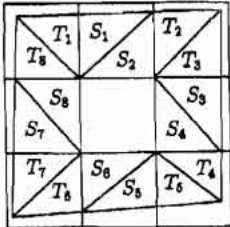
We partition the intersection of the quadrilateral and the union of squares , , , into triangles as indicated in the figure below. Then, equals the sum of the areas of the triangles . We also partition the intersection of and the union of the squares , , , into triangles as indicated in the figure below. Then, equals the sum of the areas of the triangles .
As can be seen from the figure, for each (), the triangles and have a side in common. If we consider this common side as the base for the triangles and , then the altitude of the triangle is , since by assumption , , , are points in the interior of the squares, while the altitude of equals . Therefore, for each the area of is greater than the area of . Consequently, , the sum of the areas of is greater than , the sum of the areas of .
As can be seen from the figure, for each (), the triangles and have a side in common. If we consider this common side as the base for the triangles and , then the altitude of the triangle is , since by assumption , , , are points in the interior of the squares, while the altitude of equals . Therefore, for each the area of is greater than the area of . Consequently, , the sum of the areas of is greater than , the sum of the areas of .
Techniques
QuadrilateralsTrianglesDistance chasing