Browse · MathNet
PrintChina-TST-2025A
China 2025 geometry
Problem
A finite point set in the plane is called sparse if for any , (1) Let be a sparse set where no lies inside the axis-aligned rectangle with the other two points as diagonal vertices. Prove that the area of triangle is at least .
(2) Let be a sparse set with no three collinear points, all lying inside an axis-aligned square of side length . Prove that the number of points in does not exceed
(2) Let be a sparse set with no three collinear points, all lying inside an axis-aligned square of side length . Prove that the number of points in does not exceed
Solution
(1) Let the coordinates of be . Without loss of generality, assume . Since both the conditions and conclusion are symmetric under reflection about the -axis and -axis, we can further assume . After appropriate translation, we may set , so and . Since is sparse, The area of triangle is , and we have which proves .
(2) Define the distance between two points as . It's easy to verify that the distance satisfies the triangle inequality with equality when are colinear in order. It's known that if convex polygon is contained in convex polygon , then the perimeter of doesn't exceed that of . Using similar proof methods and the triangle inequality for distance, we can show that under these conditions, the perimeter of (sum of lengths of its sides) doesn't exceed that of . Let be the given square with side length , and be a sparse subset of . By the definition of sparse sets, for any , i.e., . For a triangle with vertices in , if lies inside the rectangle with as diagonal and sides parallel to the coordinate axes, we call a bad triangle, its bad angle, and its bad edge. Each bad triangle has exactly one bad angle and one bad edge. Let be the length of the bad edge, which equals . If no angle of is bad, we call it a good triangle. Part (1) shows that good triangles have area at least .
Let the convex hull of be an -gon . We first state a lemma: Lemma: There exists a triangulation of consisting of triangles with vertices in , such that the number of bad triangles in doesn't exceed . We'll use this lemma to prove the main result. Take a triangulation satisfying the lemma. Since the perimeter of doesn't exceed that of , so . As has at most bad triangles, the number of good triangles satisfies Since the total area of good triangles doesn't exceed the area of and each good triangle has area at least , which implies .
Next, we prove the lemma. Consider a triangulation of that minimizes both the number of bad triangles and, subject to that condition, minimizes the sum of all bad angles.
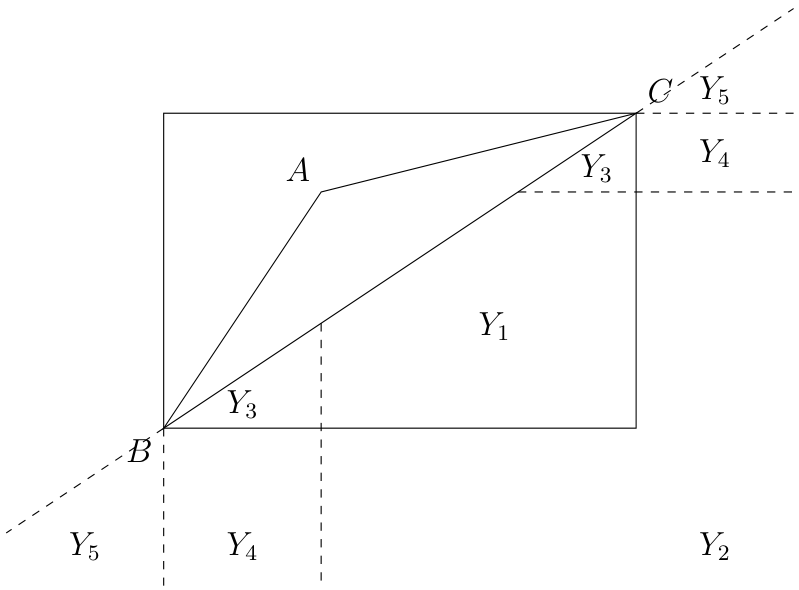
For any internal bad triangle in with bad edge , there exists another triangle sharing the edge . Let be the triangulation obtained by replacing triangles and with and . As shown in the figure, point may lie in regions through . For each possible position of , we can carefully analyze how the number of bad triangles and the sum of bad angles change when transforming to , as described in the following table:
By the minimality of , we conclude that . In this case, is also a bad triangle. If is in the bottom-left region of the figure, then is the bad edge of , giving . If is in the top-right region, then is the bad edge of , giving . In summary, for any internal bad triangle , the triangle on the other side of its bad edge is also bad, with . If is also internal, then the triangle on the other side of its bad edge is bad, and so on, forming a unique chain of bad triangles: ending with a boundary bad triangle . Denote this chain by . For a boundary bad triangle , contains only itself.
(2) Define the distance between two points as . It's easy to verify that the distance satisfies the triangle inequality with equality when are colinear in order. It's known that if convex polygon is contained in convex polygon , then the perimeter of doesn't exceed that of . Using similar proof methods and the triangle inequality for distance, we can show that under these conditions, the perimeter of (sum of lengths of its sides) doesn't exceed that of . Let be the given square with side length , and be a sparse subset of . By the definition of sparse sets, for any , i.e., . For a triangle with vertices in , if lies inside the rectangle with as diagonal and sides parallel to the coordinate axes, we call a bad triangle, its bad angle, and its bad edge. Each bad triangle has exactly one bad angle and one bad edge. Let be the length of the bad edge, which equals . If no angle of is bad, we call it a good triangle. Part (1) shows that good triangles have area at least .
Let the convex hull of be an -gon . We first state a lemma: Lemma: There exists a triangulation of consisting of triangles with vertices in , such that the number of bad triangles in doesn't exceed . We'll use this lemma to prove the main result. Take a triangulation satisfying the lemma. Since the perimeter of doesn't exceed that of , so . As has at most bad triangles, the number of good triangles satisfies Since the total area of good triangles doesn't exceed the area of and each good triangle has area at least , which implies .
Next, we prove the lemma. Consider a triangulation of that minimizes both the number of bad triangles and, subject to that condition, minimizes the sum of all bad angles.
For any internal bad triangle in with bad edge , there exists another triangle sharing the edge . Let be the triangulation obtained by replacing triangles and with and . As shown in the figure, point may lie in regions through . For each possible position of , we can carefully analyze how the number of bad triangles and the sum of bad angles change when transforming to , as described in the following table:
| Region containing D | Change in number of bad triangles and sum of bad angles |
|---|---|
| Two bad become two good | |
| One good and one bad become two good | |
| Two bad remain two bad, but sum of bad angles strictly decreases | |
| One good and one bad remain, but sum of bad angles strictly decreases |
By the minimality of , we conclude that . In this case, is also a bad triangle. If is in the bottom-left region of the figure, then is the bad edge of , giving . If is in the top-right region, then is the bad edge of , giving . In summary, for any internal bad triangle , the triangle on the other side of its bad edge is also bad, with . If is also internal, then the triangle on the other side of its bad edge is bad, and so on, forming a unique chain of bad triangles: ending with a boundary bad triangle . Denote this chain by . For a boundary bad triangle , contains only itself.
Techniques
Cartesian coordinatesOptimization in geometryConvex hullsQM-AM-GM-HM / Power Mean