Browse · MathNet
PrintSELECTION EXAMINATION
Greece counting and probability
Problem
A square is divided into equal small elementary squares, by drawing parallel lines to its sides. A spider starts from moving only to the right and up and tries to approach point . Every movement of the spider consists of steps right and steps up or of steps right and steps up (which can be done in any way she wants). The spider makes “movements” and in the sequel moves only to the right or up without any restriction. If , find the number of all possible routes the spider can follow to approach point , where are positive integers and .
Solution
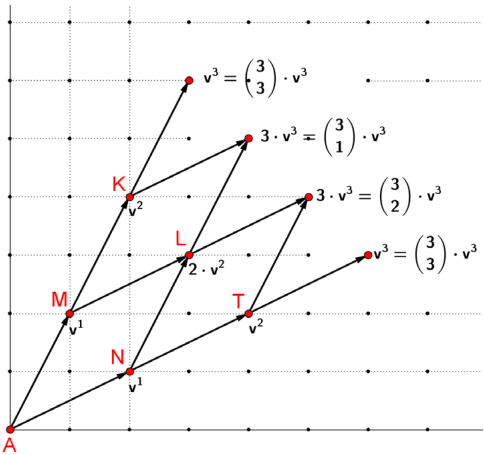
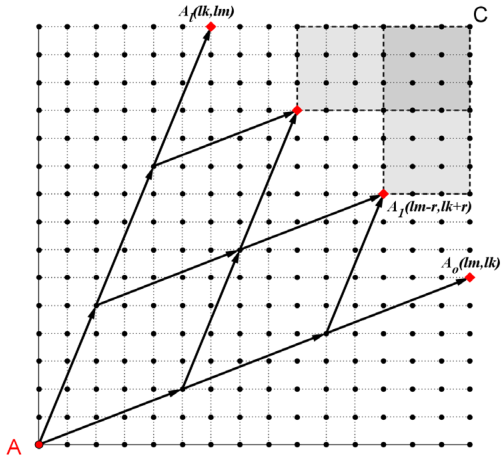
We suppose that the square is placed into a Cartesian system of coordinates with origin and axes on the sides and , as in the figure 7. Let the spider start from and make its first movement ( steps right and steps up or steps up and right). In the figure you can see the case .
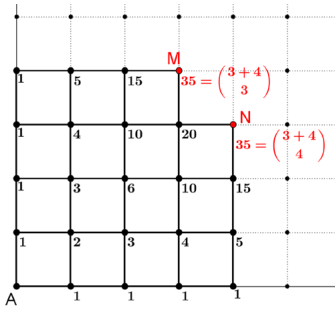
After the first movement the spider can be on the point or on the point . The number of ways the spider can approach the point or the point are equal to the combinations of elements taken at a time, that is
After the second movement the spider can be at three different points: , , and with corresponding number of ways , , and . The point can be approached by different ways from . The point can be approached by different ways from . Hence the point can be approached by different ways from point .
In a similar fashion we can find that point can be approached by different ways from point . The point can be approached by different ways by following the route and by different ways by following the route . Hence point can be approached by different ways from point .
Similarly, we conclude that after the third movement the spider can be placed in four different points that can be approached by , , , and different ways, respectively. Therefore, after the completion of the movements, the spider will be placed at different points, lying on the line with equation: .
If , then these points are the following: These points can be approached by , , , , and different ways from the point . The point can be approached from the point:
Hence the point can be approached from point by:
(*) Moving from the point to the point of the grid with direction right and up, can be made by different ways. The procedure of finding the number of ways is the same as the procedure we have used at the first movement.
Note. In the case where , then the number of all possible ways becomes:
After the first movement the spider can be on the point or on the point . The number of ways the spider can approach the point or the point are equal to the combinations of elements taken at a time, that is
After the second movement the spider can be at three different points: , , and with corresponding number of ways , , and . The point can be approached by different ways from . The point can be approached by different ways from . Hence the point can be approached by different ways from point .
In a similar fashion we can find that point can be approached by different ways from point . The point can be approached by different ways by following the route and by different ways by following the route . Hence point can be approached by different ways from point .
Similarly, we conclude that after the third movement the spider can be placed in four different points that can be approached by , , , and different ways, respectively. Therefore, after the completion of the movements, the spider will be placed at different points, lying on the line with equation: .
If , then these points are the following: These points can be approached by , , , , and different ways from the point . The point can be approached from the point:
Hence the point can be approached from point by:
(*) Moving from the point to the point of the grid with direction right and up, can be made by different ways. The procedure of finding the number of ways is the same as the procedure we have used at the first movement.
Note. In the case where , then the number of all possible ways becomes:
Final answer
Let v = binom(k+m, m) and r = m - k. The total number of routes is v^l sum_{i=0}^{l} binom(l, i) binom(lr, i r). In particular, if r = 1 (i.e., m - k = 1), this simplifies to binom(k+m, m)^l * binom(2l, l).
Techniques
Algebraic properties of binomial coefficientsRecursion, bijection