Browse · MathNet
PrintUSA IMO
United States geometry
Problem
Let be a point in the plane of triangle such that the segments , , and are the sides of an obtuse triangle. Assume that in this triangle the obtuse angle opposes the side congruent to . Prove that is acute.
Solution
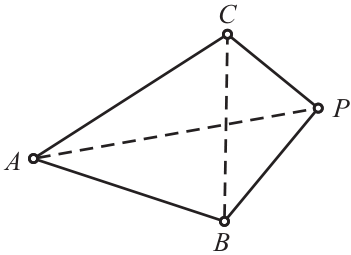
By the Cauchy-Schwarz Inequality, Applying the (Generalized) Ptolemy's Inequality to quadrilateral yields Because is the longest side of an obtuse triangle with side lengths , , , we have and hence Combining these three inequalities yields , implying that angle is acute.
---
Alternative solution.
Let and be the feet of the perpendiculars from and to line , respectively. Then . Furthermore, the given conditions imply that , which can be written as . Hence, Let be the ray minus the point . Note that, since , lies on ray . If did not lie on , then would be less than or equal to , a contradiction. Thus, lies on , and angle is acute.
---
Alternative solution.
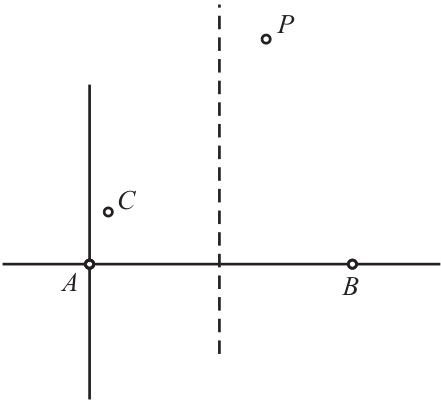
Set up a coordinate system on the plane with , , , and . Without loss of generality, we may assume that and that . Proving that angle is acute is equivalent to proving that . Since , Hence, Since , we have . It follows that , as desired.
---
Alternative solution.
We first prove the following Lemma.
Lemma. For any four points , , , and in the plane, Proof. Pick an arbitrary origin and let , , , denote the vectors from to , , , , respectively. Then which is always nonnegative. Equality holds if and only if , which is true if and only if is a (possibly degenerate) parallelogram.
Applying the Lemma to points , , , and gives Therefore, angle is acute.
---
Alternative solution.
In this solution, takes on values between and . Note that , since . Applying the Law of Sines to triangle yields It follows that Since , we have similarly Thus, If , then . Hence, and angle is acute.
---
Alternative solution.
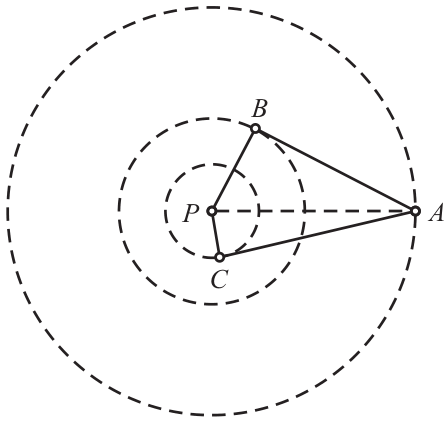
Note that . Regard as fixed and , and as free to rotate on circles of radii , and about , respectively. As vary, will be maximized when and are on opposite sides of line and and are right angles, i.e., lines and are tangent to the circles passing through and . Without loss of generality, we assume that . In this case, is cyclic and , and similarly . Hence, on the circumcircle of , arcs and are bigger than arcs and , respectively. Thus, . Since these two angles are supplementary, angle is acute.
---
Alternative solution.
Let and be the feet of the perpendiculars from and to line , respectively. Then . Furthermore, the given conditions imply that , which can be written as . Hence, Let be the ray minus the point . Note that, since , lies on ray . If did not lie on , then would be less than or equal to , a contradiction. Thus, lies on , and angle is acute.
---
Alternative solution.
Set up a coordinate system on the plane with , , , and . Without loss of generality, we may assume that and that . Proving that angle is acute is equivalent to proving that . Since , Hence, Since , we have . It follows that , as desired.
---
Alternative solution.
We first prove the following Lemma.
Lemma. For any four points , , , and in the plane, Proof. Pick an arbitrary origin and let , , , denote the vectors from to , , , , respectively. Then which is always nonnegative. Equality holds if and only if , which is true if and only if is a (possibly degenerate) parallelogram.
Applying the Lemma to points , , , and gives Therefore, angle is acute.
---
Alternative solution.
In this solution, takes on values between and . Note that , since . Applying the Law of Sines to triangle yields It follows that Since , we have similarly Thus, If , then . Hence, and angle is acute.
---
Alternative solution.
Note that . Regard as fixed and , and as free to rotate on circles of radii , and about , respectively. As vary, will be maximized when and are on opposite sides of line and and are right angles, i.e., lines and are tangent to the circles passing through and . Without loss of generality, we assume that . In this case, is cyclic and , and similarly . Hence, on the circumcircle of , arcs and are bigger than arcs and , respectively. Thus, . Since these two angles are supplementary, angle is acute.
Techniques
Triangle trigonometryCyclic quadrilateralsTangentsAngle chasingDistance chasingCartesian coordinatesVectorsOptimization in geometryCauchy-Schwarz