Browse · MathNet
PrintCono Sur Mathematical Olympiad
Argentina geometry
Problem
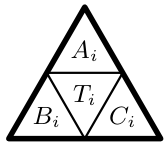
We say that an equilateral triangle on the plane is in standard position if one of its sides is horizontal and the opposite vertex lies above that side. We have equilateral triangles , all of which are in standard position. For each triangle , denote by its medial triangle. Let be the region of the plane covered by the triangles , and let be the region of the plane covered by the triangles . Prove that .
Solution
We divide each triangle into four congruent triangles , , , . Let be the set of all points that belong to some but don't belong to any . We define and analogously. It is clear then that . Next we will prove that .
Denote the common line between and . Without loss of generality we may assume that the triangles are numbered in such a way that whenever , either or is above . For each , let and denote the reflection of with respect to . We claim that: Sets are pairwise disjoint and their union equals . is a subset of . * Sets are pairwise disjoint. The first claim holds by definition. The second one holds because is a subset of , and is the reflection of . Now we prove the third claim. Assume there is a point for some . Denote by and the symmetric points of with respect to and respectively. By construction we know that and . Notice that lie on a line that is perpendicular to and . On the other hand, because of the way the lines were labelled, we know that the midpoint of either is equal to or is located above the midpoint of . Therefore lies on the segment . But then belongs to or , which is impossible, since .
After proving this, we have that as claimed. In the same way we can show that and . Finally,
Denote the common line between and . Without loss of generality we may assume that the triangles are numbered in such a way that whenever , either or is above . For each , let and denote the reflection of with respect to . We claim that: Sets are pairwise disjoint and their union equals . is a subset of . * Sets are pairwise disjoint. The first claim holds by definition. The second one holds because is a subset of , and is the reflection of . Now we prove the third claim. Assume there is a point for some . Denote by and the symmetric points of with respect to and respectively. By construction we know that and . Notice that lie on a line that is perpendicular to and . On the other hand, because of the way the lines were labelled, we know that the midpoint of either is equal to or is located above the midpoint of . Therefore lies on the segment . But then belongs to or , which is impossible, since .
After proving this, we have that as claimed. In the same way we can show that and . Finally,
Techniques
TrianglesHomothetyOptimization in geometryConstructions and loci