Browse · MATH
Printjmc
geometry senior
Problem
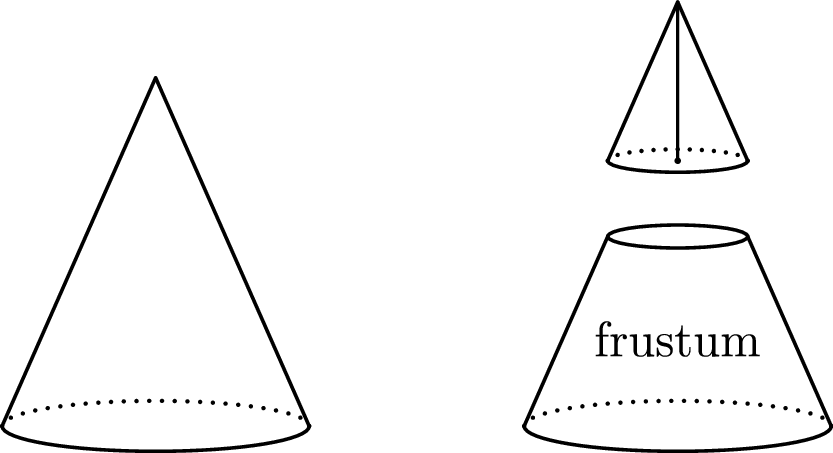
A frustum of a right circular cone is formed by cutting a small cone off of the top of a larger cone. If a particular frustum has a lower base radius of 6 inches, an upper base radius of 3 inches, and a height of 4 inches, what is its lateral surface area? (The lateral surface area of a cone or frustum is the curved surface excluding the base(s).)
Solution
We start by drawing the frustum. Let the top and bottom circles have centers and respectively, and label points and on the circumferences as shown such that , , , and lie in the same plane.
Because the frustum was cut from a right circular cone, and are both right angles. We drop a perpendicular from to and let the intersection point be . Then is a rectangle and Pythagorean theorem on right gives Thus the slant height of the frustum is 5.
Extend and above the frustum, and let them intersect at point . is the tip of the full cone that the frustum was cut from. To compute the lateral surface area of the frustum, we compute the lateral surface area of the full cone and subtract off the lateral surface area of the smaller cone that was removed.
To find the height of the whole cone, we take a vertical cross-section of the cone that includes , , , and . This cross-section is an isosceles triangle.
and are similar, so Thus and (and we see the small removed cone has half the height of the full cone). Also, .
Now we unroll the lateral surface area of the full cone. (The desired frustum lateral area is shown in blue.)
When unrolled, the full cone's lateral surface area is a sector whose arc length is the cone's base perimeter and whose radius is the cone's slant height. So, the sector has arc length and radius . A full circle with radius 10 has arc length , so the sector has of the circle's arc length and thus has 3/5 of the circle's area. Thus, the full cone has lateral surface area Similarly, the small removed cone's lateral surface area is a sector with radius 5 and arc length (which is of the arc length of a full circle with radius 5), so its lateral surface area is The lateral surface area of the frustum, in blue, is the full cone's lateral surface area minus the small removed cone's lateral surface area, which is
Because the frustum was cut from a right circular cone, and are both right angles. We drop a perpendicular from to and let the intersection point be . Then is a rectangle and Pythagorean theorem on right gives Thus the slant height of the frustum is 5.
Extend and above the frustum, and let them intersect at point . is the tip of the full cone that the frustum was cut from. To compute the lateral surface area of the frustum, we compute the lateral surface area of the full cone and subtract off the lateral surface area of the smaller cone that was removed.
To find the height of the whole cone, we take a vertical cross-section of the cone that includes , , , and . This cross-section is an isosceles triangle.
and are similar, so Thus and (and we see the small removed cone has half the height of the full cone). Also, .
Now we unroll the lateral surface area of the full cone. (The desired frustum lateral area is shown in blue.)
When unrolled, the full cone's lateral surface area is a sector whose arc length is the cone's base perimeter and whose radius is the cone's slant height. So, the sector has arc length and radius . A full circle with radius 10 has arc length , so the sector has of the circle's arc length and thus has 3/5 of the circle's area. Thus, the full cone has lateral surface area Similarly, the small removed cone's lateral surface area is a sector with radius 5 and arc length (which is of the arc length of a full circle with radius 5), so its lateral surface area is The lateral surface area of the frustum, in blue, is the full cone's lateral surface area minus the small removed cone's lateral surface area, which is
Final answer
45\pi