Browse · MathNet
Print49th Mathematical Olympiad in Ukraine
Ukraine counting and probability
Problem
A board is divided into unit squares. Two players play the following game. They take turns to paint in yellow colour an unpainted unit segment which is a side of a unit square. If after a turn a unit square with all four sides painted in yellow is obtained, then the player who made this turn wins. Who has a winning strategy?

Solution
The second player can follow the following rules for his steps.
1) If he can, he paints the side which is the fourth yellow side in some square. He does it and he wins in this game.
2) If the first player paints some side, the second player paints the side which is symmetric to the one just painted about the centre of the field . On the Fig. 4 we can see the corresponding steps.
Fig. 4
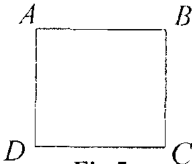
Thus we have that 1) in this game certainly the first or the second player wins; 2) the second player can always make the next step which satisfies his rules. Suppose the first player can win. Then his last step is painting the side which is the fourth yellow side in some square. Let it be the segment (Fig. 5). Before that, the second player had to paint one of the segments , or . Otherwise, as soon as these three segments were painted by the first player, the second player would have painted the segment following the first rule and the game would be finished. So he had to paint one of the segments , or . It means that the square which is symmetric to the square about the centre of the board had painted sides , and before a move of the second player. And so the second player would have painted the segment to win this game. Obviously, this argument also works for the central square.
Fig. 5
1) If he can, he paints the side which is the fourth yellow side in some square. He does it and he wins in this game.
2) If the first player paints some side, the second player paints the side which is symmetric to the one just painted about the centre of the field . On the Fig. 4 we can see the corresponding steps.
Fig. 4
Thus we have that 1) in this game certainly the first or the second player wins; 2) the second player can always make the next step which satisfies his rules. Suppose the first player can win. Then his last step is painting the side which is the fourth yellow side in some square. Let it be the segment (Fig. 5). Before that, the second player had to paint one of the segments , or . Otherwise, as soon as these three segments were painted by the first player, the second player would have painted the segment following the first rule and the game would be finished. So he had to paint one of the segments , or . It means that the square which is symmetric to the square about the centre of the board had painted sides , and before a move of the second player. And so the second player would have painted the segment to win this game. Obviously, this argument also works for the central square.
Fig. 5
Final answer
The second player has a winning strategy.
Techniques
Games / greedy algorithmsInvariants / monovariants