Browse · MathNet
PrintChina Girls' Mathematical Olympiad
China geometry
Problem
As shown in Fig. 8.1, is the inscribed circle touching side of at point , and points are on the segments , respectively, satisfying ; is the inscribed circle of tangent to side at point ; intersect at point , and intersect at point . Please prove that divides segment equally. (posed by Bian Hongping)
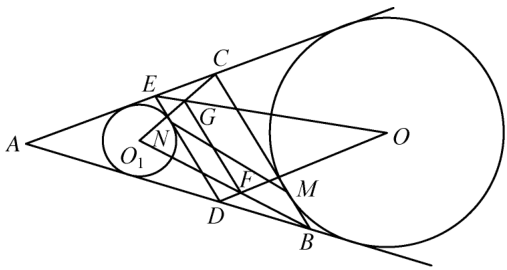 Fig. 8.1
Solution
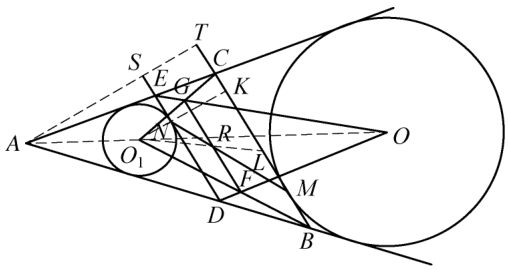
If , then the graph is symmetric about the bisector of and the conclusion is obvious. So we may assume that . As shown in Fig. 8.2, let be the midpoint of , line intersecting with at , and be extended to intersect with at . Draw line that is perpendicular to at and intersects with line at . Connecting , obviously is on the segment . By Menelaus' theorem, we have
Fig. 8.2
Since , we have . So , which means that . Then . Therefore, is the midpoint of . We now only need to prove that are collinear. For this purpose, by the inverse of Menelaus' theorem, we only need to prove that
Since , we have (the second equality is justified by ①). So we only need to prove that
Since , , , , then lines , , are parallel. By the theorem of dividing the segments into proportional by parallel lines, we have . Substituting it into ③, we then only need to prove
Since , , , quadrilateral is a rectangle and then . Furthermore, from we have . Substituting these results into ④, we now only need to prove
Let , , . We have
Then On the other hand, Therefore, ⑤ holds. The proof is complete.
---
Alternative solution.
Let the radii of and be and , respectively. Obviously, , and are collinear.
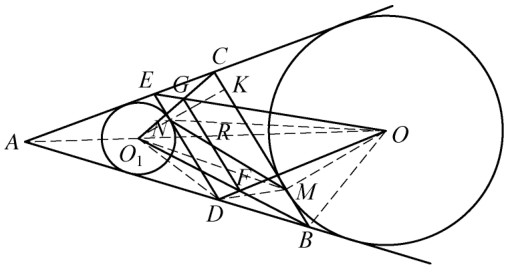
Connect and extend it to intersect with at . If , then by symmetry, the proposition holds. So we may assume that in the following. We connect , respectively (see Fig. 8.3). Since , we have
Fig. 8.3
From ② and ③, we have Combining it with ①, we get Since , then On the other hand, In the same way, By ④, we have . Therefore, divides segment equally. The proof is complete.
Fig. 8.2
Since , we have . So , which means that . Then . Therefore, is the midpoint of . We now only need to prove that are collinear. For this purpose, by the inverse of Menelaus' theorem, we only need to prove that
Since , we have (the second equality is justified by ①). So we only need to prove that
Since , , , , then lines , , are parallel. By the theorem of dividing the segments into proportional by parallel lines, we have . Substituting it into ③, we then only need to prove
Since , , , quadrilateral is a rectangle and then . Furthermore, from we have . Substituting these results into ④, we now only need to prove
Let , , . We have
Then On the other hand, Therefore, ⑤ holds. The proof is complete.
---
Alternative solution.
Let the radii of and be and , respectively. Obviously, , and are collinear.
Connect and extend it to intersect with at . If , then by symmetry, the proposition holds. So we may assume that in the following. We connect , respectively (see Fig. 8.3). Since , we have
Fig. 8.3
From ② and ③, we have Combining it with ①, we get Since , then On the other hand, In the same way, By ④, we have . Therefore, divides segment equally. The proof is complete.
Techniques
Triangle centers: centroid, incenter, circumcenter, orthocenter, Euler line, nine-point circleMenelaus' theoremTangentsTriangle trigonometryDistance chasingTrigonometry