Browse · harp
Printsmc
geometry senior
Problem
Let be a parallelogram with area . Points and are the projections of and respectively, onto the line and points and are the projections of and respectively, onto the line See the figure, which also shows the relative locations of these points. 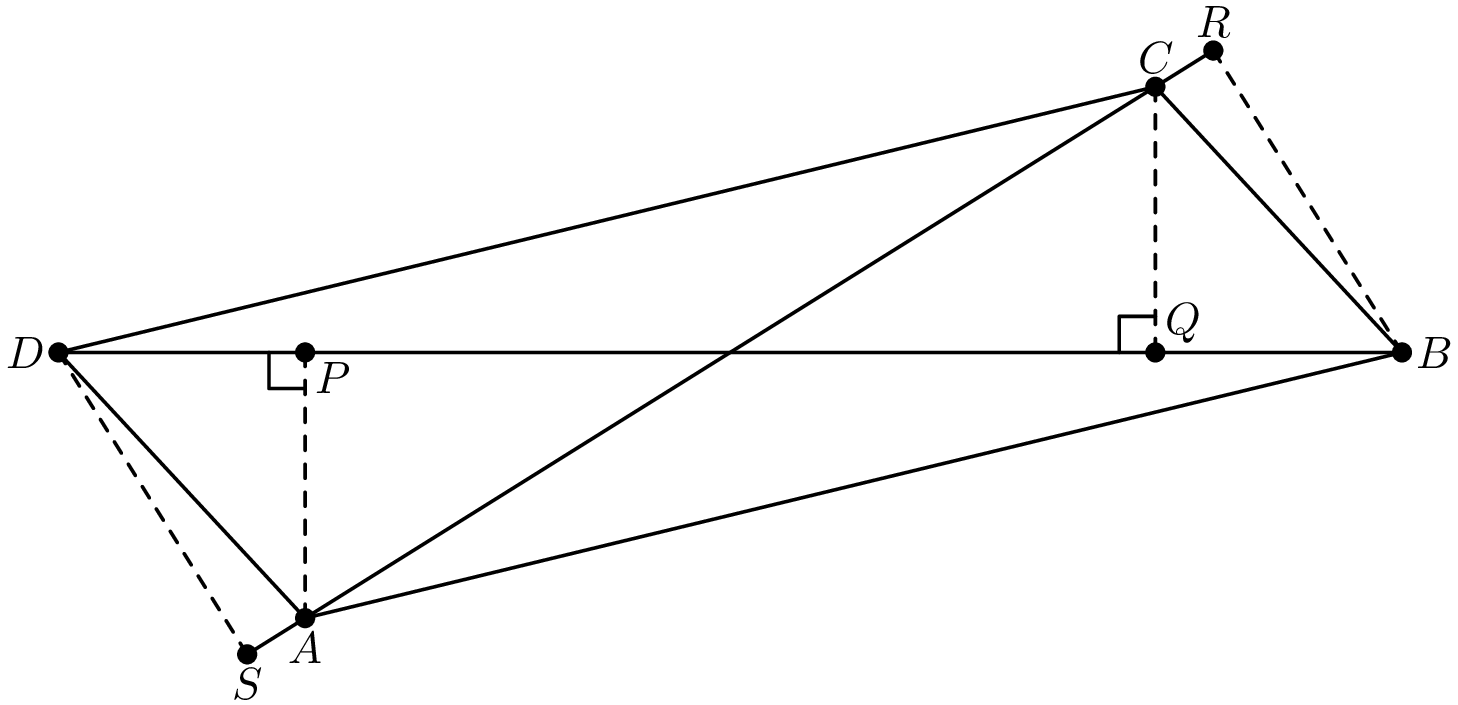 Suppose and and let denote the length of the longer diagonal of Then can be written in the form where and are positive integers and is not divisible by the square of any prime. What is
(A)
(B)
(C)
(D)
Solution
Let denote the intersection point of the diagonals and . Remark that by symmetry is the midpoint of both and , so and . Now note that since , quadrilateral is cyclic, and so which implies . Thus let be such that and . Then Pythagorean Theorem on yields , and soSolving this for yields , and soThe requested answer is .
Final answer
A