Browse · MathNet
PrintXXVI OBM
Brazil geometry
Problem
Let be a convex quadrilateral. Prove that the incircles of the triangles , , and have a point in common if, and only if, is a rhombus.
Solution
If is a rhombus the incircle touch the respective triangle in the midpoint of the diagonals, which belongs to all four circles.
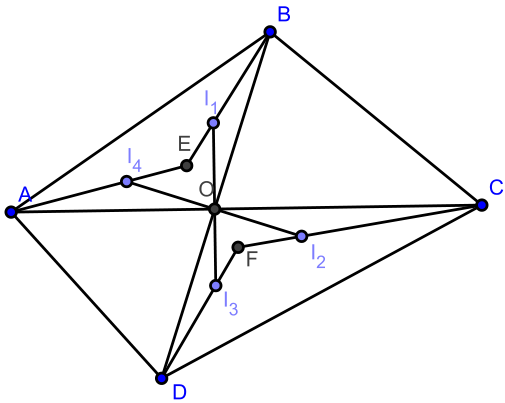
Now suppose the circles have a common point . Since the incircle are contained in its triangle and the intersection of the triangles , , , is the intersection of the diagonals, must coincide with .
Let's prove that the diagonals are perpendicular. Suppose that it's not the case. So we may suppose without loss of generality that . Let and be the incenters of , , and , respectively. Thus and are in the interior of and and are in the interior of .
Let and be the intersection of , and , , respectively. So . Using a similar argument on we obtain . Summing these two inequalities, we obtain that the sum of the internal angles of the quadrilateral is less than , contradiction. So and are perpendicular and, moreover, the four incenters and lie in the diagonals. This means that the bisectors and altitudes from vertices with respect to the triangles , , , coincide and hence these triangles are isosceles. Thus and is a rhombus.
Now suppose the circles have a common point . Since the incircle are contained in its triangle and the intersection of the triangles , , , is the intersection of the diagonals, must coincide with .
Let's prove that the diagonals are perpendicular. Suppose that it's not the case. So we may suppose without loss of generality that . Let and be the incenters of , , and , respectively. Thus and are in the interior of and and are in the interior of .
Let and be the intersection of , and , , respectively. So . Using a similar argument on we obtain . Summing these two inequalities, we obtain that the sum of the internal angles of the quadrilateral is less than , contradiction. So and are perpendicular and, moreover, the four incenters and lie in the diagonals. This means that the bisectors and altitudes from vertices with respect to the triangles , , , coincide and hence these triangles are isosceles. Thus and is a rhombus.
Techniques
Quadrilaterals with perpendicular diagonalsTriangle centers: centroid, incenter, circumcenter, orthocenter, Euler line, nine-point circleTangentsAngle chasing