Browse · MathNet
PrintMacedonian Mathematical Olympiad
North Macedonia counting and probability
Problem
A magical square of dimensions is a square with side , consisting of unit squares, so that the real numbers written in the unit squares (one number in each unit square) satisfy the property: the sum of the numbers in the unit squares in any row is equal to the sum of the numbers in the unit squares in any column and is equal to the sum of the numbers in the unit squares in the two diagonals. A rectangle of dimensions , , is given, which consists of unit squares. If in each unit square one number is written in such a way that each square of dimensions is magical, then how many different numbers can be used at most to fill the rectangle?
Solution
We consider the magical square:
or, equivalently We get . In what follows we will denote the central element by .
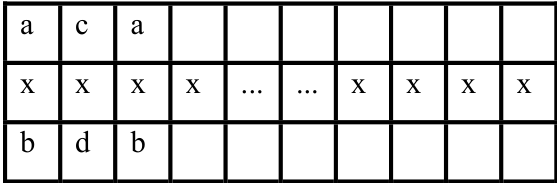
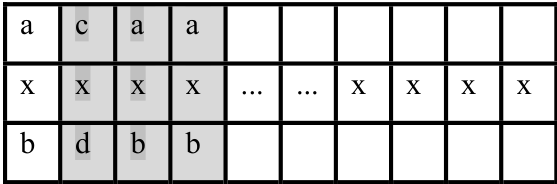
Picture 3. Next we consider the colored square in Picture 4. Because and we get that the rectangle is filled in the following way:
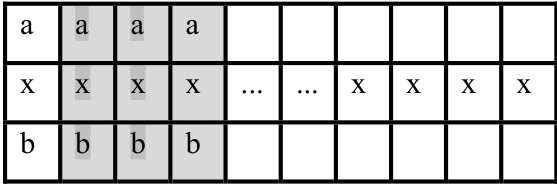
Analogously to the way the colored square was filled in Picture 3, we get that , . But then
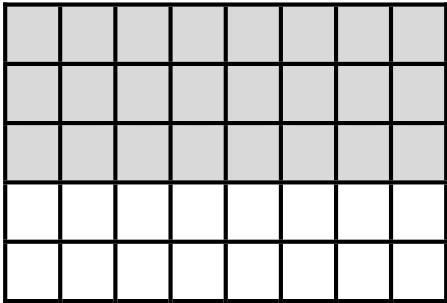
, from where i.e. all elements of the rectangle have to be equal. Let , . Then, because of the previous discussion, the rectangle of width and length has to be filled with one number (Picture 5). Picture 5. For the same reasons, the same holds for the colored rectangle and every rectangle obtained by vertical translation. Finally, if , then the rectangle can be filled with different numbers. If or , then the rectangle can be filled only with a single number.
Picture 3. Next we consider the colored square in Picture 4. Because and we get that the rectangle is filled in the following way:
Analogously to the way the colored square was filled in Picture 3, we get that , . But then
, from where i.e. all elements of the rectangle have to be equal. Let , . Then, because of the previous discussion, the rectangle of width and length has to be filled with one number (Picture 5). Picture 5. For the same reasons, the same holds for the colored rectangle and every rectangle obtained by vertical translation. Finally, if , then the rectangle can be filled with different numbers. If or , then the rectangle can be filled only with a single number.
Final answer
If both dimensions are three, the maximum is nine; otherwise the maximum is one.
Techniques
Coloring schemes, extremal argumentsSimple Equations