Browse · MathNet
PrintSlovenija 2008
Slovenia 2008 geometry
Problem
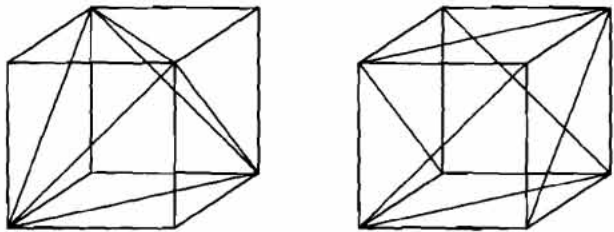
On every face of a cube we draw one of the two diagonals. Some of these diagonals share a vertex. Let denote the number of pairs of diagonals that have a vertex in common (each diagonal can occur in several different pairs). Find the greatest and the smallest possible values of .
Solution
The first figure is for and the second is for . Let us prove that these are the greatest and the smallest possible values of .
A cube has vertices. We draw diagonals, so there are endpoints altogether. There are , , or of the chosen diagonals coming from every vertex of the cube. So, for every vertex we get , , or different pairs of diagonals.
Assume that it is possible to get . If there exists a vertex with diagonals, then the remaining vertices can have at most one diagonal. This would imply that there are at most endpoints, a contradiction.
Thus, no vertex has chosen diagonals meeting at it and there can be at most vertices where two of the diagonals meet. Again, every other vertex can be the endpoint of at most one diagonal and there are at most endpoints in this case. Once more, a contradiction. We have shown that .
There are different pairs of diagonals. No two diagonals belonging to the opposite faces of the cube intersect, so there are at most different pairs of intersecting diagonals, .
A cube has vertices. We draw diagonals, so there are endpoints altogether. There are , , or of the chosen diagonals coming from every vertex of the cube. So, for every vertex we get , , or different pairs of diagonals.
Assume that it is possible to get . If there exists a vertex with diagonals, then the remaining vertices can have at most one diagonal. This would imply that there are at most endpoints, a contradiction.
Thus, no vertex has chosen diagonals meeting at it and there can be at most vertices where two of the diagonals meet. Again, every other vertex can be the endpoint of at most one diagonal and there are at most endpoints in this case. Once more, a contradiction. We have shown that .
There are different pairs of diagonals. No two diagonals belonging to the opposite faces of the cube intersect, so there are at most different pairs of intersecting diagonals, .
Final answer
Minimum N = 4, Maximum N = 12
Techniques
Other 3D problemsCounting two waysColoring schemes, extremal arguments