Browse · MathNet
PrintIranian Mathematical Olympiad
Iran algebra
Problem
Suppose and are two nonnegative integers. In the Philosopher's Chess, the chessboard is an infinite array of same regular hexagon cells. The Phoenix piece, which is a special piece in this kind of chess, moves as follows: At first, the Phoenix selects one of the six directions and moves cells in that direction. Then it turns 60 degrees clockwise and moves cells in that new direction to get to the final point. At most how many cells of the Philosopher's Chess' chessboard exist in such a way that one cannot start from one of them and reach another one with a finite number of movements of the Phoenix piece? 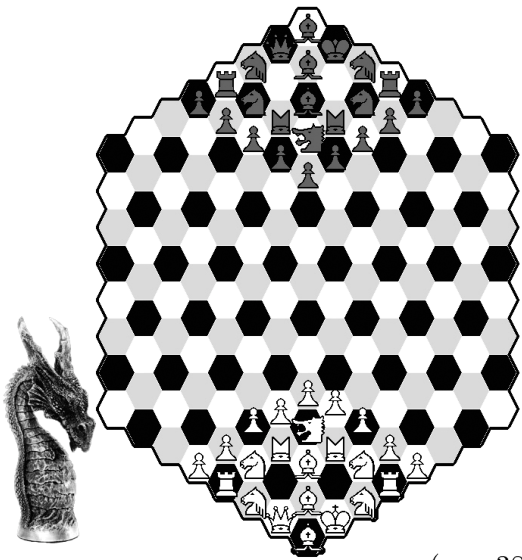
Solution
By considering centers of the hexagons, we get the following equivalent problem: "Two vertices and of the triangular lattice are called equivalent if is equal to sum of finitely many vectors from the set: Where , and according to the normal Cartesian coordinates.
What is the maximum number of nonequivalent vertices? Note that , thus we can determine vectors of set using only and : Since the first vector is the difference of the two others, two vertices and are equivalent iff their difference can be written as a linear combination of vectors and with integer coefficients. Note that for integers and the space generated by the vectors (using integer coefficients) equals the space generated by vectors . Therefore, we can change former vectors to get simpler vectors to work with. Note that in this change the value of (determinant of the matrix formed by vectors and as rows) is invariant, because . Now, in a similar way to Euclidean Algorithm, if we change by . Repeating this process several times leads to vectors of the form and . It means that we can suppose the coefficient of for one of them is zero. hence, if we want to go from one vertex to another, the difference of the coefficients of must be a multiple of , since does not affect the coefficient of . As a result, for two equivalent vertices, we can first use vector several times to match their first coordinate. Then, we must use to match the second coordinate. Hence we have nonequivalent vertices. But which is invariant during the process. So the maximum number of nonequivalent vertices is .
What is the maximum number of nonequivalent vertices? Note that , thus we can determine vectors of set using only and : Since the first vector is the difference of the two others, two vertices and are equivalent iff their difference can be written as a linear combination of vectors and with integer coefficients. Note that for integers and the space generated by the vectors (using integer coefficients) equals the space generated by vectors . Therefore, we can change former vectors to get simpler vectors to work with. Note that in this change the value of (determinant of the matrix formed by vectors and as rows) is invariant, because . Now, in a similar way to Euclidean Algorithm, if we change by . Repeating this process several times leads to vectors of the form and . It means that we can suppose the coefficient of for one of them is zero. hence, if we want to go from one vertex to another, the difference of the coefficients of must be a multiple of , since does not affect the coefficient of . As a result, for two equivalent vertices, we can first use vector several times to match their first coordinate. Then, we must use to match the second coordinate. Hence we have nonequivalent vertices. But which is invariant during the process. So the maximum number of nonequivalent vertices is .
Final answer
m^2 + mn + n^2
Techniques
VectorsDeterminantsCartesian coordinatesInvariants / monovariants