Browse · MathNet
PrintSelected Problems from the Final Round of National Olympiad
Estonia geometry
Problem
Inside a regular -gon, an arbitrary point is chosen and connected to every vertex of the -gon. The triangles obtained are colored alternately black and white so that triangles with a common side are of different color. Prove that the sum of the areas of all white triangles equals the sum of the areas of all black triangles.
Solution
If , i.e., the -gon is a square, then the claim holds because the base sides of white triangles are the opposite sides of the square and the altitudes lie on the same line, so the total area of white triangles is a half of the area of the square.
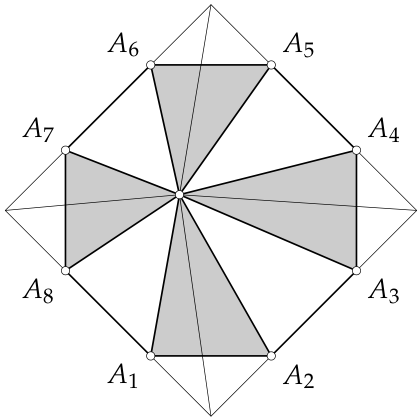
Assume in the following that . Consider the regular -gon whose sides are obtained by prolonging all sides of the -gon that belong to white triangles (see Fig. 16).
Fig. 16
Join the point chosen inside the initial -gon with all vertices of the -gon. The altitude drawn in any white triangle coincides with the altitude drawn in the corresponding triangle in the -gon, while the ratio of the corresponding base sides equals the ratio of the side length of the -gon and the side length of the -gon, denote it by . Thus the total area of white triangles is , where is the area of the -gon. Analogously, the total area of black triangles is , too.
---
Alternative solution.
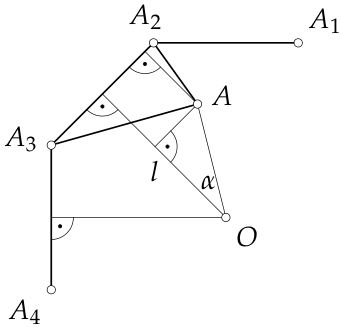
The claim of the problem is equivalent to the statement that the sum of the altitudes of black triangles drawn to the sides that coincide to the sides of the -gon is equal to that of white triangles. Let be the center of the -gon, be the point chosen inside, be the angle between line and the line perpendicular to a side, and be the distance between and any side of the -gon (see Fig. 17).
Fig. 17
Then the altitude of the corresponding triangle is . The altitude of the next triangle of the same color can be expressed similarly but is replaced with . Thus the sum of all altitudes of the triangles of the same color is .
To show that the sum inside parentheses equals , multiply the sum by . Since , a telescoping sum emerges and after reduction one obtains . Hence for both colors, the sum of the altitudes of all triangles of this color is .
Remark. The sum in Solution 2 can also be computed as follows. Denote , where is the imaginary unit and let , . Then the sum under consideration is the real part of the complex number . Thus , whence the sum under consideration is equal to .
Assume in the following that . Consider the regular -gon whose sides are obtained by prolonging all sides of the -gon that belong to white triangles (see Fig. 16).
Fig. 16
Join the point chosen inside the initial -gon with all vertices of the -gon. The altitude drawn in any white triangle coincides with the altitude drawn in the corresponding triangle in the -gon, while the ratio of the corresponding base sides equals the ratio of the side length of the -gon and the side length of the -gon, denote it by . Thus the total area of white triangles is , where is the area of the -gon. Analogously, the total area of black triangles is , too.
---
Alternative solution.
The claim of the problem is equivalent to the statement that the sum of the altitudes of black triangles drawn to the sides that coincide to the sides of the -gon is equal to that of white triangles. Let be the center of the -gon, be the point chosen inside, be the angle between line and the line perpendicular to a side, and be the distance between and any side of the -gon (see Fig. 17).
Fig. 17
Then the altitude of the corresponding triangle is . The altitude of the next triangle of the same color can be expressed similarly but is replaced with . Thus the sum of all altitudes of the triangles of the same color is .
To show that the sum inside parentheses equals , multiply the sum by . Since , a telescoping sum emerges and after reduction one obtains . Hence for both colors, the sum of the altitudes of all triangles of this color is .
Remark. The sum in Solution 2 can also be computed as follows. Denote , where is the imaginary unit and let , . Then the sum under consideration is the real part of the complex number . Thus , whence the sum under consideration is equal to .
Techniques
TrigonometryComplex numbers in geometryConstructions and loci