Browse · MathNet
PrintTHE Tenth ROMANIAN MASTER OF MATHEMATICS
Romania geometry
Problem
In the Cartesian plane, let and be the graphs of the quadratic functions and , where . The graphs and cross at distinct points and . The four tangents to and at and form a convex quadrangle which has an inscribed circle. Prove that the graphs and have the same axis of symmetry.
Solution
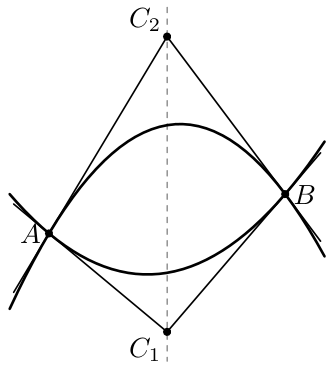
Let the tangents to at and meet at . Since is convex and is concave, the convex quadrangle formed by the four tangents is exactly .
Lemma. If and are the tangents drawn from a point to the graph of a quadratic trinomial , , , then the abscissa of is the arithmetic mean of the abscissae of and .
Proof. Assume, without loss of generality, that is at the origin, so the equations of the two tangents have the form and . Next, the abscissae and of the tangency points and , respectively, are multiple roots of the polynomials and , respectively. By the Vieta theorem, , so , since the case is ruled out by .
The Lemma shows that the line is parallel to the -axis and the points and are equidistant from this line.
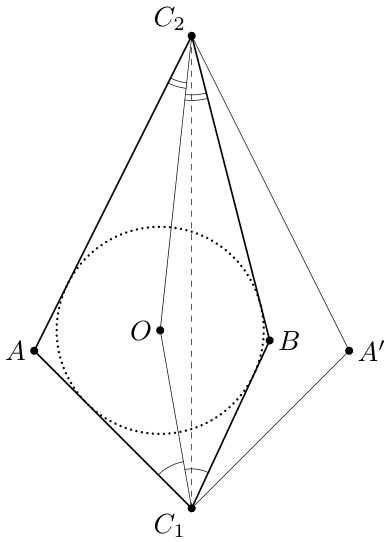
Suppose, if possible, that the incentre of the quadrangle does not lie on the line . Assume, without loss of generality, that lies inside the triangle and let be the reflection of in the line . Then the ray emanating from lies inside the angle , so lies inside the quadrangle , whence and are not equidistant from – a contradiction.
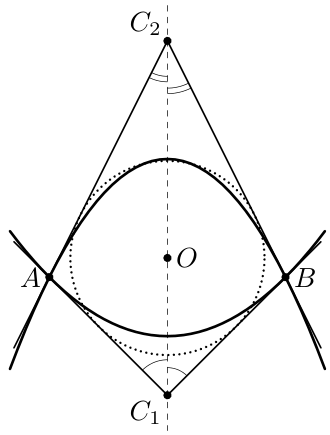
Thus lies on , so the lines and are reflections of one another in the line , and . Hence , and since the line is the axis of symmetry of both parabolas, as required.
---
Alternative solution.
Use the standard equation of a tangent to a smooth curve in the plane, to deduce that the tangents at two distinct points and on the parabola of equation , , meet at some point whose coordinates are Usage of the standard formula for Euclidean distance yields so, after obvious manipulations, Now, let the tangents to at and meet at , write the condition in the statement in the form , apply the above formula and clear common factors to get Next, use the fact that and are the solutions of the quadratic equation , so , to obtain Finally, since and the denominators above are both positive, the last equality forces ; that is, , so the two parabolas have the same axis.
Lemma. If and are the tangents drawn from a point to the graph of a quadratic trinomial , , , then the abscissa of is the arithmetic mean of the abscissae of and .
Proof. Assume, without loss of generality, that is at the origin, so the equations of the two tangents have the form and . Next, the abscissae and of the tangency points and , respectively, are multiple roots of the polynomials and , respectively. By the Vieta theorem, , so , since the case is ruled out by .
The Lemma shows that the line is parallel to the -axis and the points and are equidistant from this line.
Suppose, if possible, that the incentre of the quadrangle does not lie on the line . Assume, without loss of generality, that lies inside the triangle and let be the reflection of in the line . Then the ray emanating from lies inside the angle , so lies inside the quadrangle , whence and are not equidistant from – a contradiction.
Thus lies on , so the lines and are reflections of one another in the line , and . Hence , and since the line is the axis of symmetry of both parabolas, as required.
---
Alternative solution.
Use the standard equation of a tangent to a smooth curve in the plane, to deduce that the tangents at two distinct points and on the parabola of equation , , meet at some point whose coordinates are Usage of the standard formula for Euclidean distance yields so, after obvious manipulations, Now, let the tangents to at and meet at , write the condition in the statement in the form , apply the above formula and clear common factors to get Next, use the fact that and are the solutions of the quadratic equation , so , to obtain Finally, since and the denominators above are both positive, the last equality forces ; that is, , so the two parabolas have the same axis.
Techniques
Inscribed/circumscribed quadrilateralsTangentsCartesian coordinatesDistance chasingVieta's formulasQuadratic functions