Browse · MathNet
Print55rd Ukrainian National Mathematical Olympiad - Fourth Round
Ukraine geometry
Problem
In the convex quadrilateral with angles and equal , is the intersection of diagonals, is the midpoint of , is the point of intersection of and . It happens that . Prove that .
(Serduk Nazar)
(Serduk Nazar)
Solution
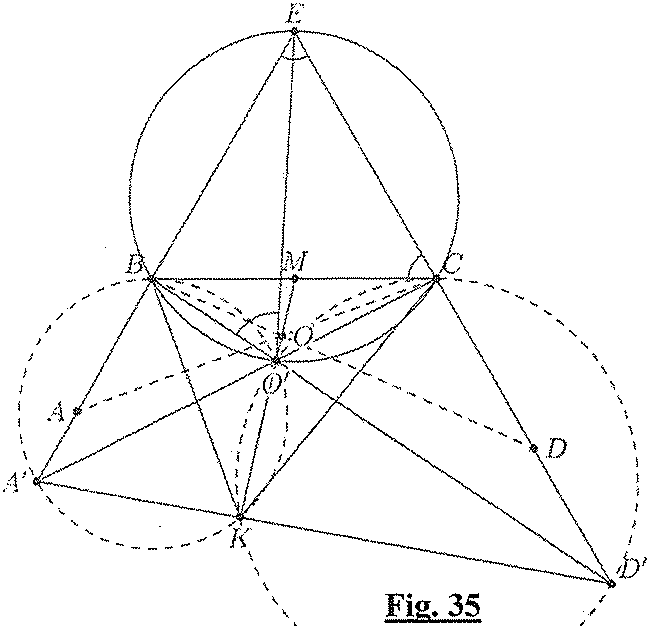
Let lines and intersect at . We have that . Let us prove that . Indeed, one of the angles or is at least . WLOG, this angle is (Fig. 35). Then in . So , hence on the segment there is point , such that . Then circumcircles of and are tangent to . Hence, , . So
Fig. 35
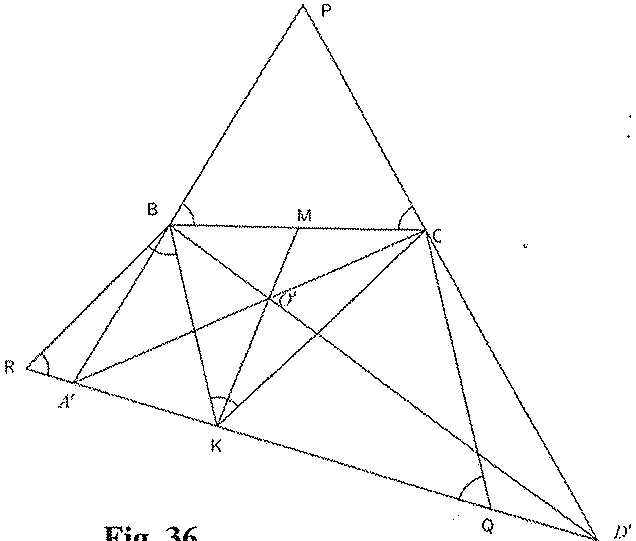
Then point is on circumcircle of . Let line intersect at , intersect at . From the fact that is cyclic we conclude that (Fig. 36) Consider and . Two pairs of angles are equal. Hence . Then . So point is on circumcircle of . Similarly, point is on the circle . Then . It follows that points , and are on the same line.
Point lies on segment . If this point is inside , then lies inside , inside . Then lies strictly outside , but by the problem is inside , a contradiction. Similarly, if point is outside , then , are outside and , so is strictly inside , again a contradiction. Hence . Then and . But this is already proved that , which is needed, because and .
---
Alternative solution.
Let us draw external bisector of . Let it intersect lines and at and (Fig. 36). We draw on sides outside equilateral triangles , and . Obviously and are on , and is an intersection of and .
Consider . We saw, that
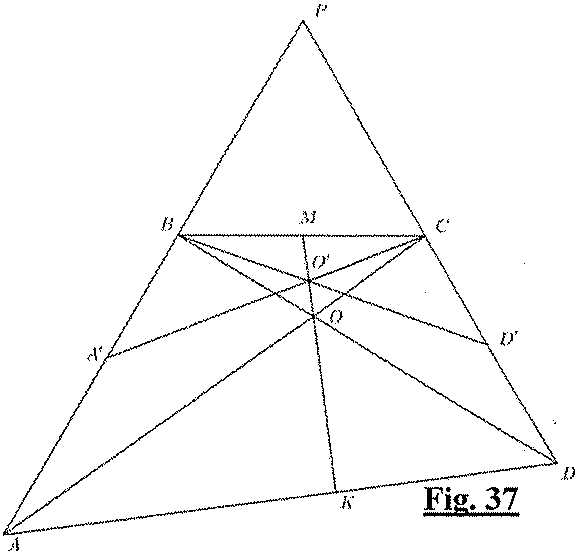
It implies that and are isogonal, also is external bisector. So and are isogonal, hence and are isogonal. Similarly we have that segments and are isogonal. It is easy to see that - the point of intersection of tangents to circumcircle of , so . For this is symmedian of , so and are isogonal. As it is known , and intersect in the same point, namely at Fermat point, so as lines , and intersect in the same point. Let this be point . Assume that (Fig. 37). Then points and are on sides and , but in this case and don't intersect each other. Similarly if . Hence .
Fig. 37
Fig. 35
Then point is on circumcircle of . Let line intersect at , intersect at . From the fact that is cyclic we conclude that (Fig. 36) Consider and . Two pairs of angles are equal. Hence . Then . So point is on circumcircle of . Similarly, point is on the circle . Then . It follows that points , and are on the same line.
Point lies on segment . If this point is inside , then lies inside , inside . Then lies strictly outside , but by the problem is inside , a contradiction. Similarly, if point is outside , then , are outside and , so is strictly inside , again a contradiction. Hence . Then and . But this is already proved that , which is needed, because and .
---
Alternative solution.
Let us draw external bisector of . Let it intersect lines and at and (Fig. 36). We draw on sides outside equilateral triangles , and . Obviously and are on , and is an intersection of and .
Consider . We saw, that
It implies that and are isogonal, also is external bisector. So and are isogonal, hence and are isogonal. Similarly we have that segments and are isogonal. It is easy to see that - the point of intersection of tangents to circumcircle of , so . For this is symmedian of , so and are isogonal. As it is known , and intersect in the same point, namely at Fermat point, so as lines , and intersect in the same point. Let this be point . Assume that (Fig. 37). Then points and are on sides and , but in this case and don't intersect each other. Similarly if . Hence .
Fig. 37
Techniques
Angle chasingTangentsCyclic quadrilateralsNapoleon and Fermat pointsBrocard point, symmediansIsogonal/isotomic conjugates, barycentric coordinatesTriangle inequalities