Browse · MathNet
PrintChina Girls' Mathematical Olympiad
China geometry
Problem
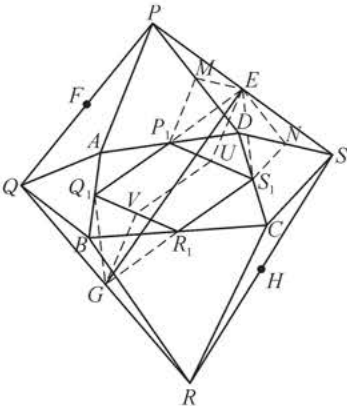
Outside a convex quadrilateral we construct equilateral triangles , , and . Denoting by the sum of the diagonals of , and by the sum of line segments joining the midpoints of opposite sides of , we find the maximum value of .
Solution
If is a square, then .
Now we prove that .
Denote by the midpoints of , , , , and by , , , the midpoints of , , , . Then is a parallelogram.
Now draw lines , , and denote by , the midpoints of , . Then and So we have . Hence, is equilateral.
By the same argument, is also equilateral. Now let , be the midpoints of , , respectively. We then obtain and also
Taking the sum of these two inequalities, we have , i.e.
Now we prove that .
Denote by the midpoints of , , , , and by , , , the midpoints of , , , . Then is a parallelogram.
Now draw lines , , and denote by , the midpoints of , . Then and So we have . Hence, is equilateral.
By the same argument, is also equilateral. Now let , be the midpoints of , , respectively. We then obtain and also
Taking the sum of these two inequalities, we have , i.e.
Final answer
(1+sqrt(3))/2
Techniques
QuadrilateralsTriangle inequalitiesOptimization in geometryAngle chasingDistance chasing