Browse · MathNet
Print2016 Eighth Romanian Master of Mathematics
Romania 2016 geometry
Problem
Let be a triangle and let be a point on the segment , and . The circle meets the segment again at an interior point . The circle meets the segment again at an interior point . Let be the reflection of in the line . The lines and meet at , and the lines and meet at . Prove that the lines , and are concurrent (or all parallel).
Solution
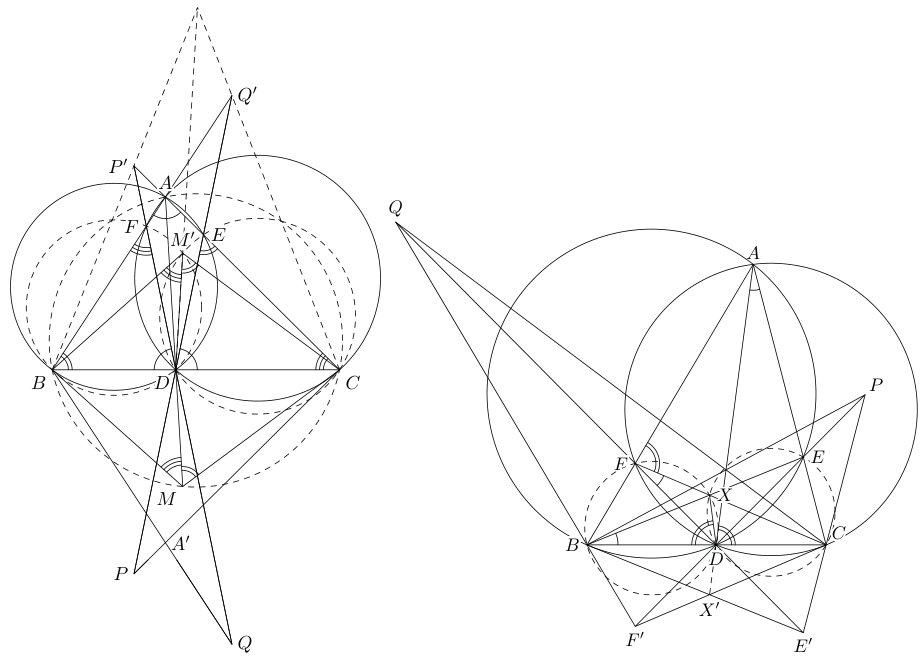
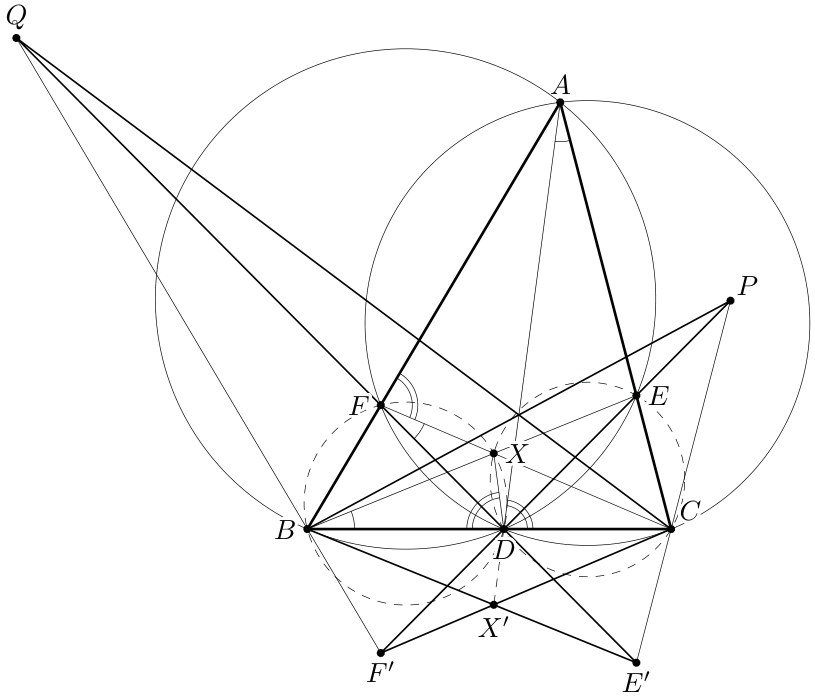
Let denote reflection in the line . Since , by concyclicity, the lines and are images of one another under , so the lines and meet at , and the lines and meet at . Consequently, the lines and meet at some (possibly ideal) point on the line . Since the pairs of lines , , meet at three collinear points, namely , , respectively, the triangles and are perspective, i.e., the lines are concurrent, by the Desargues theorem.
---
Alternative solution.
As in the first solution, denotes reflection in the line , the lines and are images of one another under , the lines and meet at , and the lines and meet at . Let the line meet the circle again at . Letting , it is sufficient to prove that the lines , and are concurrent. Begin by noticing that , to infer that lies on the circle . Similarly, lies on the circle , so the line is the radical axis of the circles and . Since lies on the lines and , it is the radical centre of the circles , , and ; hence the line is the radical axis of the circles and . Similarly, the line is the radical axis of the circles and . So the conclusion follows: the lines , and are concurrent at the radical centre of the circles , and ; thus the lines , and are also concurrent.
---
Alternative solution.
As in the previous solutions, denotes reflection in the line . Let the lines and meet at . Due to the circles BDEA and CDFA, we have , so the quadrilateral BFXD is cyclic; similarly, the quadrilateral CEXD is cyclic. Hence , the lines DX and DA are therefore images of one another under , and lies on the line AD. Let and , and apply the Pappus theorem to the hexagon to infer that , D, and are collinear. The conclusion follows.
---
Alternative solution.
As in the first solution, denotes reflection in the line , the lines and are images of one another under , the lines and meet at , and the lines and meet at . Let the line meet the circle again at . Letting , it is sufficient to prove that the lines , and are concurrent. Begin by noticing that , to infer that lies on the circle . Similarly, lies on the circle , so the line is the radical axis of the circles and . Since lies on the lines and , it is the radical centre of the circles , , and ; hence the line is the radical axis of the circles and . Similarly, the line is the radical axis of the circles and . So the conclusion follows: the lines , and are concurrent at the radical centre of the circles , and ; thus the lines , and are also concurrent.
---
Alternative solution.
As in the previous solutions, denotes reflection in the line . Let the lines and meet at . Due to the circles BDEA and CDFA, we have , so the quadrilateral BFXD is cyclic; similarly, the quadrilateral CEXD is cyclic. Hence , the lines DX and DA are therefore images of one another under , and lies on the line AD. Let and , and apply the Pappus theorem to the hexagon to infer that , D, and are collinear. The conclusion follows.
Techniques
Desargues theoremPappus theoremRadical axis theoremAngle chasing