Browse · MathNet
PrintBaltic Way shortlist
Baltic Way geometry
Problem
A convex quadrilateral is right-angled at and fulfils . Determine its greatest possible area.
Solution
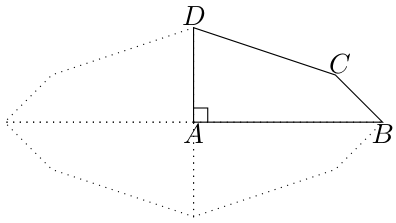
Answer: . Reflect the quadrilateral in line , and reflect the resulting pentagon again in line ; see Figure 1. This produces an octagon of fixed perimeter and area four times that of . The maximal area is obtained for a regular octagon of edge length . Since the area of a regular octagon of edge is known (or easily verified) to be , the maximal area of the original quadrilateral is .
---
Alternative solution.
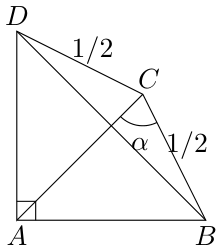
Let us fix the segment , and consider the points and as variables. The locus of points fulfilling is a (semi-)circle with diameter . In order to maximise the area of triangle , the length of the altitude from must be maximised, which occurs when lies on the perpendicular bisector of , so that . The locus of points fulfilling is (an arc of) an ellipse with foci and . Again, in order to maximise the area of triangle , the length of the altitude from must be maximised, which again occurs for on the perpendicular bisector of , so that . The maximal quadrilateral satisfying the conditions will thus be mirror-symmetric with
as in Figure 2. Put . Using some trigonometry, we find and , so that the area of can be expressed as Since , this function obtains its unique maximum for .
---
Alternative solution.
Let us fix the segment , and consider the points and as variables. The locus of points fulfilling is a (semi-)circle with diameter . In order to maximise the area of triangle , the length of the altitude from must be maximised, which occurs when lies on the perpendicular bisector of , so that . The locus of points fulfilling is (an arc of) an ellipse with foci and . Again, in order to maximise the area of triangle , the length of the altitude from must be maximised, which again occurs for on the perpendicular bisector of , so that . The maximal quadrilateral satisfying the conditions will thus be mirror-symmetric with
as in Figure 2. Put . Using some trigonometry, we find and , so that the area of can be expressed as Since , this function obtains its unique maximum for .
Final answer
1/8 * (1 + sqrt(2))
Techniques
QuadrilateralsConstructions and lociTrigonometryOptimization in geometry