Browse · MathNet
PrintAUT_ABooklet_2023
Austria 2023 geometry
Problem
Alice and Bob play a game, in which they take turns drawing segments of length in the Euclidean plane. Alice begins, drawing the first segment, and from then on, each segment must start at the endpoint of the previous segment. It is not permitted to draw the segment lying over the preceding one. If the new segment shares at least one point—except for its starting point—with one of the previously drawn segments, one has lost.
a) Show that both Alice and Bob could force the game to end, if they don't care who wins.
b) Is there a winning strategy for one of them?
(Michael Reitmeir)
a) Show that both Alice and Bob could force the game to end, if they don't care who wins.
b) Is there a winning strategy for one of them?
(Michael Reitmeir)
Solution
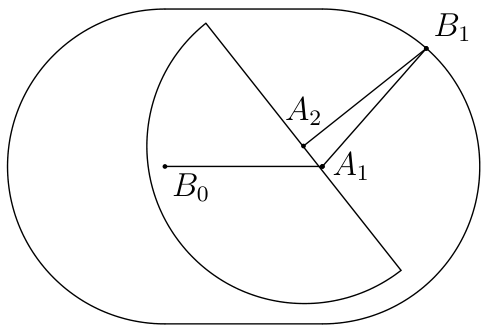
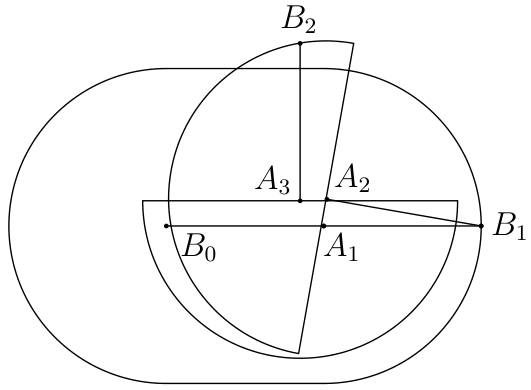
a) In the following, let denote the end-point of the segment that Alice drew in her -th turn (assuming the game has not ended by then), and let denote the end-point of Bob's -th segment. Furthermore, let denote the starting point of Bob's first segment. If Alice can force an end to the game, so can Bob by applying the same strategy and ignoring Alice's first move. It is therefore sufficient to prove that Alice can force an end. Bob must always choose the -th end-point on the circle with radius and center in . We name this circle . Furthermore, let denote the line perpendicular to through . We now note that if Bob chooses his end-point in such a way that his segment forms an acute angle with the preceding segment (such that lies on the same side of as the segment ), Alice can end the game with her next move. Now let denote the part of on the opposite side of from (including the intersection points of and ). In the following, we only need to consider the case in which Bob chooses the point on the semi-circle . Let denote the set of all points, whose distance from the first drawn segment is less than . The set consists of a rectangle and the interior of two semi-circles. Bob chooses on . In the next move, Alice can choose as close as she wishes to . Let denote the distance between and . We now consider two cases.
Case 1: do not lie on a common line.
If Alice chooses (which she is not allowed to do, according to the rules), will overlap with the semicircular edge of at one end. The other end of must therefore lie in the interior of the rectangular section of , which means that this end must have a positive distance from the edge of . Since Alice can choose an arbitrarily small value of , she can (for reasons of continuity) move the point away slightly from towards the rectangular section of such that comes to lie completely in the interior of . This means that will lie completely in the interior of , and all its points thus have a distance less than from the first segment. Alice can therefore certainly choose her next segment in such a way that it intersects the first segment.
Case 2: lie on a common line. In this case, Alice cannot choose in such a way that lies completely in the interior of . If Bob chooses in the interior of , Alice can choose her next segment in such a way that it intersects the first segment, ending the game. We can therefore assume that Bob chooses on outside of . In this case, Alice can choose her next point in such a way that its distance from is at most . By the triangle inequality, the distance from to is then at most . If (which is not allowed by the rules), we would have . In this case, analogously to the previous case, would overlap with the semicircular edge of , and the other end would lie in the interior of the rectangular part of with a positive distance from the edge. Since Alice can choose arbitrarily small, she can (again by reasons of continuity) move slightly away from toward the part of in the interior of the rectangular section of , such that comes to lie completely in the interior of . Then lies in the interior of , and Alice can choose her next segment in such a way that it intersects the first segment.
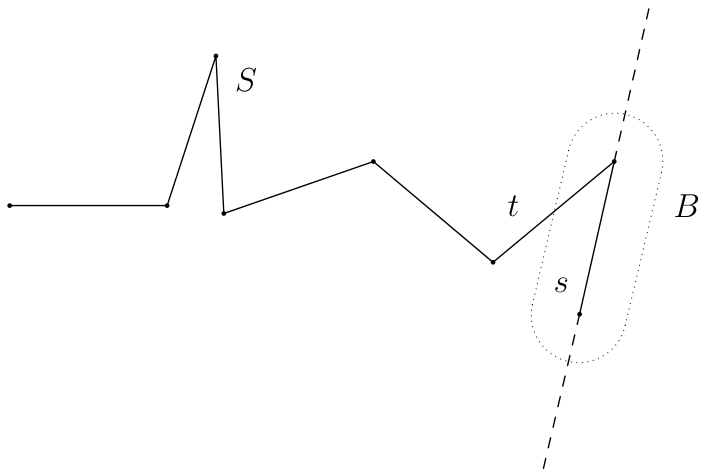
b) We will show that each of the players can always make a move with which they do not lose. This is trivially the case for the first two moves, so we assume without loss of generality that at least two segments have already been drawn. Let denote the last segment drawn and the one drawn immediately before that. Furthermore, let denote the union of all segments that were drawn before and . Let denote the smallest distance between any of the points of and . Since and are assumed to not have any common points, we certainly have .
Now let denote the set of all points , whose distance from is less than . certainly does not contain any point from . The only segments among those that have been drawn to this point that contain any of the points in are thus and . Extending to a line, we divide the Euclidean plane into two half-planes, one of which certainly does not include any of the points of . We choose this half-plane and determine its intersection with . We can certainly find a segment of length in this part of , with one end in the end of , that does not intersect either or any of the other segments.
Case 1: do not lie on a common line.
If Alice chooses (which she is not allowed to do, according to the rules), will overlap with the semicircular edge of at one end. The other end of must therefore lie in the interior of the rectangular section of , which means that this end must have a positive distance from the edge of . Since Alice can choose an arbitrarily small value of , she can (for reasons of continuity) move the point away slightly from towards the rectangular section of such that comes to lie completely in the interior of . This means that will lie completely in the interior of , and all its points thus have a distance less than from the first segment. Alice can therefore certainly choose her next segment in such a way that it intersects the first segment.
Case 2: lie on a common line. In this case, Alice cannot choose in such a way that lies completely in the interior of . If Bob chooses in the interior of , Alice can choose her next segment in such a way that it intersects the first segment, ending the game. We can therefore assume that Bob chooses on outside of . In this case, Alice can choose her next point in such a way that its distance from is at most . By the triangle inequality, the distance from to is then at most . If (which is not allowed by the rules), we would have . In this case, analogously to the previous case, would overlap with the semicircular edge of , and the other end would lie in the interior of the rectangular part of with a positive distance from the edge. Since Alice can choose arbitrarily small, she can (again by reasons of continuity) move slightly away from toward the part of in the interior of the rectangular section of , such that comes to lie completely in the interior of . Then lies in the interior of , and Alice can choose her next segment in such a way that it intersects the first segment.
b) We will show that each of the players can always make a move with which they do not lose. This is trivially the case for the first two moves, so we assume without loss of generality that at least two segments have already been drawn. Let denote the last segment drawn and the one drawn immediately before that. Furthermore, let denote the union of all segments that were drawn before and . Let denote the smallest distance between any of the points of and . Since and are assumed to not have any common points, we certainly have .
Now let denote the set of all points , whose distance from is less than . certainly does not contain any point from . The only segments among those that have been drawn to this point that contain any of the points in are thus and . Extending to a line, we divide the Euclidean plane into two half-planes, one of which certainly does not include any of the points of . We choose this half-plane and determine its intersection with . We can certainly find a segment of length in this part of , with one end in the end of , that does not intersect either or any of the other segments.
Final answer
a) Yes, either player can force the game to end. b) No; neither player has a winning strategy, as both can always make a safe move.
Techniques
Distance chasingConstructions and lociGames / greedy algorithms