Browse · MathNet
PrintInternational Mathematical Olympiad
geometry
Problem
Let be a convex pentagon such that , , and . Prove that the perpendicular line from to and the line segments and are concurrent.
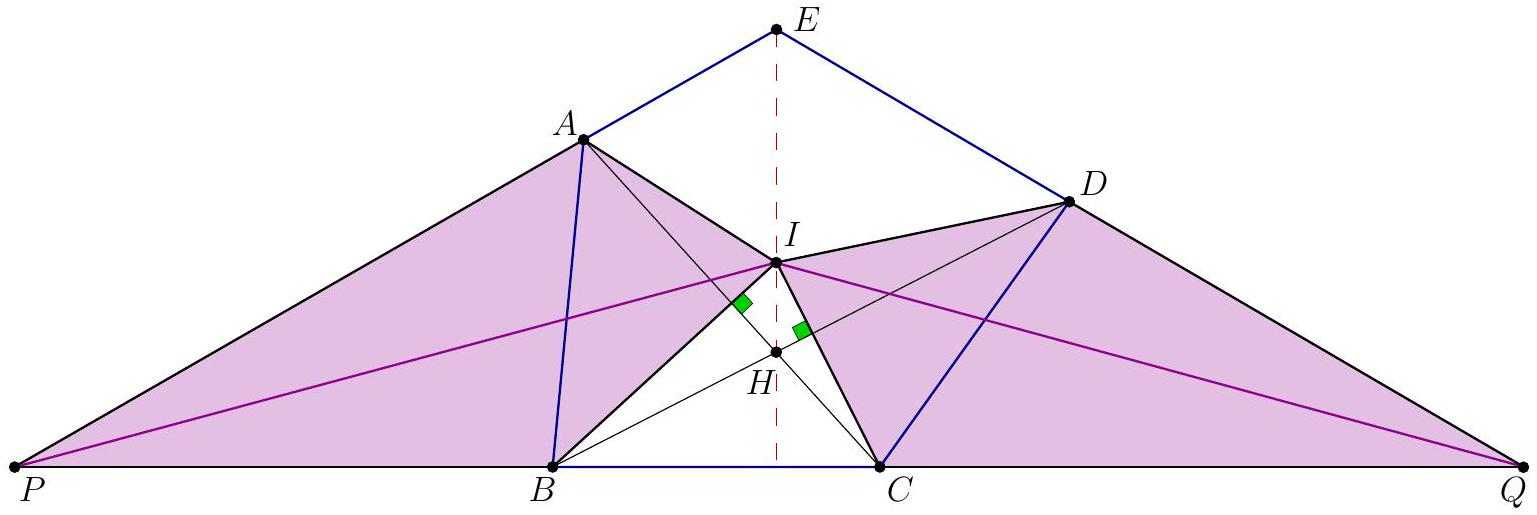
Solution
Throughout the solution, we refer to , and as internal angles of the pentagon . Let the perpendicular bisectors of and , which pass respectively through and , meet at point . Then and, similarly, . Hence and meet at the orthocenter of the triangle , and . It remains to prove that lies on the line or, equivalently, .
Lines and bisect and , respectively. Since , and , the triangles and are congruent. Hence , so the line bisects . Similarly, the line bisects . Finally, the line bisects because lies on all the other four internal bisectors of the angles of the pentagon.
The sum of the internal angles in a pentagon is , so In quadrilateral , which means that , completing the proof.
---
Alternative solution.
We present another proof of the fact that lies on line . Since all five internal bisectors of meet at , this pentagon has an inscribed circle with center . Let this circle touch side at .
Applying Brianchon's theorem to the (degenerate) hexagon we conclude that and are concurrent, so point also lies on line , completing the proof.
---
Alternative solution.
We present yet another proof that . In pentagon , . Then , so rays and meet at a point , and rays and meet at a point . Now, and, similarly, . Since , the triangles and are congruent with the same orientation. Moreover, is isosceles with .
In Solution 1 we have proved that triangles and are also congruent with the same orientation. Then we conclude that quadrilaterals and are congruent, which implies . Then is the perpendicular bisector of and, therefore, .
Lines and bisect and , respectively. Since , and , the triangles and are congruent. Hence , so the line bisects . Similarly, the line bisects . Finally, the line bisects because lies on all the other four internal bisectors of the angles of the pentagon.
The sum of the internal angles in a pentagon is , so In quadrilateral , which means that , completing the proof.
---
Alternative solution.
We present another proof of the fact that lies on line . Since all five internal bisectors of meet at , this pentagon has an inscribed circle with center . Let this circle touch side at .
Applying Brianchon's theorem to the (degenerate) hexagon we conclude that and are concurrent, so point also lies on line , completing the proof.
---
Alternative solution.
We present yet another proof that . In pentagon , . Then , so rays and meet at a point , and rays and meet at a point . Now, and, similarly, . Since , the triangles and are congruent with the same orientation. Moreover, is isosceles with .
In Solution 1 we have proved that triangles and are also congruent with the same orientation. Then we conclude that quadrilaterals and are congruent, which implies . Then is the perpendicular bisector of and, therefore, .
Techniques
Angle chasingTangentsConcurrency and CollinearityTriangle centers: centroid, incenter, circumcenter, orthocenter, Euler line, nine-point circle