Browse · MathNet
Print72nd Czech and Slovak Mathematical Olympiad
Czech Republic geometry
Problem
Given an acute-angled scalene triangle . The angle bisector of the angle and the perpendicular bisectors of the sides , define a triangle. Prove that its orthocenter lies on the median from the vertex .
(Josef Tkadlec)
(Josef Tkadlec)
Solution
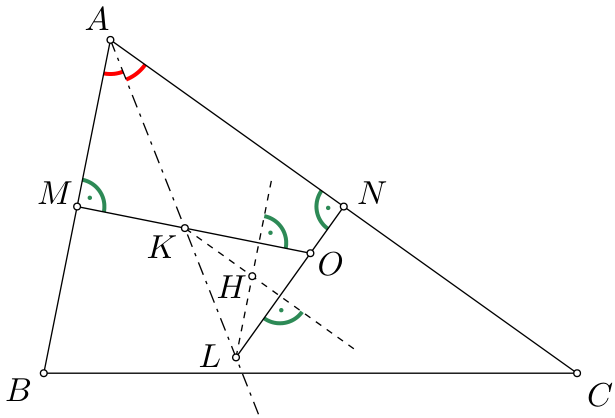
Let us denote the midpoint of , the midpoint of , and the intersections of the angle bisector with perpendicular bisectors of and , respectively. The intersection of perpendicular bisectors of and is denoted by . The triangle is therefore the triangle from the problem statement. Its orthocenter we denote by . All these points are marked in the figure 1 for the case . (The case looks analogously, the case is excluded by the specification—then points merge into one point.)
We have to prove that lies on the median from the vertex of triangle . It is sufficient to show that triangles and have the same area.
Since we have . Therefore and have the same distance from the line . However, it is equal to the length of the segment , since the point lies on the angle bisector of and is the perpendicular projection of onto . Hence, we get that the area of is equal to . Analogously, we deduce that area of is equal to . It remains to prove .
For the points and lying on the angle bisector of we have . The rectangular triangles and are therefore similar, and therefore . Hence with respect to and we get , i.e. as we needed to prove.
---
Alternative solution.
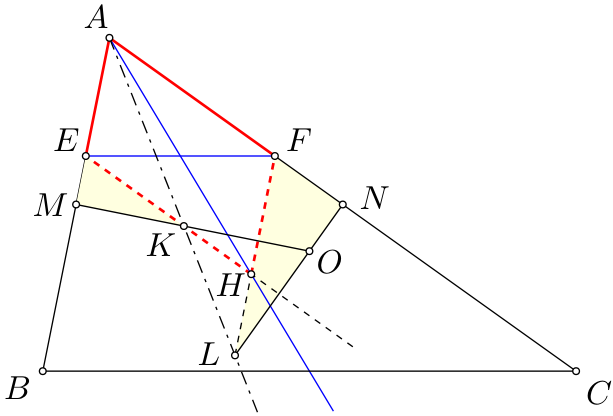
In addition to the points from the first solution, we also consider the intersection of lines and and intersection of lines and . Again we observe that and , so the quadrilateral is a parallelogram (see fig. 2).
We use again similarity of triangles and and deduce . Equality of exterior angles at vertices , of the parallelogram yields . Thus, the rectangular triangles and are also similar, whence it follows . Hence, and triangles and are similar by the SAS condition (they coincide in the angle at the vertex and in the ratio of the adjacent sides). We thus obtain the decisive relation .
Since in the parallelogram the line bisects the diagonal , this line also bisects the segment , which is homothetic with with center . In other words, lies on the median from of the triangle , as we had to prove.
---
Alternative solution.
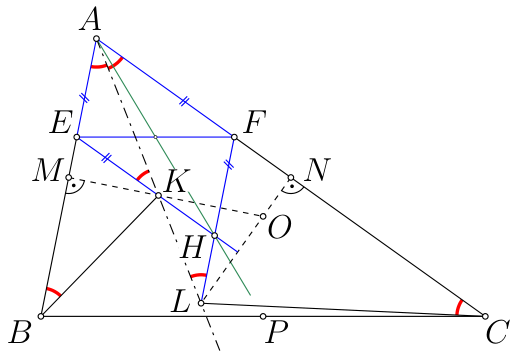
We consider points from the second solution. As there, we conclude that is a parallelogram, and therefore the midpoint of the segment lies on the ray . If we prove then the midpoint of also lies on the ray .
Due to the construction from the problem statement and the parallelogram , the six angles and marked in fig. 3 are congruent. According to the theorem , we have and . According to the first similarity, , and by the second similarity . Together we get , so by the SAS theorem, holds, and hence , as we promised to prove.
We have to prove that lies on the median from the vertex of triangle . It is sufficient to show that triangles and have the same area.
Since we have . Therefore and have the same distance from the line . However, it is equal to the length of the segment , since the point lies on the angle bisector of and is the perpendicular projection of onto . Hence, we get that the area of is equal to . Analogously, we deduce that area of is equal to . It remains to prove .
For the points and lying on the angle bisector of we have . The rectangular triangles and are therefore similar, and therefore . Hence with respect to and we get , i.e. as we needed to prove.
---
Alternative solution.
In addition to the points from the first solution, we also consider the intersection of lines and and intersection of lines and . Again we observe that and , so the quadrilateral is a parallelogram (see fig. 2).
We use again similarity of triangles and and deduce . Equality of exterior angles at vertices , of the parallelogram yields . Thus, the rectangular triangles and are also similar, whence it follows . Hence, and triangles and are similar by the SAS condition (they coincide in the angle at the vertex and in the ratio of the adjacent sides). We thus obtain the decisive relation .
Since in the parallelogram the line bisects the diagonal , this line also bisects the segment , which is homothetic with with center . In other words, lies on the median from of the triangle , as we had to prove.
---
Alternative solution.
We consider points from the second solution. As there, we conclude that is a parallelogram, and therefore the midpoint of the segment lies on the ray . If we prove then the midpoint of also lies on the ray .
Due to the construction from the problem statement and the parallelogram , the six angles and marked in fig. 3 are congruent. According to the theorem , we have and . According to the first similarity, , and by the second similarity . Together we get , so by the SAS theorem, holds, and hence , as we promised to prove.
Techniques
Triangle centers: centroid, incenter, circumcenter, orthocenter, Euler line, nine-point circleHomothetyAngle chasingDistance chasing