Browse · MathNet
PrintEstonian Mathematical Olympiad
Estonia number theory
Problem
Find all positive integers for which it is possible to write all positive integers from to in some order on a circle, each exactly once, such that every number is coprime with the number that is two positions away from it.
Solution
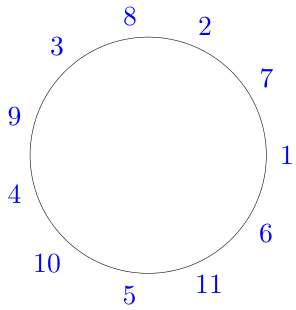
Let be odd. Write the number at some point on the circle and, after every full turns, write the next number by size (Fig. 45 shows the case for ). In this way, all the numbers from to can be written in different points. Choosing any number on the circle and the number two positions away from it, we have either consecutive integers or the numbers and . In both cases, the chosen numbers are coprime.
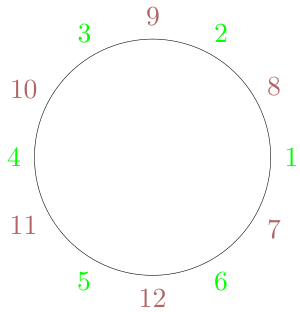
If is divisible by , let , where is an even number. Like described for odd , write the numbers from to on the circle and in the remaining points, write the numbers from to in order (Fig. 46 shows the case for ). Choosing any number on the circle and the number two positions away from it, we have either consecutive integers or the numbers and or the numbers and . In the first two cases, the chosen numbers are coprime. If the numbers and had a common divisor , then would also be a divisor of , that is, , and also a divisor of , that is, . But because is even, so is odd and has no factor . Thus, the only possibility is , meaning . Therefore, the chosen numbers are coprime in all cases.
Fig. 45 Fig. 46
Now let be an even number that is not divisible by , i.e., , where is an odd number. Suppose that the positive integers from to are arranged in some order on a circle. This divides these numbers into two groups, each containing numbers: the first group contains the number and all those that can be reached by repeatedly jumping to the number two positions away, while the second group contains all the remaining numbers. Among all the written numbers, there are even numbers, and at least half of them must belong to one group; since is odd, more than half of the even numbers must belong to one group. This means that there must be two even numbers that are consecutive within the group, i.e., one is two positions away from the other on the circle. These two numbers have a common factor . Therefore, it is not possible to arrange the numbers from to on the circle such that every number is coprime with the number two positions away from it.
If is divisible by , let , where is an even number. Like described for odd , write the numbers from to on the circle and in the remaining points, write the numbers from to in order (Fig. 46 shows the case for ). Choosing any number on the circle and the number two positions away from it, we have either consecutive integers or the numbers and or the numbers and . In the first two cases, the chosen numbers are coprime. If the numbers and had a common divisor , then would also be a divisor of , that is, , and also a divisor of , that is, . But because is even, so is odd and has no factor . Thus, the only possibility is , meaning . Therefore, the chosen numbers are coprime in all cases.
Fig. 45 Fig. 46
Now let be an even number that is not divisible by , i.e., , where is an odd number. Suppose that the positive integers from to are arranged in some order on a circle. This divides these numbers into two groups, each containing numbers: the first group contains the number and all those that can be reached by repeatedly jumping to the number two positions away, while the second group contains all the remaining numbers. Among all the written numbers, there are even numbers, and at least half of them must belong to one group; since is odd, more than half of the even numbers must belong to one group. This means that there must be two even numbers that are consecutive within the group, i.e., one is two positions away from the other on the circle. These two numbers have a common factor . Therefore, it is not possible to arrange the numbers from to on the circle such that every number is coprime with the number two positions away from it.
Final answer
All positive integers n with n ≡ 0, 1, or 3 mod 4 (i.e., n not ≡ 2 mod 4).
Techniques
Greatest common divisors (gcd)Coloring schemes, extremal argumentsPigeonhole principle