Browse · MathNet
PrintChina National Team Selection Test
China geometry
Problem
Suppose there are beetles on a chessboard consisting of unit squares. Each unit square can accommodate at most one beetle. At a moment, all beetles fly and land on the chessboard again. For a beetle, we call the vector from its flying unit to its landing unit the beetle's "displacement vector". We call the sum of all beetle's "displacement vectors" the "total displacement vectors". Find the maximum length of "total displacement vector" considering the number of beetles and all possible positions of flying and landing. (posed by Qu Zhenhua)
Solution
Set up a coordinate system with origin at the center of chessboard and the grid line as the coordinate line. Denote the set of the centers of squares by , and the set where the beetles initially stand on by , and the set that the beetles land on by . Let be the one-to-one mapping defined by a beetle's position at the beginning to the position of first landing. Thus, the total displacement vector is given by Note that the right-hand side of ① is independent of . We need only to find the maximum of for all , . We may suppose that , since element of does not change . Suppose that attains its maximum at , obviously . Let line be at point .
Lemma 1. Line does not pass any point of . is the set of on one side of , and is the set of on the other side of .
Proof of Lemma 1. First, . Otherwise, since is even, there are at least two points and which are not in . Suppose that the angle between and does not exceed , then . So add into , add into , then will increase, which is a contradiction.
Second, . Otherwise, there exist , such that and . Suppose that the angle between and does not exceed . Put into , and into , changes to , and , which is a contradiction.
Third, does not pass any point of . Otherwise, let pass , then change into into , changes to . Notice that , so , which is a contradiction.
Fourth, we show that is the set of on one side of (the side that is pointing to), and is the set of on the other side of . Otherwise, there is at the side that is pointing to. And there is a on the other side. Then the angle between and is less than . Change into and into , then changes into , the length of which is greater, which is a contradiction. Lemma 1 is now proved.
Lemma 2. Let be a line passing and does not pass points of . Denote all points of on one side of by , all points of on the other side by . Denote , then the maximum of is obtained when is horizontal (or vertical), and is vertical (or horizontal).
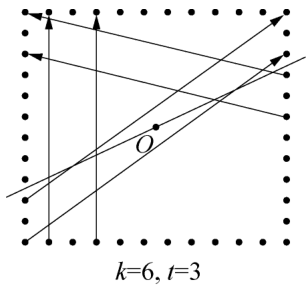
Proof of Lemma 2. is located at the boundary of a square with points on each side. Let the four vertices of the square be , , and . By Fig. 6.1 symmetricity, we may suppose that intersects at point with non-negative slope. Let be located between the ()th (from top to bottom) of on and the th of on (see Fig. 6.1, in case of ). Thus, where and are horizontal and vertical unit vectors, respectively. Denote , , then As a quadratic function of , is the symmetric axis. It is easy to know that takes its maximum at . So , that is, is horizontal, so is vertical. Lemma 2 is proved.
Turn to the original problem. By symmetricity, we need to only consider that the slope of is non-negative and less than 1. Let be located on two sides of . Denote , then So, . If is horizontal, is all the points of on the upper half-plane, is all points of on the lower half-plane; each takes its maximum, and all point upward. And the equality of ② holds. So indeed takes the maximum .
Lemma 1. Line does not pass any point of . is the set of on one side of , and is the set of on the other side of .
Proof of Lemma 1. First, . Otherwise, since is even, there are at least two points and which are not in . Suppose that the angle between and does not exceed , then . So add into , add into , then will increase, which is a contradiction.
Second, . Otherwise, there exist , such that and . Suppose that the angle between and does not exceed . Put into , and into , changes to , and , which is a contradiction.
Third, does not pass any point of . Otherwise, let pass , then change into into , changes to . Notice that , so , which is a contradiction.
Fourth, we show that is the set of on one side of (the side that is pointing to), and is the set of on the other side of . Otherwise, there is at the side that is pointing to. And there is a on the other side. Then the angle between and is less than . Change into and into , then changes into , the length of which is greater, which is a contradiction. Lemma 1 is now proved.
Lemma 2. Let be a line passing and does not pass points of . Denote all points of on one side of by , all points of on the other side by . Denote , then the maximum of is obtained when is horizontal (or vertical), and is vertical (or horizontal).
Proof of Lemma 2. is located at the boundary of a square with points on each side. Let the four vertices of the square be , , and . By Fig. 6.1 symmetricity, we may suppose that intersects at point with non-negative slope. Let be located between the ()th (from top to bottom) of on and the th of on (see Fig. 6.1, in case of ). Thus, where and are horizontal and vertical unit vectors, respectively. Denote , , then As a quadratic function of , is the symmetric axis. It is easy to know that takes its maximum at . So , that is, is horizontal, so is vertical. Lemma 2 is proved.
Turn to the original problem. By symmetricity, we need to only consider that the slope of is non-negative and less than 1. Let be located on two sides of . Denote , then So, . If is horizontal, is all the points of on the upper half-plane, is all points of on the lower half-plane; each takes its maximum, and all point upward. And the equality of ② holds. So indeed takes the maximum .
Final answer
2*1006^3
Techniques
VectorsCartesian coordinatesOptimization in geometry