Browse · MathNet
Print41st Balkan Mathematical Olympiad
number theory
Problem
Prove that for every positive integer there exists an integer and distinct primes such that, if denotes the number of integers in which are relatively prime to , then
Solution
If , choose , . If , choose , , . Assume . Let be primes congruent to modulo . By the Chinese Remainder Theorem choose for every , that is, choose an integer such that . Consider a fractional part , where are different primes among . Note that if is odd and if is even. If is odd, then working modulo , we get , for some integer . It follows that If is even, then , for some integer . Hence The difference between and equals to for , as desired.
---
Alternative solution.
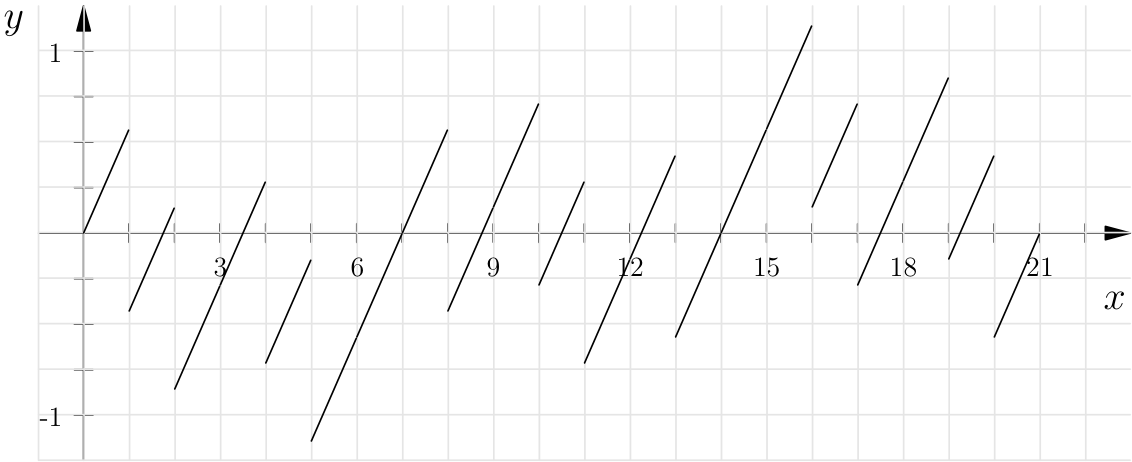
Alternative Solution. Note that Denote by and , then In particular, the function satisfies We consider the function over the real numbers. Note that is periodic: . Also, it satisfies for all except integer points of discontinuity. For example, the graph of looks as follows: We prove by induction, for , that we can find primes such that a slightly stronger inequality holds: . The base case: if then choose . We have and Given primes , suppose , where and are the minimum and maximum values that , , can achieve. We can see that and because of the discontinuity at the supremum integer point. Suppose we can find primes such that . We show how to find a prime such that . Let and be the two sets of residues modulo , respectively, which identify two integers for which minimum and maximum of occurs. Note that for all because the minimum value occurs at a point of discontinuity, at an integer coprime with . Suppose we add a prime , then . Set , where is an integer and . Since , we get Pick an integer , where . By Dirichlet's Theorem there exist infinitely many primes such that for all , which satisfy , where and . Therefore we can find a prime satisfying the given conditions and . Using induction hypothesis we conclude that
---
Alternative solution.
Alternative Solution. The most obvious approach appears to be induction on . Let's see if we can make that work. Step 1. Say and work. We are going to keep these primes and add one new prime to them. We'll set things up so that is much larger than . We will select some new positive integer to go with . Let . We decree right from the start that is congruent to modulo . So for some positive integer . This way, we get to keep all fractional parts from the induction hypothesis. Also, we want all of to be odd, and we want none of to divide . Consider this part of the induction hypothesis. We require that divides . Let's see how to ensure that. Since and are relatively prime, this is the same as divides and divides . The requirement that divides gives us congruent to . By Dirichlet, there are infinitely many primes with this property. (Note that this special case of Dirichlet has a known proof accessible to high-schoolers, unlike, to the best of my knowledge, the general case.) So we set to some crazy large prime in this arithmetic progression. We'll see how large later on. Once we've fixed , we moreover have to ensure that divides . Since and are relatively prime, we can choose such that this holds. To recap, is absolutely enormous and divides . Step 3. Let be any product of several (possibly zero) distinct primes out of . So is any divisor of . Then is a summand in our induction hypothesis and is a summand in what we hope will eventually amount to our induction step. Consider . This is . By Step 2, we have that divides . Also, remember that is really insanely large. So is below the nearest larger positive integer. Here, is at most . So by making absurdly large we can guarantee that is arbitrarily close to a positive integer, from below, for all . In particular, we can make it so close to a positive integer that its fractional part is larger than the fractional parts of all expressions of the form . Then it follows immediately that, for each expression of the form , we have that is arbitrarily close to . Step 4. Let be the sum of the fractional parts for and ; that is, and so on. By the induction hypothesis, we know . Let be the analogous sum for and . Since is congruent to modulo , we have that contains all terms from . The new terms are all things of the form , where . We know that each such thingie is very close to . Here, is a term which appears in as well, with this sign exactly. So is really very close to plus the sum of all the 's. The sum of all the e's, on the other hand, is just the alternating sum of the binomial coefficients in row k of Pascal's triangle; so, zero. Therefore, T is very close to . By making q sufficiently large, we can make “very close” amount to as close as we wish. Since by the induction hypothesis, when is sufficiently close to , we get , as needed. The induction step is complete. Step 5. We still have to take care of the base case. It looks like , , and works with .
---
Alternative solution.
Alternative Solution. Note that Denote by and , then In particular, the function satisfies We consider the function over the real numbers. Note that is periodic: . Also, it satisfies for all except integer points of discontinuity. For example, the graph of looks as follows: We prove by induction, for , that we can find primes such that a slightly stronger inequality holds: . The base case: if then choose . We have and Given primes , suppose , where and are the minimum and maximum values that , , can achieve. We can see that and because of the discontinuity at the supremum integer point. Suppose we can find primes such that . We show how to find a prime such that . Let and be the two sets of residues modulo , respectively, which identify two integers for which minimum and maximum of occurs. Note that for all because the minimum value occurs at a point of discontinuity, at an integer coprime with . Suppose we add a prime , then . Set , where is an integer and . Since , we get Pick an integer , where . By Dirichlet's Theorem there exist infinitely many primes such that for all , which satisfy , where and . Therefore we can find a prime satisfying the given conditions and . Using induction hypothesis we conclude that
---
Alternative solution.
Alternative Solution. The most obvious approach appears to be induction on . Let's see if we can make that work. Step 1. Say and work. We are going to keep these primes and add one new prime to them. We'll set things up so that is much larger than . We will select some new positive integer to go with . Let . We decree right from the start that is congruent to modulo . So for some positive integer . This way, we get to keep all fractional parts from the induction hypothesis. Also, we want all of to be odd, and we want none of to divide . Consider this part of the induction hypothesis. We require that divides . Let's see how to ensure that. Since and are relatively prime, this is the same as divides and divides . The requirement that divides gives us congruent to . By Dirichlet, there are infinitely many primes with this property. (Note that this special case of Dirichlet has a known proof accessible to high-schoolers, unlike, to the best of my knowledge, the general case.) So we set to some crazy large prime in this arithmetic progression. We'll see how large later on. Once we've fixed , we moreover have to ensure that divides . Since and are relatively prime, we can choose such that this holds. To recap, is absolutely enormous and divides . Step 3. Let be any product of several (possibly zero) distinct primes out of . So is any divisor of . Then is a summand in our induction hypothesis and is a summand in what we hope will eventually amount to our induction step. Consider . This is . By Step 2, we have that divides . Also, remember that is really insanely large. So is below the nearest larger positive integer. Here, is at most . So by making absurdly large we can guarantee that is arbitrarily close to a positive integer, from below, for all . In particular, we can make it so close to a positive integer that its fractional part is larger than the fractional parts of all expressions of the form . Then it follows immediately that, for each expression of the form , we have that is arbitrarily close to . Step 4. Let be the sum of the fractional parts for and ; that is, and so on. By the induction hypothesis, we know . Let be the analogous sum for and . Since is congruent to modulo , we have that contains all terms from . The new terms are all things of the form , where . We know that each such thingie is very close to . Here, is a term which appears in as well, with this sign exactly. So is really very close to plus the sum of all the 's. The sum of all the e's, on the other hand, is just the alternating sum of the binomial coefficients in row k of Pascal's triangle; so, zero. Therefore, T is very close to . By making q sufficiently large, we can make “very close” amount to as close as we wish. Since by the induction hypothesis, when is sufficiently close to , we get , as needed. The induction step is complete. Step 5. We still have to take care of the base case. It looks like , , and works with .
Techniques
Chinese remainder theoremInverses mod nInclusion-exclusionFloors and ceilingsInduction / smoothing