Browse · MathNet
Print63rd Czech and Slovak Mathematical Olympiad
Czech Republic geometry
Problem
Let be the midpoint of the side of a triangle . Prove that the equality holds if and only if the triangle is isosceles or right-angled, with as a base or a hypotenuse, respectively. (Pavel Novotný)
Solution
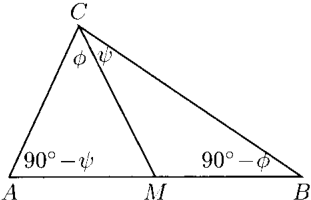
Assume first that . Using the notation and (Fig. 1), we conclude from our assumption that , and hence as well, because of an easy angle computation in : Fig. 1
Applying Law of Sines to and , we get Comparing the two ratios of sines and using the formula , we obtain an equality or . Since the angles and are acute, both and are between and . Thus by a well known sine property, the equality means that either or . In the first case (when ), the interior angle of at the vertices and are equal, in the second case (when ) the interior angle at the vertex is right. This completes the proof of one of the two implications stated in the problem.
Fig. 1
To prove the second (converse) implication, let us assume that (i) or (ii) .
Case (i). It follows from that the triangles and are congruent (by SSS theorem), with right interior angles at the vertex . Consequently,
Applying Law of Sines to and , we get The converse implication is proven.
---
Alternative solution.
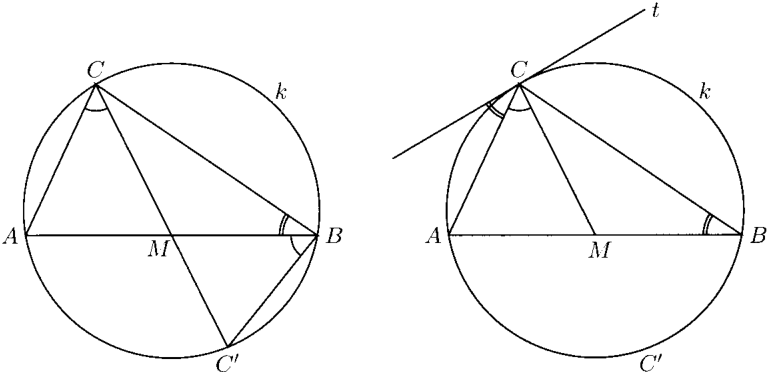
Let be the circumcircle of the given triangle . Its median can be extended to the chord of the circle (Fig. 2). Since the inscribed angles and (or ) are congruent, the considered sum of angles and is equal to the angle . By Thales' theorem the last angle is right if and only if the chord is a diameter of the circle . This happens if and only if the centre of lies on the ray . For such a situation, we distinguish two cases: and . Note that holds if and only if the angle is right (by Thales' theorem again). Thus let us analyse the second case : The three distinct points and are obviously collinear if and only if the line , a perpendicular bisector of a segment , passes through the point . However, the last condition is equivalent to the desired equality . This completes the proof (common for the both composing implications).
Fig. 2
Remark. Instead of the chord of the circumcircle , it is possible to consider the tangent line to the circle at its point (Fig. 3). Since the inscribed angle is always congruent to the marked angle between and , the sum of the angles and equals if and only if the tangent is perpendicular to the ray . The last is equivalent to the condition from the above solution, namely that the ray passes through the centre of .
Applying Law of Sines to and , we get Comparing the two ratios of sines and using the formula , we obtain an equality or . Since the angles and are acute, both and are between and . Thus by a well known sine property, the equality means that either or . In the first case (when ), the interior angle of at the vertices and are equal, in the second case (when ) the interior angle at the vertex is right. This completes the proof of one of the two implications stated in the problem.
Fig. 1
To prove the second (converse) implication, let us assume that (i) or (ii) .
Case (i). It follows from that the triangles and are congruent (by SSS theorem), with right interior angles at the vertex . Consequently,
Applying Law of Sines to and , we get The converse implication is proven.
---
Alternative solution.
Let be the circumcircle of the given triangle . Its median can be extended to the chord of the circle (Fig. 2). Since the inscribed angles and (or ) are congruent, the considered sum of angles and is equal to the angle . By Thales' theorem the last angle is right if and only if the chord is a diameter of the circle . This happens if and only if the centre of lies on the ray . For such a situation, we distinguish two cases: and . Note that holds if and only if the angle is right (by Thales' theorem again). Thus let us analyse the second case : The three distinct points and are obviously collinear if and only if the line , a perpendicular bisector of a segment , passes through the point . However, the last condition is equivalent to the desired equality . This completes the proof (common for the both composing implications).
Fig. 2
Remark. Instead of the chord of the circumcircle , it is possible to consider the tangent line to the circle at its point (Fig. 3). Since the inscribed angle is always congruent to the marked angle between and , the sum of the angles and equals if and only if the tangent is perpendicular to the ray . The last is equivalent to the condition from the above solution, namely that the ray passes through the centre of .
Techniques
Triangle trigonometryTriangle centers: centroid, incenter, circumcenter, orthocenter, Euler line, nine-point circleCyclic quadrilateralsTangentsAngle chasing