Browse · MathNet
PrintChina Mathematical Olympiad
China geometry
Problem
Two circles and of different radii intersect at two points and , let and be two points on and , respectively, such that is the midpoint of the segment . The extension of meets at another point , the extension of meets at another point . Let and be the perpendicular bisectors of and , respectively.
(1) Show that and have a unique common point (denoted by ).
(2) Prove that the lengths of , and are the side lengths of a right triangle.
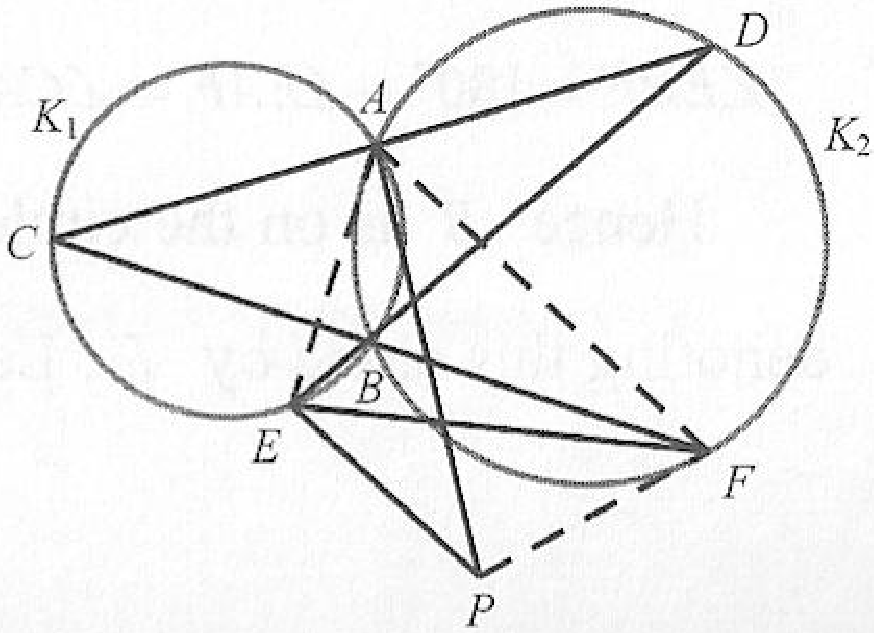
(1) Show that and have a unique common point (denoted by ).
(2) Prove that the lengths of , and are the side lengths of a right triangle.
Solution
(1) Since , , , are concyclic, and , , , are concyclic, , and by the theorem of power of a point, we have Suppose on the contrary that and do not intersect, then , hence . Plugging into (1), we get , thus , hence . It follows that and are the diameters of and respectively, hence and have same radii, which contradicts with assumption. Thus and have a unique common point.
(2) Join , and , we have Since , is the bisector of . Since is on the perpendicular bisector of the segment , is on the circumcircle of . We have Hence is on the circle with center and radius , denoting this circle by . Let be the radius of . By the
theorem of power of a point, we have thus It follows that , , form the side lengths of a right triangle.
(2) Join , and , we have Since , is the bisector of . Since is on the perpendicular bisector of the segment , is on the circumcircle of . We have Hence is on the circle with center and radius , denoting this circle by . Let be the radius of . By the
theorem of power of a point, we have thus It follows that , , form the side lengths of a right triangle.
Techniques
Radical axis theoremCyclic quadrilateralsAngle chasingDistance chasing