Browse · MathNet
PrintInternational Mathematical Olympiad
geometry
Problem
A convex quadrilateral has an inscribed circle with center . Let , , , and be the incenters of the triangles , , , and , respectively. Suppose that the common external tangents of the circles and meet at , and the common external tangents of the circles and meet at . Prove that .
Solution
Denote by , , and the circles , , , and , let their centers be , , and , and let their radii be , , and , respectively.
Claim 1. and .
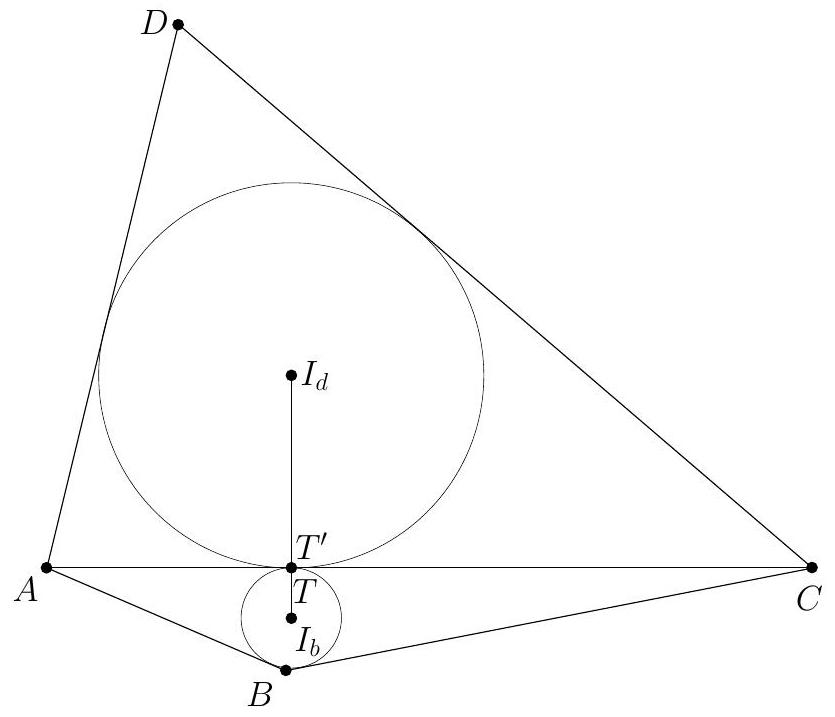
Proof. Let the incircles of triangles and be tangent to the line at and , respectively. (See the figure to the left.) We have in triangle , in triangle , and in quadrilateral , so This shows . As an immediate consequence, .
The second statement can be shown analogously.
Claim 2. The points , , and lie on the lines , , and , respectively.
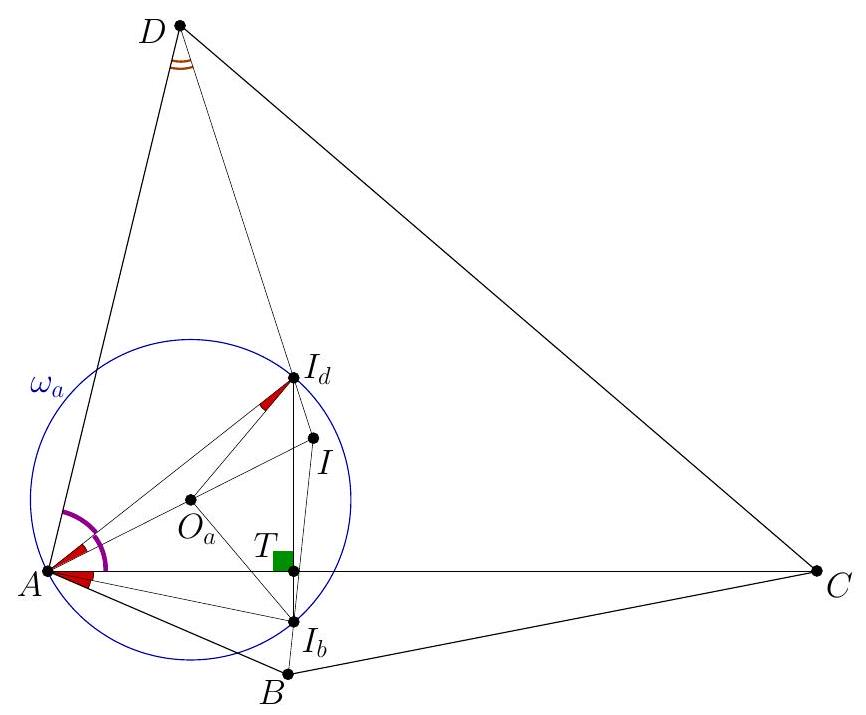
Proof. By symmetry it suffices to prove the claim for . (See the figure to the right above.)
Notice first that the incircles of triangles and can be obtained from the incircle of the quadrilateral with homothety centers and , respectively, and homothety factors less than , therefore the points and lie on the line segments and , respectively.
As is well-known, in every triangle the altitude and the diameter of the circumcircle starting from the same vertex are symmetric about the angle bisector. By Claim 1, in triangle , the segment is the altitude starting from . Since the foot lies inside the segment , the circumcenter of triangle lies in the angle domain in such a way that . The points and are the incenters of triangles and , so the lines and bisect the angles and , respectively. Then so lies on the angle bisector of , that is, on line .
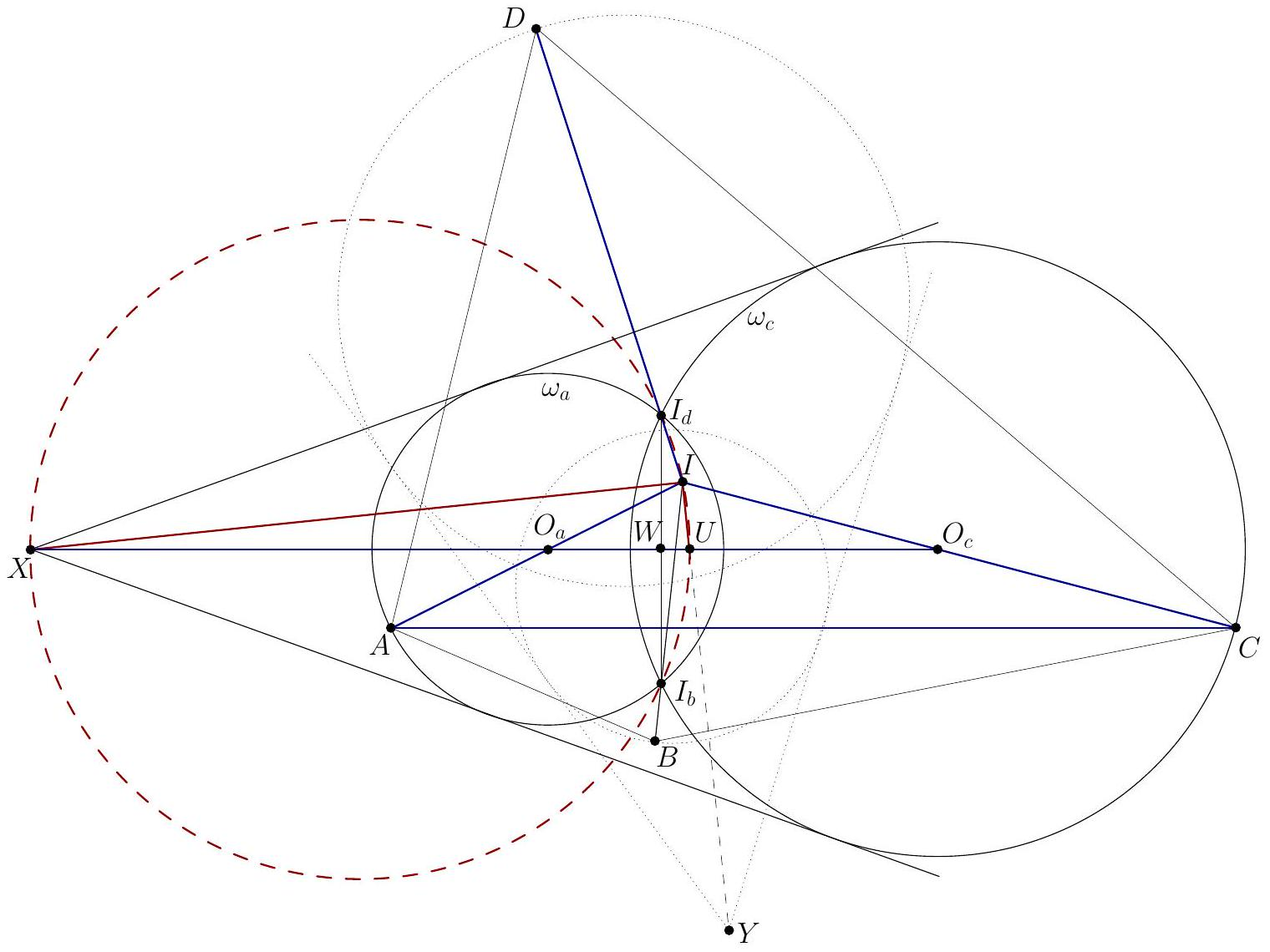
The point is the external similitude center of and ; let be their internal similitude center. The points and lie on the perpendicular bisector of the common chord of and , and the two similitude centers and lie on the same line; by Claim 2, that line is parallel to .
From the similarity of the circles and , from and , and from we can see that So the points lie on the Apollonius circle of the points with ratio . In this Apollonius circle is a diameter, and the lines and are respectively the internal and external bisectors of , according to the angle bisector theorem. Moreover, in the Apollonius circle the diameter is the perpendicular bisector of , so the lines and are the internal and external bisectors of , respectively.
Repeating the same argument for the points instead of , we get that the line is the internal bisector of and the external bisector of . Therefore, the lines and respectively are the internal and external bisectors of , so they are perpendicular.
Claim 1. and .
Proof. Let the incircles of triangles and be tangent to the line at and , respectively. (See the figure to the left.) We have in triangle , in triangle , and in quadrilateral , so This shows . As an immediate consequence, .
The second statement can be shown analogously.
Claim 2. The points , , and lie on the lines , , and , respectively.
Proof. By symmetry it suffices to prove the claim for . (See the figure to the right above.)
Notice first that the incircles of triangles and can be obtained from the incircle of the quadrilateral with homothety centers and , respectively, and homothety factors less than , therefore the points and lie on the line segments and , respectively.
As is well-known, in every triangle the altitude and the diameter of the circumcircle starting from the same vertex are symmetric about the angle bisector. By Claim 1, in triangle , the segment is the altitude starting from . Since the foot lies inside the segment , the circumcenter of triangle lies in the angle domain in such a way that . The points and are the incenters of triangles and , so the lines and bisect the angles and , respectively. Then so lies on the angle bisector of , that is, on line .
The point is the external similitude center of and ; let be their internal similitude center. The points and lie on the perpendicular bisector of the common chord of and , and the two similitude centers and lie on the same line; by Claim 2, that line is parallel to .
From the similarity of the circles and , from and , and from we can see that So the points lie on the Apollonius circle of the points with ratio . In this Apollonius circle is a diameter, and the lines and are respectively the internal and external bisectors of , according to the angle bisector theorem. Moreover, in the Apollonius circle the diameter is the perpendicular bisector of , so the lines and are the internal and external bisectors of , respectively.
Repeating the same argument for the points instead of , we get that the line is the internal bisector of and the external bisector of . Therefore, the lines and respectively are the internal and external bisectors of , so they are perpendicular.
Techniques
Circle of ApolloniusTangentsCoaxal circlesHomothetyAngle chasingTriangle centers: centroid, incenter, circumcenter, orthocenter, Euler line, nine-point circle