Browse · MATH
Printjmc
geometry senior
Problem
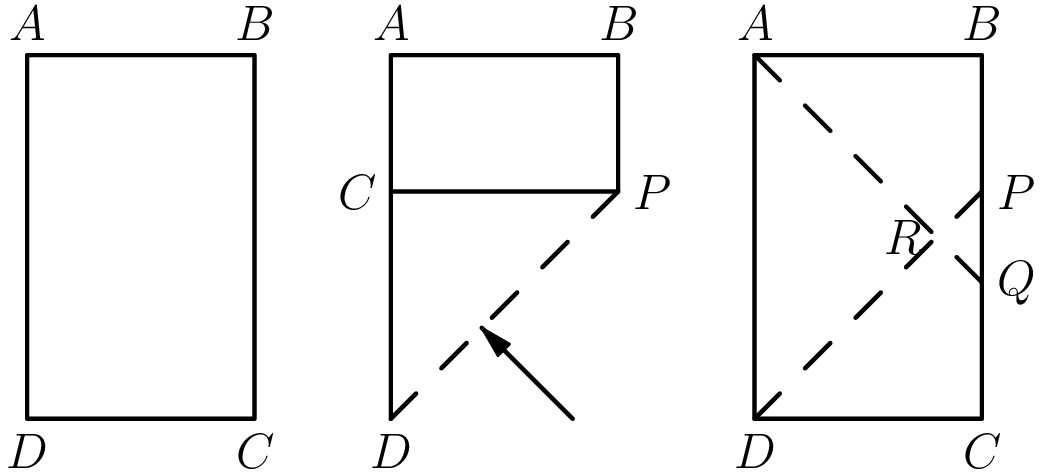
A rectangular piece of paper is folded so that edge lies along edge making a crease It is unfolded, and then folded again so that edge lies along edge making a second crease The two creases meet at forming triangles and . If and what is the area of quadrilateral in
Solution
To find the area of quadrilateral we subtract the area of from the area of
First, we calculate the area of We know that and that When the paper is first folded, is parallel to and lies across the entire width of the paper, so Therefore, the area of is Next, we calculate the area of We know that has and is isosceles with Thus, Similarly, has and Therefore, since and we have Similarly, Since we get Also, and
Using four of these triangles, we can create a square of side length (thus area ).
The area of one of these triangles (for example, ) is of the area of the square, or So the area of quadrilateral is therefore
First, we calculate the area of We know that and that When the paper is first folded, is parallel to and lies across the entire width of the paper, so Therefore, the area of is Next, we calculate the area of We know that has and is isosceles with Thus, Similarly, has and Therefore, since and we have Similarly, Since we get Also, and
Using four of these triangles, we can create a square of side length (thus area ).
The area of one of these triangles (for example, ) is of the area of the square, or So the area of quadrilateral is therefore
Final answer
11.5