Browse · MathNet
PrintVMO
Vietnam geometry
Problem
Let be an acute triangle with fixed points and point moves on the big arc of such that . Incircle of triangle touches at . Let be the -excenter of triangle . cuts at and lies on such that is parallel to .
a) cuts at . Prove that .
b) Let be the point the circumcircle of triangle such that is parallel to . The line cuts again at . Prove that the midpoint of lies on a fixed circle.
a) cuts at . Prove that .
b) Let be the point the circumcircle of triangle such that is parallel to . The line cuts again at . Prove that the midpoint of lies on a fixed circle.
Solution
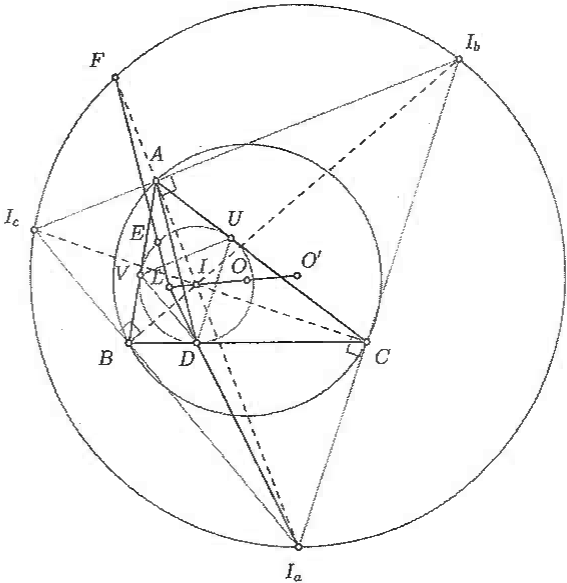
a) Let touch , at ; be the excenters of vertices in triangle . Clearly, , and are three altitudes of triangle . On the other hand, notice that , , so two triangles and have corresponding parallel sides. So there exists a homothety that turns into , into and into .
Through , becomes which is the circumcenter of triangle . However, in triangle , is the orthocenter and is the Euler circle, so belongs to , which implies the center of belongs to . On the other hand, notice that the center of also lies on ; and intersect at so we infer that is the center of .
We have are collinear and so is the image of via the above homothety, so it lies on . Furthermore, notice that triangle has as the orthocenter and as the altitude, so we infer that and are symmetric through , hence, .
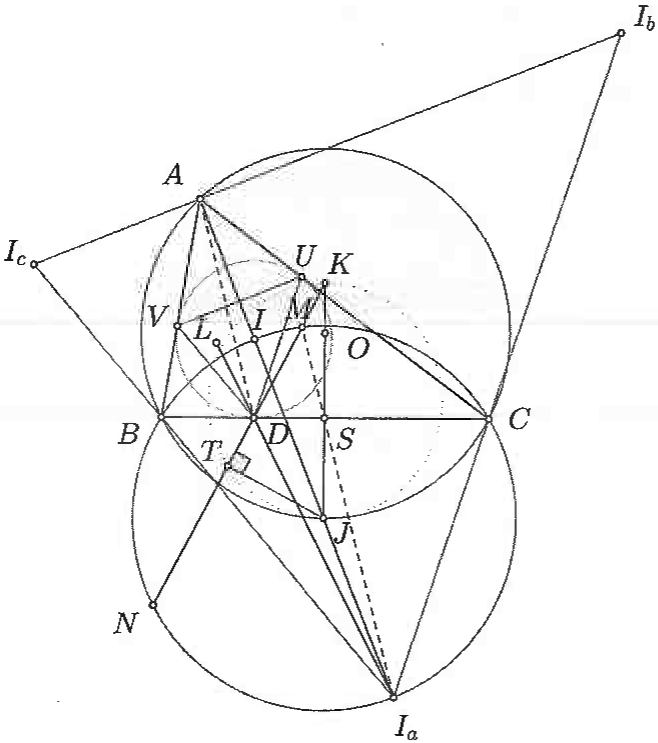
b) It is easy to see that is the midpoint of the minor arc of , which is a fixed point. Let be the intersection of with the perpendicular bisector of , we will prove that is a fixed point, it follows that always moves on a circle of diameter , which is a fixed circle. Let be the midpoint of , then because and are anti-parallel, then is the symmedian of triangle . Since the tangents at and of intersect at , is the symmedian of the triangle . Moreover, the homothety turns triangle into triangle so we infer that the image of through this homothety is . So , infer that and are collinear.
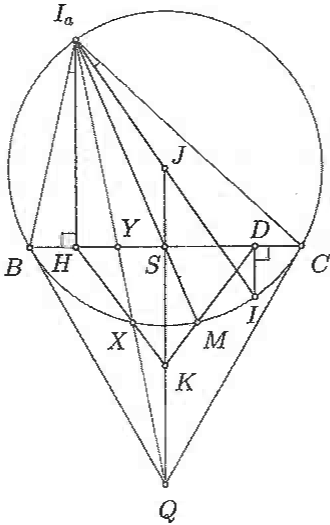
The tangent lines at and of intersect at , we will prove that is fixed by showing that is the midpoint of .
Let be the projection of on . We have and are isogonal with respect to angle , so it is easy to see , i.e. and are symmetric with respect to . Let meet again at and meet at . We have is the symmedian of triangle , so and are symmetric through , which implies passes through .
On the other hand, we have so . Since is parallel to then is the midpoint of .
Through , becomes which is the circumcenter of triangle . However, in triangle , is the orthocenter and is the Euler circle, so belongs to , which implies the center of belongs to . On the other hand, notice that the center of also lies on ; and intersect at so we infer that is the center of .
We have are collinear and so is the image of via the above homothety, so it lies on . Furthermore, notice that triangle has as the orthocenter and as the altitude, so we infer that and are symmetric through , hence, .
b) It is easy to see that is the midpoint of the minor arc of , which is a fixed point. Let be the intersection of with the perpendicular bisector of , we will prove that is a fixed point, it follows that always moves on a circle of diameter , which is a fixed circle. Let be the midpoint of , then because and are anti-parallel, then is the symmedian of triangle . Since the tangents at and of intersect at , is the symmedian of the triangle . Moreover, the homothety turns triangle into triangle so we infer that the image of through this homothety is . So , infer that and are collinear.
The tangent lines at and of intersect at , we will prove that is fixed by showing that is the midpoint of .
Let be the projection of on . We have and are isogonal with respect to angle , so it is easy to see , i.e. and are symmetric with respect to . Let meet again at and meet at . We have is the symmedian of triangle , so and are symmetric through , which implies passes through .
On the other hand, we have so . Since is parallel to then is the midpoint of .
Techniques
Triangle centers: centroid, incenter, circumcenter, orthocenter, Euler line, nine-point circleHomothetyBrocard point, symmediansIsogonal/isotomic conjugates, barycentric coordinatesTangentsAngle chasingConstructions and loci