Browse · MathNet
PrintIRL_ABooklet_2023
Ireland 2023 number theory
Problem
For , a special n-triangle is a triangle with distinct numbers on each side such that the sum of the numbers on a side is the same for all sides. For instance, because , the following is a special 3-triangle: Note that a special -triangle contains numbers. An infinite set of positive integers is a special set if, for each , the smallest numbers of can be used to form a special -triangle. Show that the set of positive integers that are not multiples of 2023 is a special set.
Solution
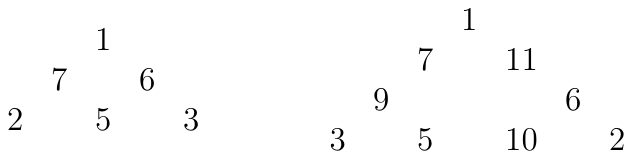
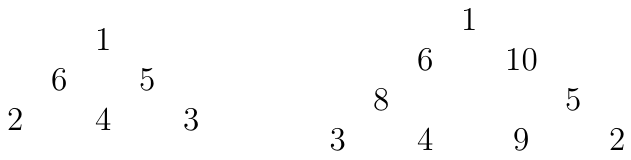
For each , let denote the set of all positive integers that are not multiples of , and let be the elements of in increasing order. The set consists of blocks of consecutive integers followed by a skipped integer. If the length of each of these blocks is a multiple of 3 and so can only be the last element of a block if is divisible by 3. In other words: For each that satisfies , we will show that is a special set. Since , the desired result follows. We now fix satisfying . For simplicity, from now on we suppress the index in . We will use induction to show that for each , the numbers can be used to form a special -triangle. The base case consists in showing that there are special 3- and 4-triangles.
When , for , and it is easily checked that these triangles are special. For the above turns into and when we get and these are indeed special triangles. For the inductive step, we show how to obtain a special -triangle for from a special -triangle for . Any special -triangle contains the numbers . We group the next six numbers of into two sets, and . By virtue of statement (1), both sets consist of three consecutive integers. Hence, It is now clear that we obtain a special -triangle when we add and to one side, and to another, and and to the final side in any given special -triangle.
When , for , and it is easily checked that these triangles are special. For the above turns into and when we get and these are indeed special triangles. For the inductive step, we show how to obtain a special -triangle for from a special -triangle for . Any special -triangle contains the numbers . We group the next six numbers of into two sets, and . By virtue of statement (1), both sets consist of three consecutive integers. Hence, It is now clear that we obtain a special -triangle when we add and to one side, and to another, and and to the final side in any given special -triangle.
Techniques
Divisibility / FactorizationModular ArithmeticInduction / smoothing