Browse · MathNet
PrintChina Mathematical Competition
China algebra
Problem
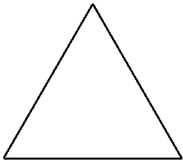
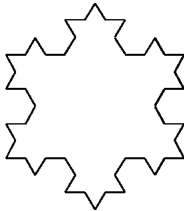
As shown in the diagram, there is a sequence of the curves . It is known that the region enclosed by has area and is an equilateral triangle. We obtain from by operating as follows: Trisecting every side of , then we construct an equilateral triangle outwardly on every side of sitting on the middle segment of the side and finally remove this middle segment (). Write as the area of the region enclosed by .
(1) Find a formula for the general term of the sequence of numbers ; (2) Find .

 ...
...
(1) Find a formula for the general term of the sequence of numbers ; (2) Find .
Solution
(1) We perform the operation on . It is easy to see that each side of becomes sides of . So the number of sides of is . In the same way, we operate on . Each side of becomes sides of . So the number of sides of is . Consequently, it is not difficult to get that the number of sides of is .
It is known that the area of is . Comparing with , it is easy to see that we add to a smaller equilateral triangle with area on each side of . Since has sides, so Again, comparing with , we see that has an additional smaller equilateral triangle with area on each side of , and has sides. So that Similarly, we have Hence, we have
We will prove by mathematical induction as follows: When , it is known that holds from above. Suppose, when , we have . When , it is easy to see that, after times of operations, by comparing with , we have added to a smaller equilateral triangle with area on each side of and has sides. So we get By mathematical induction, is proved.
(2) From (1), we have . Therefore,
It is known that the area of is . Comparing with , it is easy to see that we add to a smaller equilateral triangle with area on each side of . Since has sides, so Again, comparing with , we see that has an additional smaller equilateral triangle with area on each side of , and has sides. So that Similarly, we have Hence, we have
We will prove by mathematical induction as follows: When , it is known that holds from above. Suppose, when , we have . When , it is easy to see that, after times of operations, by comparing with , we have added to a smaller equilateral triangle with area on each side of and has sides. So we get By mathematical induction, is proved.
(2) From (1), we have . Therefore,
Final answer
S_n = 8/5 − (3/5)(4/9)^n; lim_{n→∞} S_n = 8/5
Techniques
Sums and productsInduction / smoothingConstructions and loci