Browse · harp
Printsmc
counting and probability senior
Problem
Each square in a grid is either filled or empty, and has up to eight adjacent neighboring squares, where neighboring squares share either a side or a corner. The grid is transformed by the following rules: Any filled square with two or three filled neighbors remains filled. Any empty square with exactly three filled neighbors becomes a filled square. * All other squares remain empty or become empty. A sample transformation is shown in the figure below. 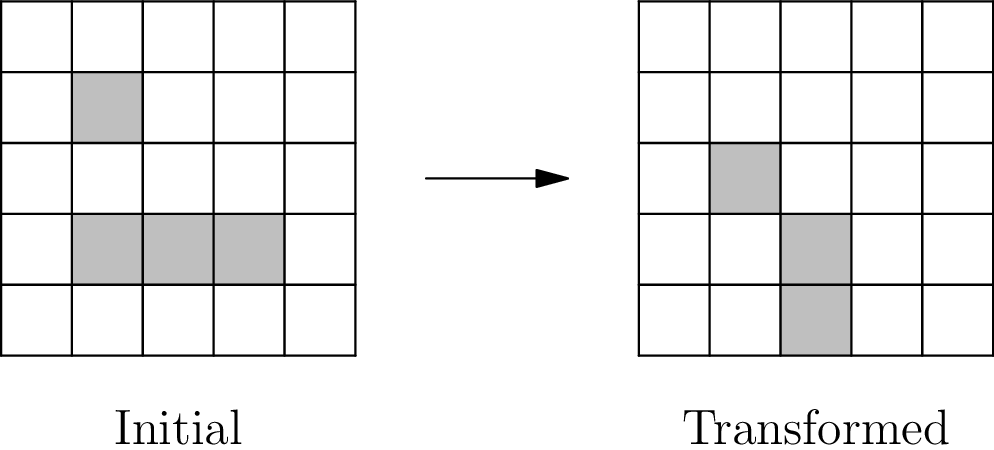 Suppose the grid has a border of empty squares surrounding a subgrid. How many initial configurations will lead to a transformed grid consisting of a single filled square in the center after a single transformation? (Rotations and reflections of the same configuration are considered different.)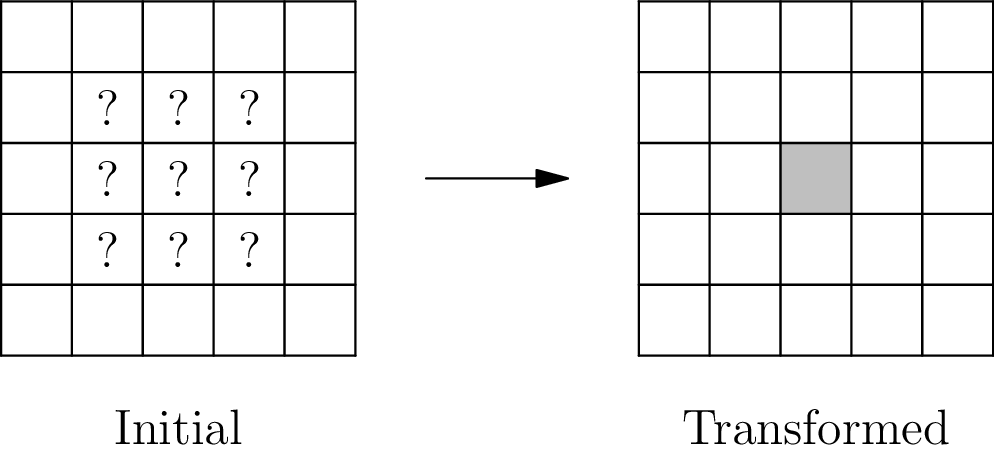
(A)
(B)
(C)
(D)
Solution
There are two cases for the initial configuration: 1. The center square is filled. Exactly two of the eight adjacent neighboring squares of the center are filled. Clearly, the only possibility is that the squares along one diagonal are filled, as shown below: In this case, there are possible initial configurations. All rotations and reflections are considered. 4. The center square is empty. Exactly three of the eight adjacent neighboring squares of the center are filled. The possibilities are shown below: In this case, there are possible initial configurations. All rotations and reflections are considered. Together, the answer is
Final answer
C