Browse · MathNet
PrintProblems from Ukrainian Authors
Ukraine geometry
Problem
In a triangle with an angle , the Euler line intersects the circumcircle of the triangle at the points and . is the height and is the nine-point circle. The circumcircle of triangle intersects the for the second time at the point . is a point such that – diameter of . Prove that is the symmedian of .
An Euler line is a line through the orthocenter, the center of the circumcenter, and the point where the medians of the triangle intersect. The nine-point circle is the circle on which the bases of the heights, the midpoints of the sides, and the midpoints of the segments between the vertices and the orthocenter lie. The symmedian of a triangle from a vertex is a line symmetric to the median from the vertex about the bisector from the vertex.
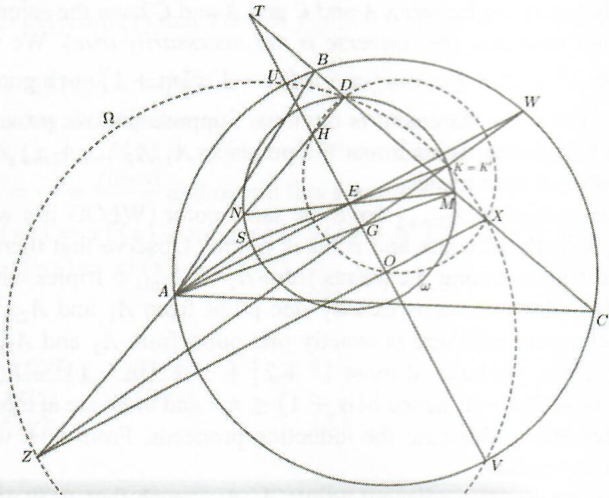 Fig. 23
An Euler line is a line through the orthocenter, the center of the circumcenter, and the point where the medians of the triangle intersect. The nine-point circle is the circle on which the bases of the heights, the midpoints of the sides, and the midpoints of the segments between the vertices and the orthocenter lie. The symmedian of a triangle from a vertex is a line symmetric to the median from the vertex about the bisector from the vertex.
Solution
Let and be the orthocentre and the centre of the circumcircle of respectively, and be the centre of . Then, as you know be the centre of . Let be the midpoint of . Let the circle intersect for the second time at point . Since , then , so points and are on the same circle (fig. 23). Let be the point of intersection of the lines and , then, according to the degree of the point, . Thus, the points lie on the same circle, and since , then , whence . And remembering that , we get that bisects chord of the circle , from where passes through the centre of the circle , and hence passes through the point diametrically opposite to the point on the circle . However , hence is the point diametrically opposite to on the circle . So passes through . In the right , , so
. Thus, the condition implies that , and therefore , with being the bisector , and hence is also the bisector of . The condition implies that the radius of the circle is . Since the condition implies that is the midpoint of the segment . Denote by the point that is symmetric to with respect to . Then is also symmetric to with respect to , since , so and , whence is the midpoint of the smaller arc of the circumcircle , and therefore lies on . Moreover, since and , then is the midpoint of the segment . In the trapezoid , and are the midpoints of the bases and , so, by a well-known fact, the point of intersection of its diagonals lies on , but is the centroid of , so lies on . Let us prove the collinearity of the points and , which implies that and lie on the same line. To do this, let be the projection of point onto . Moreover, since , and , is the midpoint of the segment . In the trapezoid , and are the midpoints of the bases and , so, by a well-known fact, the point of intersection of its diagonals lies on , but is the centroid of , so lies on . Let us prove the collinearity of the points and , which implies that and lie on the same line. To do this, let be the projection of point onto . Then, since, , the points to are cyclic, and therefore lies on the circle . However lies on , so to prove the collinearity of the points and , it is enough to show that lies on the circle , which implies that is the second intersection of the circles and , i.e. , and therefore like will lie on the line . We have that, , so the points and lie on the same circle, and hence (this equality is obtained from the axial symmetry of points and with respect to line ). However, the two lines and are perpendicular to , so they are parallel, so , i.e. . Since the points and are cyclic, then . Therefore
Let be the midpoint of , then, as we know, lies on , and is right, so is the diameter of the circle , so the points and are collinear. Moreover, since and , then is a parallelogram, hence , and therefore . Thus, as we proved above, , and hence , so the point lies on the circumcircle – , which proves the collinearity of points and . In particular points and lie on the same line. Let be a point symmetric to with respect to . Then, since and are also symmetric with respect to , then is an isosceles trapezoid, so the point of intersection of its diagonals lies on . However , so lies on , which passes through . So is the second intersection of and the circle . Then , and from the isosceles trapezoid , , so , from which points and lie on the same circle, but , from which is the bisector of , that is is the symmedian , which was the proof.
. Thus, the condition implies that , and therefore , with being the bisector , and hence is also the bisector of . The condition implies that the radius of the circle is . Since the condition implies that is the midpoint of the segment . Denote by the point that is symmetric to with respect to . Then is also symmetric to with respect to , since , so and , whence is the midpoint of the smaller arc of the circumcircle , and therefore lies on . Moreover, since and , then is the midpoint of the segment . In the trapezoid , and are the midpoints of the bases and , so, by a well-known fact, the point of intersection of its diagonals lies on , but is the centroid of , so lies on . Let us prove the collinearity of the points and , which implies that and lie on the same line. To do this, let be the projection of point onto . Moreover, since , and , is the midpoint of the segment . In the trapezoid , and are the midpoints of the bases and , so, by a well-known fact, the point of intersection of its diagonals lies on , but is the centroid of , so lies on . Let us prove the collinearity of the points and , which implies that and lie on the same line. To do this, let be the projection of point onto . Then, since, , the points to are cyclic, and therefore lies on the circle . However lies on , so to prove the collinearity of the points and , it is enough to show that lies on the circle , which implies that is the second intersection of the circles and , i.e. , and therefore like will lie on the line . We have that, , so the points and lie on the same circle, and hence (this equality is obtained from the axial symmetry of points and with respect to line ). However, the two lines and are perpendicular to , so they are parallel, so , i.e. . Since the points and are cyclic, then . Therefore
Let be the midpoint of , then, as we know, lies on , and is right, so is the diameter of the circle , so the points and are collinear. Moreover, since and , then is a parallelogram, hence , and therefore . Thus, as we proved above, , and hence , so the point lies on the circumcircle – , which proves the collinearity of points and . In particular points and lie on the same line. Let be a point symmetric to with respect to . Then, since and are also symmetric with respect to , then is an isosceles trapezoid, so the point of intersection of its diagonals lies on . However , so lies on , which passes through . So is the second intersection of and the circle . Then , and from the isosceles trapezoid , , so , from which points and lie on the same circle, but , from which is the bisector of , that is is the symmedian , which was the proof.
Techniques
Triangle centers: centroid, incenter, circumcenter, orthocenter, Euler line, nine-point circleBrocard point, symmediansCyclic quadrilateralsRadical axis theoremAngle chasing