Browse · MathNet
Print49th Mathematical Olympiad in Ukraine
Ukraine counting and probability
Problem
A country has a road network with the following properties: along each road we can go in both directions; between two different towns may exist at most one road; there does not exist a road which connects some town with itself; the road network is a connected graph; there are at least roads out of any town . The king of this country wants to go round all the towns, but it turned out that it is impossible. What is the minimum number of towns the country can have?
Solution
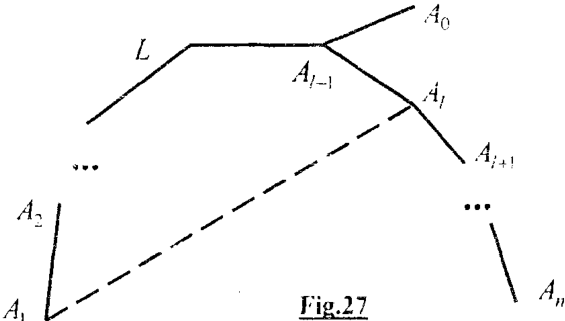
Consider a road network of this country as a graph. Denote the chain of maximum length by in this graph. Denote by sequence of connected vertices .
Fig.27
That is, all other chains have the same or less length as . Obviously, there is at least one outside vertex, for instance, some , that is outside chain . Besides, as the graph is connected, we can obtain a chain which connects with one of the vertices of chain . Define the properties of the chain obtained. Call the vertex of chain an inside one, if there are no edges outside chain .
1) Vertices and are not connected with each other, otherwise there will be a chain longer than chain . Really, if there is an edge in the graph, and the vertex is connected with some vertex , , then there exists the following chain which is longer than chain , a contradiction.
2) Vertices and are inside ones, that is, vertex is connected with and with other vertices where . Then .
3) Vertices with numbers are also inside ones. Really, let there be an edge , if isn't an inside vertex, then there is an edge in the graph and vertex isn't inside. Then it is possible to build a chain which is longer than chain : . Therefore, in this chain there are at least inside vertices.
4) As there is an outside vertex which is also connected with vertices, that are not included in inside vertices mentioned above, totally there must be at least vertices.
Show that there is a corresponding graph with such number of vertices. Consider two groups of vertices and . The graph is built in such a way that each vertex , is connected with each vertex , , that is, the degree of each vertex equals , and the degree of each vertex equals . If there is a chain which includes all the vertices, then there must be a vertex after each vertex and vice versa, because vertices with the same letter are not connected with each other. But there are vertices , so we must have at least vertices , and there are less. The example given concludes our proof.
---
Alternative solution.
Show another proof of the existence of the chain which includes all towns if . Let be the vertices of our graph. We add one more vertex to the graph and connect vertex with all vertices . The new graph satisfies the condition that it has vertices less than and the degree of each vertex more than . According to the theorem about a Hamiltonian circuit, in the new graph there exists a Hamiltonian circuit. Therefore, we can represent its circuit as the cycle . Among vertices , , we have not added vertex . Then the chain is a circuit which goes round all the towns.
The example we can take from the first solution.
Fig.27
That is, all other chains have the same or less length as . Obviously, there is at least one outside vertex, for instance, some , that is outside chain . Besides, as the graph is connected, we can obtain a chain which connects with one of the vertices of chain . Define the properties of the chain obtained. Call the vertex of chain an inside one, if there are no edges outside chain .
1) Vertices and are not connected with each other, otherwise there will be a chain longer than chain . Really, if there is an edge in the graph, and the vertex is connected with some vertex , , then there exists the following chain which is longer than chain , a contradiction.
2) Vertices and are inside ones, that is, vertex is connected with and with other vertices where . Then .
3) Vertices with numbers are also inside ones. Really, let there be an edge , if isn't an inside vertex, then there is an edge in the graph and vertex isn't inside. Then it is possible to build a chain which is longer than chain : . Therefore, in this chain there are at least inside vertices.
4) As there is an outside vertex which is also connected with vertices, that are not included in inside vertices mentioned above, totally there must be at least vertices.
Show that there is a corresponding graph with such number of vertices. Consider two groups of vertices and . The graph is built in such a way that each vertex , is connected with each vertex , , that is, the degree of each vertex equals , and the degree of each vertex equals . If there is a chain which includes all the vertices, then there must be a vertex after each vertex and vice versa, because vertices with the same letter are not connected with each other. But there are vertices , so we must have at least vertices , and there are less. The example given concludes our proof.
---
Alternative solution.
Show another proof of the existence of the chain which includes all towns if . Let be the vertices of our graph. We add one more vertex to the graph and connect vertex with all vertices . The new graph satisfies the condition that it has vertices less than and the degree of each vertex more than . According to the theorem about a Hamiltonian circuit, in the new graph there exists a Hamiltonian circuit. Therefore, we can represent its circuit as the cycle . Among vertices , , we have not added vertex . Then the chain is a circuit which goes round all the towns.
The example we can take from the first solution.
Final answer
2m+2
Techniques
Graph Theory