Browse · MathNet
PrintUSA IMO
United States geometry
Problem
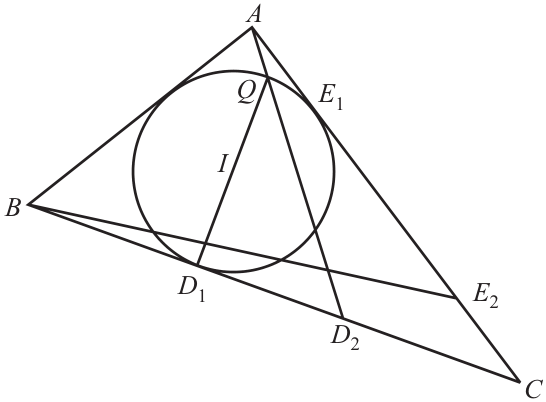
Let be a triangle and let be its incircle. Denote by and the points where is tangent to sides and , respectively. Denote by and the points on sides and , respectively, such that and , and denote by the point of intersection of segments and . Circle intersects segment at two points, the closer of which to the vertex is denoted by . Prove that .
Solution
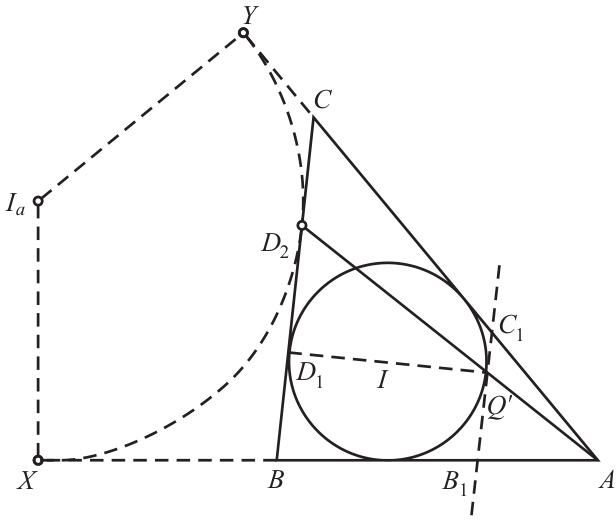
First Solution. The key observation is the following Lemma. Lemma. Segment is a diameter of circle . Proof. Let be the center of circle , that is, is the incenter of triangle . Extend segment through to intersect circle again at , and extend segment through to intersect segment at . We show that , which in turn implies that , that is, is a diameter of . Let be the line tangent to circle at , and let intersect segments and at and , respectively. Then is an excircle of triangle . Let denote the dilation with center and ratio . Since and , . Hence, . Thus, , , and . It also follows that the excircle of triangle opposite vertex is tangent to side at .
It is well known that We compute . Let and denote the points of tangency of circle with rays and , respectively. Then by equal tangents, , , and . Hence, It follows that Combining (1) and (2) yields . Thus, that is, , as desired. ■
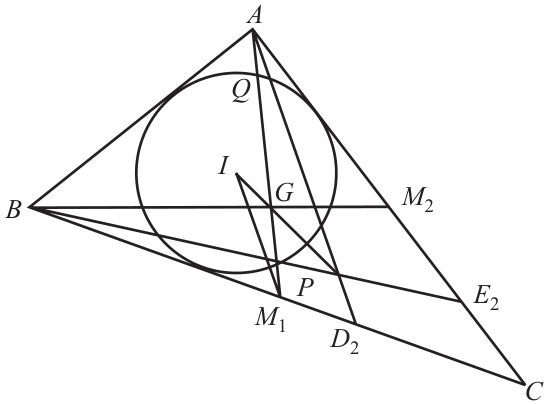
Now we prove our main result. Let and be the midpoints of segments and , respectively. Then is also the midpoint of segment , from which it follows that is a midline of triangle . Hence, and . Similarly, we can prove that . Let be the centroid of triangle . Thus, segments and intersect at . Define transformation as the dilation with center and ratio . Then and . Under the dilation, parallel lines go to parallel lines and the intersection of two lines goes to the intersection of their images. Since and , maps lines and to lines and , respectively. It also follows that and that or Combining (3) and (4) yields as desired.
Second Solution. From the Lemma, we have where and are the radii of circles and , respectively. Note that and that where is the center of and is the area of region . Thus, Applying Menelaus's Theorem to triangle and line gives or Hence, or The desired result now follows from (5) and (6).
It is well known that We compute . Let and denote the points of tangency of circle with rays and , respectively. Then by equal tangents, , , and . Hence, It follows that Combining (1) and (2) yields . Thus, that is, , as desired. ■
Now we prove our main result. Let and be the midpoints of segments and , respectively. Then is also the midpoint of segment , from which it follows that is a midline of triangle . Hence, and . Similarly, we can prove that . Let be the centroid of triangle . Thus, segments and intersect at . Define transformation as the dilation with center and ratio . Then and . Under the dilation, parallel lines go to parallel lines and the intersection of two lines goes to the intersection of their images. Since and , maps lines and to lines and , respectively. It also follows that and that or Combining (3) and (4) yields as desired.
Second Solution. From the Lemma, we have where and are the radii of circles and , respectively. Note that and that where is the center of and is the area of region . Thus, Applying Menelaus's Theorem to triangle and line gives or Hence, or The desired result now follows from (5) and (6).
Techniques
HomothetyTangentsMenelaus' theoremTriangle centers: centroid, incenter, circumcenter, orthocenter, Euler line, nine-point circle