Browse · MathNet
Print63rd Czech and Slovak Mathematical Olympiad
Czech Republic geometry
Problem
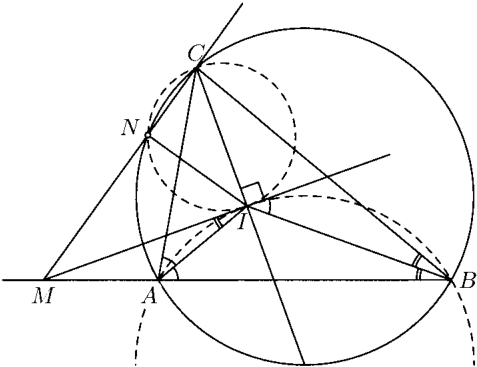
We are given a triangle with incentre . Suppose that there exists an intersection point of the line and the perpendicular to through . Prove that the circumcircle of the triangle intersects the segment in an interior point and that .
(Peter Novotny)
(Peter Novotny)
Solution
First we show in two different ways that the line , a perpendicular to through , is tangent to the circle . The first way is based on the known fact that and are obtuse angles of measures and , respectively (in common notation for interior angles of ). This fact implies that the line forms acute angles and with the segments and , respectively\textsuperscript{1}, hence the angles congruent with angles and in circle (Fig. 1). Well known properties of inscribed and subtended angles lead to the conclusion that the line is tangent to the circle . The second reason for this conclusion is based on the known fact that the centre of is the midpoint of the arc of circle which lies on the ray bisecting .
Fig. 1
From the proved tangency of to it follows that the point lies on the line outside of the segment . Moreover, the power of with respect to is positive and given by . Hence lies in the exterior of the circle (as is its chord) and the power of with respect to is the same . Since from the right-angled triangle , it holds that . This means that the circle intersects the segment in an interior point , because implies that for the second point of intersection of the ray with . This proves the first conclusion of the problem.
To show that is a right angle, we use the proved equality and apply a familiar theorem to the leg of the right-angled triangle : Its altitude from the vertex meets the hypotenuse in such a point which is determined by equation . Thus we have in our case and the solution is complete.
\textsuperscript{1} As a consequence we can see that the assumed existence of the intersection point is equivalent to the inequality or . Due to the symmetry we can assume that as in our figure; the point then lies on the ray opposite to ray and satisfies .
Fig. 1
From the proved tangency of to it follows that the point lies on the line outside of the segment . Moreover, the power of with respect to is positive and given by . Hence lies in the exterior of the circle (as is its chord) and the power of with respect to is the same . Since from the right-angled triangle , it holds that . This means that the circle intersects the segment in an interior point , because implies that for the second point of intersection of the ray with . This proves the first conclusion of the problem.
To show that is a right angle, we use the proved equality and apply a familiar theorem to the leg of the right-angled triangle : Its altitude from the vertex meets the hypotenuse in such a point which is determined by equation . Thus we have in our case and the solution is complete.
\textsuperscript{1} As a consequence we can see that the assumed existence of the intersection point is equivalent to the inequality or . Due to the symmetry we can assume that as in our figure; the point then lies on the ray opposite to ray and satisfies .
Techniques
Triangle centers: centroid, incenter, circumcenter, orthocenter, Euler line, nine-point circleTangentsAngle chasingDistance chasing