Browse · MathNet
PrintChina Mathematical Competition (Shaanxi)
China geometry
Problem
Suppose , , are three non-collinear points corresponding to complex numbers , , (, and being real numbers), respectively. Prove that the curve shares a single common point with the line bisecting and parallel to in , and find this point.
Solution
Let (), then Separating real and imaginary parts, we get
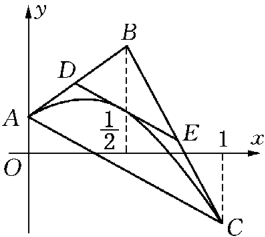
That is, () Since , , are non-collinear, . So Equation (1) is the segment of a parabola (see the diagram). Furthermore, the midpoints of and are and , respectively. So the equation of line is . (2) Solving Equations (1) and (2) simultaneously, we get . Then , since . So the parabola and line have one and only one common point . Notice that , so point is on the segment and satisfies Equation (1), as required.
---
Alternative solution.
We can solve the problem using the method of complex numbers directly. Let , be the midpoints of , , respectively. Then the complex numbers corresponding to , are , , respectively. So, complex number corresponding to a point on the segment satisfies
Substitute the above expression into the equation of the curve and separate the real and imaginary parts from both sides to give the following two equations, Eliminating from the equations, we get Then . Since , , are non-collinear, we know that . So . Then , that is, . Then we have , so . That means that the curve and the line have one and only one common point, and the complex number corresponding to this common point is
That is, () Since , , are non-collinear, . So Equation (1) is the segment of a parabola (see the diagram). Furthermore, the midpoints of and are and , respectively. So the equation of line is . (2) Solving Equations (1) and (2) simultaneously, we get . Then , since . So the parabola and line have one and only one common point . Notice that , so point is on the segment and satisfies Equation (1), as required.
---
Alternative solution.
We can solve the problem using the method of complex numbers directly. Let , be the midpoints of , , respectively. Then the complex numbers corresponding to , are , , respectively. So, complex number corresponding to a point on the segment satisfies
Substitute the above expression into the equation of the curve and separate the real and imaginary parts from both sides to give the following two equations, Eliminating from the equations, we get Then . Since , , are non-collinear, we know that . So . Then , that is, . Then we have , so . That means that the curve and the line have one and only one common point, and the complex number corresponding to this common point is
Final answer
1/2 + ((a+c+2b)/4)i
Techniques
Complex numbers in geometryCartesian coordinatesTriangles