Browse · MathNet
PrintIMO 2006 Shortlisted Problems
2006 geometry
Problem
Consider a convex polyhedron without parallel edges and without an edge parallel to any face other than the two faces adjacent to it. Call a pair of points of the polyhedron antipodal if there exist two parallel planes passing through these points and such that the polyhedron is contained between these planes. Let be the number of antipodal pairs of vertices, and let be the number of antipodal pairs of midpoints of edges. Determine the difference in terms of the numbers of vertices, edges and faces.
Solution
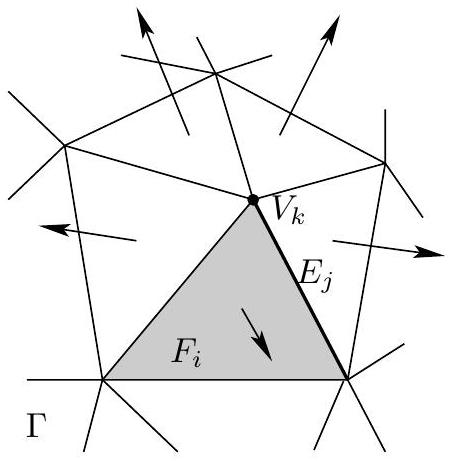
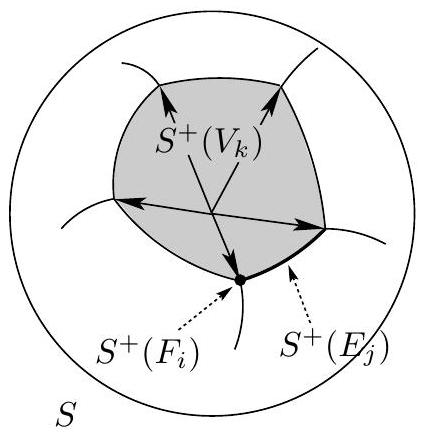
Denote the polyhedron by ; let its vertices, edges and faces be , and , respectively. Denote by the midpoint of edge . Let be the unit sphere, the set of all unit vectors in three-dimensional space. Map the boundary elements of to some objects on as follows. For a face , let and be the unit normal vectors of face , pointing outwards from and inwards to , respectively. These points are diametrically opposite. For an edge , with neighbouring faces and , take all support planes of (planes which have a common point with but do not intersect it) containing edge , and let be the set of their outward normal vectors. The set is an arc of a great circle on . is perpendicular to edge and it connects points and . Define also the set of inward normal vectors which is the reflection of across the origin. For a vertex , which is the common endpoint of edges and shared by faces , take all support planes of through point and let be the set of their outward normal vectors. This is a region on , a spherical polygon with vertices bounded by arcs . Let be the reflection of , the set of inward normal vectors. Note that region is convex in the sense that it is the intersection of several half spheres. Now translate the conditions on to the language of these objects.
a. Polyhedron has no parallel edges - the great circles of and are different for all .
b. If an edge does not belong to a face then they are not parallel - the great circle which contains arcs and does not pass through points and .
c. Polyhedron has no parallel faces - points and are pairwise distinct.
The regions , arcs and points provide a decomposition of the surface of the sphere. Regions , arcs and points provide the reflection of this decomposition. These decompositions are closely related to the problem.
Lemma 1. For any , regions and overlap if and only if vertices and are antipodal.
Lemma 2. For any and intersect if and only if the midpoints and of edges and are antipodal.
Proof of lemma 1. First note that by properties (a,b,c) above, the two regions cannot share only a single point or an arc. They are either disjoint or they overlap. Assume that the two regions have a common interior point . Let and be two parallel support planes of through points and , respectively, with normal vector . By the definition of regions and is the inward normal vector of and the outward normal vector of . Therefore polyhedron lies between the two planes; vertices and are antipodal. To prove the opposite direction, assume that and are antipodal. Then there exist two parallel support planes and through and , respectively, such that is between them. Let be the inward normal vector of ; then is the outward normal vector of , therefore . The two regions have a common point, so they overlap.
Proof of lemma 2. Again, by properties (a, b) above, the endpoints of cannot belong to and vice versa. The two arcs are either disjoint or intersecting. Assume that arcs and intersect at point . Let and be the two support planes through edges and , respectively, with normal vector . By the definition of and , vector points inwards from and outwards from . Therefore is between the planes. Since planes and pass through and , these points are antipodal. For the opposite direction, assume that points and are antipodal. Let and be two support planes through these points, respectively. An edge cannot intersect a support plane, therefore and lie in the planes and , respectively. Let be the inward normal vector of , which is also the outward normal vector of . Then . So the two arcs are not disjoint; they therefore intersect.
Now create a new decomposition of sphere . Draw all and on sphere and put a knot at each point where two arcs meet. We have knots at points and another knots at points , corresponding to the faces of ; by property (c) they are different. We also have some pairs where arcs and intersect. By Lemma 2, each antipodal pair ( ) gives rise to two such intersections; hence, the number of all intersections is and we have knots in all. Each intersection knot splits two arcs, increasing the number of arcs by 2. Since we started with arcs, corresponding the edges of , the number of the resulting curve segments is . The network of these curve segments divides the sphere into some "new" regions. Each new region is the intersection of some overlapping sets and . Due to the convexity, the intersection of two overlapping regions is convex and thus contiguous. By Lemma 1, each pair of overlapping regions corresponds to an antipodal vertex pair and each antipodal vertex pair gives rise to two different overlaps, which are symmetric with respect to the origin. So the number of new regions is . The result now follows from Euler's polyhedron theorem. We have and therefore Therefore is by one less than the number of vertices of .
---
Alternative solution.
Use the same notations for the polyhedron and its vertices, edges and faces as in Solution 1. We regard points as vectors starting from the origin. Polyhedron is regarded as a closed convex set, including its interior. In some cases the edges and faces of are also regarded as sets of points. The symbol denotes the boundary of the certain set; e.g. is the surface of . Let be the set of vectors between arbitrary points of . Then , being the sum of two bounded convex sets, is also a bounded convex set and, by construction, it is also centrally symmetric with respect to the origin. We will prove that is also a polyhedron and express the numbers of its faces, edges and vertices in terms and .
Lemma 1. For points , point is a boundary point of if and only if and are antipodal. Moreover, for each boundary point there exists exactly one pair of points such that .
Proof. Assume first that and are antipodal points of . Let parallel support planes and pass through them such that is in between. Consider plane . This plane separates the interiors of and . After reflecting one of the sets, e.g. , the sets and lie in the same half space bounded by . Then lies in that half space, so is a boundary point of the set . Translating by we obtain that is a boundary point of . To prove the opposite direction, let be a boundary point of , and let . We claim that . Clearly is a bounded convex set and . For any two points , we have and . Since is a boundary point of , the vector cannot have the same direction as . This implies that the interior of is empty. Now suppose that contains a line segment . Then and are subsets of some faces or edges of and these faces/edges are parallel to . In all cases, we find two faces, two edges, or a face and an edge which are parallel, contradicting the conditions of the problem. Therefore, indeed. Since consists of a single point, the interiors of bodies and are disjoint and there exists a plane which separates them. Let be the normal vector of pointing into that half space bounded by which contains . Consider the planes and ; they are support planes of , passing through and , respectively. From plane , the vector points into that half space which contains . From plane , vector points into the opposite half space containing . Therefore, we found two proper support through points and such that is in between. For the uniqueness part, assume that there exist points such that . The points and lie in the sets and separated by . Since , this can happen only if both are in ; but the only such point is 0. Therefore, implies and . The lemma is complete.
Lemma 2. Let and be two antipodal points and assume that plane , passing through 0, separates the interiors of and . Let and . Then .
Proof. The sets and lie in the same closed half space bounded by . Therefore, for any points and , we have if and only if . Then . Now a translation by ( ) completes the lemma.
Now classify the boundary points of , according to the types of points and . In all cases we choose a plane through 0 which separates the interiors of and . We will use the notation and as well.
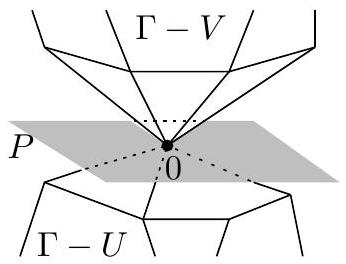
Case 1: Both and are vertices of . Bodies and have a common vertex which is 0. Choose plane in such a way that . Then Lemma 2 yields . Therefore is a support plane of such that they have only one common point so no line segment exists on which would contain in its interior. Since this case occurs for antipodal vertex pairs and each pair is counted twice, the number of such boundary points on is .
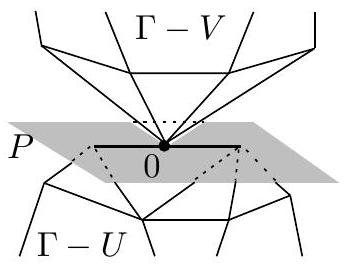
Case 2: Point is an interior point of an edge and is a vertex of . Choose plane such that and . By Lemma 2, . Hence there exists a line segment in which contains in its interior, but there is no planar region in with the same property. We obtain a similar result if belongs to an edge of and is a vertex.
Case 3: Points and are interior points of edges and , respectively. Let be the plane of and . Then and . Therefore point belongs to a parallelogram face on . The centre of the parallelogram is , the vector between the midpoints. Therefore an edge pair ( ) occurs if and only if and are antipodal which happens times.
Case 4: Point lies in the interior of a face and is a vertex of . The only choice for is the plane of . Then we have and . This is a planar face of which is congruent to . For each face , the only possible vertex is the farthest one from the plane of . If is a vertex and belongs to face then we obtain the same way that belongs to a face which is also congruent to . Therefore, each face of has two copies on , a translated and a reflected copy.
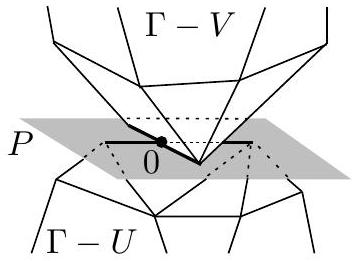
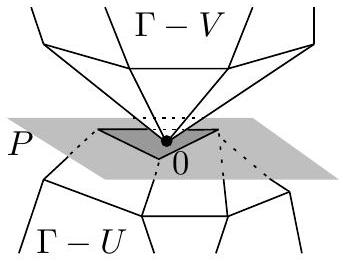
Case 5: Point belongs to a face of and point belongs to an edge or a face . In this case objects and must be parallel which is not allowed. case 1 case 2 case 3 case 4
Now all points in belong to some planar polygons (cases 3 and 4), finitely many line segments (case 2) and points (case 1). Therefore is indeed a polyhedron. Now compute the numbers of its vertices, edges and faces. The vertices are obtained in case 1, their number is . Faces are obtained in cases 3 and 4. Case 3 generates parallelogram faces. Case 4 generates faces. We compute the number of edges of from the degrees (number of sides) of faces of . Let be the the degree of face . The sum of degrees is twice as much as the number of edges, so . The sum of degrees of faces of is , so the number of edges on is . Applying Euler's polyhedron theorem on and , we have and . Then the conclusion follows:
a. Polyhedron has no parallel edges - the great circles of and are different for all .
b. If an edge does not belong to a face then they are not parallel - the great circle which contains arcs and does not pass through points and .
c. Polyhedron has no parallel faces - points and are pairwise distinct.
The regions , arcs and points provide a decomposition of the surface of the sphere. Regions , arcs and points provide the reflection of this decomposition. These decompositions are closely related to the problem.
Lemma 1. For any , regions and overlap if and only if vertices and are antipodal.
Lemma 2. For any and intersect if and only if the midpoints and of edges and are antipodal.
Proof of lemma 1. First note that by properties (a,b,c) above, the two regions cannot share only a single point or an arc. They are either disjoint or they overlap. Assume that the two regions have a common interior point . Let and be two parallel support planes of through points and , respectively, with normal vector . By the definition of regions and is the inward normal vector of and the outward normal vector of . Therefore polyhedron lies between the two planes; vertices and are antipodal. To prove the opposite direction, assume that and are antipodal. Then there exist two parallel support planes and through and , respectively, such that is between them. Let be the inward normal vector of ; then is the outward normal vector of , therefore . The two regions have a common point, so they overlap.
Proof of lemma 2. Again, by properties (a, b) above, the endpoints of cannot belong to and vice versa. The two arcs are either disjoint or intersecting. Assume that arcs and intersect at point . Let and be the two support planes through edges and , respectively, with normal vector . By the definition of and , vector points inwards from and outwards from . Therefore is between the planes. Since planes and pass through and , these points are antipodal. For the opposite direction, assume that points and are antipodal. Let and be two support planes through these points, respectively. An edge cannot intersect a support plane, therefore and lie in the planes and , respectively. Let be the inward normal vector of , which is also the outward normal vector of . Then . So the two arcs are not disjoint; they therefore intersect.
Now create a new decomposition of sphere . Draw all and on sphere and put a knot at each point where two arcs meet. We have knots at points and another knots at points , corresponding to the faces of ; by property (c) they are different. We also have some pairs where arcs and intersect. By Lemma 2, each antipodal pair ( ) gives rise to two such intersections; hence, the number of all intersections is and we have knots in all. Each intersection knot splits two arcs, increasing the number of arcs by 2. Since we started with arcs, corresponding the edges of , the number of the resulting curve segments is . The network of these curve segments divides the sphere into some "new" regions. Each new region is the intersection of some overlapping sets and . Due to the convexity, the intersection of two overlapping regions is convex and thus contiguous. By Lemma 1, each pair of overlapping regions corresponds to an antipodal vertex pair and each antipodal vertex pair gives rise to two different overlaps, which are symmetric with respect to the origin. So the number of new regions is . The result now follows from Euler's polyhedron theorem. We have and therefore Therefore is by one less than the number of vertices of .
---
Alternative solution.
Use the same notations for the polyhedron and its vertices, edges and faces as in Solution 1. We regard points as vectors starting from the origin. Polyhedron is regarded as a closed convex set, including its interior. In some cases the edges and faces of are also regarded as sets of points. The symbol denotes the boundary of the certain set; e.g. is the surface of . Let be the set of vectors between arbitrary points of . Then , being the sum of two bounded convex sets, is also a bounded convex set and, by construction, it is also centrally symmetric with respect to the origin. We will prove that is also a polyhedron and express the numbers of its faces, edges and vertices in terms and .
Lemma 1. For points , point is a boundary point of if and only if and are antipodal. Moreover, for each boundary point there exists exactly one pair of points such that .
Proof. Assume first that and are antipodal points of . Let parallel support planes and pass through them such that is in between. Consider plane . This plane separates the interiors of and . After reflecting one of the sets, e.g. , the sets and lie in the same half space bounded by . Then lies in that half space, so is a boundary point of the set . Translating by we obtain that is a boundary point of . To prove the opposite direction, let be a boundary point of , and let . We claim that . Clearly is a bounded convex set and . For any two points , we have and . Since is a boundary point of , the vector cannot have the same direction as . This implies that the interior of is empty. Now suppose that contains a line segment . Then and are subsets of some faces or edges of and these faces/edges are parallel to . In all cases, we find two faces, two edges, or a face and an edge which are parallel, contradicting the conditions of the problem. Therefore, indeed. Since consists of a single point, the interiors of bodies and are disjoint and there exists a plane which separates them. Let be the normal vector of pointing into that half space bounded by which contains . Consider the planes and ; they are support planes of , passing through and , respectively. From plane , the vector points into that half space which contains . From plane , vector points into the opposite half space containing . Therefore, we found two proper support through points and such that is in between. For the uniqueness part, assume that there exist points such that . The points and lie in the sets and separated by . Since , this can happen only if both are in ; but the only such point is 0. Therefore, implies and . The lemma is complete.
Lemma 2. Let and be two antipodal points and assume that plane , passing through 0, separates the interiors of and . Let and . Then .
Proof. The sets and lie in the same closed half space bounded by . Therefore, for any points and , we have if and only if . Then . Now a translation by ( ) completes the lemma.
Now classify the boundary points of , according to the types of points and . In all cases we choose a plane through 0 which separates the interiors of and . We will use the notation and as well.
Case 1: Both and are vertices of . Bodies and have a common vertex which is 0. Choose plane in such a way that . Then Lemma 2 yields . Therefore is a support plane of such that they have only one common point so no line segment exists on which would contain in its interior. Since this case occurs for antipodal vertex pairs and each pair is counted twice, the number of such boundary points on is .
Case 2: Point is an interior point of an edge and is a vertex of . Choose plane such that and . By Lemma 2, . Hence there exists a line segment in which contains in its interior, but there is no planar region in with the same property. We obtain a similar result if belongs to an edge of and is a vertex.
Case 3: Points and are interior points of edges and , respectively. Let be the plane of and . Then and . Therefore point belongs to a parallelogram face on . The centre of the parallelogram is , the vector between the midpoints. Therefore an edge pair ( ) occurs if and only if and are antipodal which happens times.
Case 4: Point lies in the interior of a face and is a vertex of . The only choice for is the plane of . Then we have and . This is a planar face of which is congruent to . For each face , the only possible vertex is the farthest one from the plane of . If is a vertex and belongs to face then we obtain the same way that belongs to a face which is also congruent to . Therefore, each face of has two copies on , a translated and a reflected copy.
Case 5: Point belongs to a face of and point belongs to an edge or a face . In this case objects and must be parallel which is not allowed. case 1 case 2 case 3 case 4
Now all points in belong to some planar polygons (cases 3 and 4), finitely many line segments (case 2) and points (case 1). Therefore is indeed a polyhedron. Now compute the numbers of its vertices, edges and faces. The vertices are obtained in case 1, their number is . Faces are obtained in cases 3 and 4. Case 3 generates parallelogram faces. Case 4 generates faces. We compute the number of edges of from the degrees (number of sides) of faces of . Let be the the degree of face . The sum of degrees is twice as much as the number of edges, so . The sum of degrees of faces of is , so the number of edges on is . Applying Euler's polyhedron theorem on and , we have and . Then the conclusion follows:
Final answer
A - B = m - ℓ + 1 = n - 1
Techniques
Other 3D problemsEuler characteristic: V-E+FVectors