Browse · MathNet
PrintThe South African Mathematical Olympiad Third Round
South Africa geometry
Problem
Let be a triangle with . A point on the circumcircle of (on the same side of as ) is chosen in such a way that . Let and the angle bisector of intersect at , and let the line through and parallel to intersect at . Prove that .
Solution
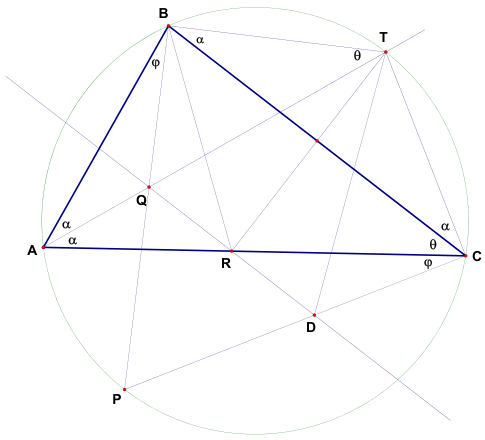
Let extended meet the circumcircle of triangle in , and let the line through and intersect in . See Figure 2: Figure 2 Put , so that also and . Put , so that also . Put , so that also .
Then (since . From (since is a cyclic quadrilateral), we therefore have , giving . Since triangle is isosceles (, so that ), we have , forcing . Furthermore, chords and both subtend the same angle at , hence are equal in length. It follows that , hence . But since (recall that ), we see that is a cyclic quadrilateral. This implies that (because ). So , and we also have that is a cyclic quadrilateral. (Recall that .) It follows that , and we thus have , since . Finally, follows from the fact that .
---
Alternative solution.
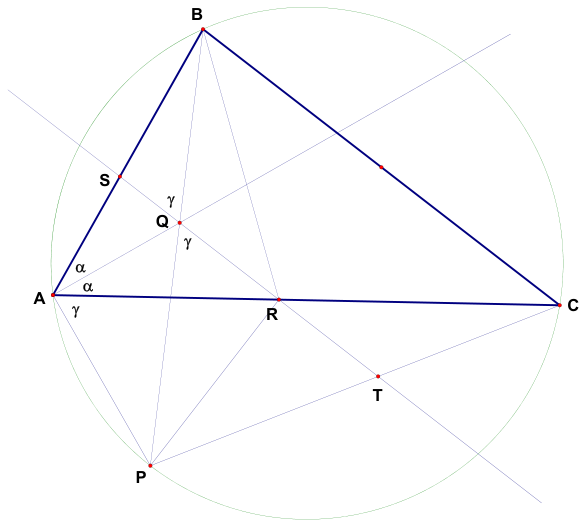
Let the line through and intersect and in and , respectively. See Figure 3: Figure 3 Put . Then also . From the fact that , it follows that , so that . Thus is a cyclic quadrilateral. Hence , and since , we have . So .
We see that (, and (from and )). Consequently, .
Then (since . From (since is a cyclic quadrilateral), we therefore have , giving . Since triangle is isosceles (, so that ), we have , forcing . Furthermore, chords and both subtend the same angle at , hence are equal in length. It follows that , hence . But since (recall that ), we see that is a cyclic quadrilateral. This implies that (because ). So , and we also have that is a cyclic quadrilateral. (Recall that .) It follows that , and we thus have , since . Finally, follows from the fact that .
---
Alternative solution.
Let the line through and intersect and in and , respectively. See Figure 3: Figure 3 Put . Then also . From the fact that , it follows that , so that . Thus is a cyclic quadrilateral. Hence , and since , we have . So .
We see that (, and (from and )). Consequently, .
Techniques
Cyclic quadrilateralsAngle chasingDistance chasing