Browse · MathNet
Print45th Mongolian Mathematical Olympiad
Mongolia counting and probability
Problem
Consider an table of squares. We put some balls into squares. After that, for each empty square, count the number of adjacent squares with balls, and write down that number in the empty square. Find the maximum possible value of the sum of these numbers over all empty squares.
Solution
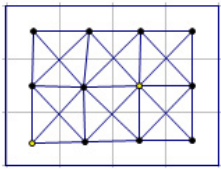
The table cells are represented by the graph's vertices. We connect adjacent cells, corresponding to edges between graph vertices.
For example, we illustrate the table in the figure.
If a square has a ball, we color it black; if a square is empty, we color it white.
Then, the sum of the numbers in all empty squares is equal to the number of edges in the table's graph that connect vertices of opposite colors (i.e., edges between black and white vertices).
So, the problem reduces to coloring the table's graph with two colors to maximize the number of edges between vertices of opposite colors.
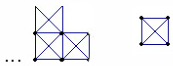
Lemma: In a graph of squares colored with two colors, the number of edges connecting vertices of opposite colors is less than per vertex for a certain type of graph, and less than per vertex for another type. (This lemma holds for square graphs.)
Proof. By coloring all possibilities for four vertices in the graph, we can verify the lemma. For the last graph, with only one type of coloring, the number of edges connecting opposite colors is exactly .
Corollary:
a) For a graph with vertices colored with two colors, the maximum number of edges connecting vertices of opposite colors is .
b) For another type of graph, the maximum number of edges connecting vertices of opposite colors is .
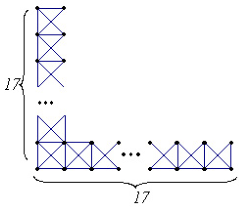
Proof a) In the above graph, we can assume it is the union of two types of graphs: one with a single square and squares. By the lemma, this graph has at most edges connecting opposite colored vertices.
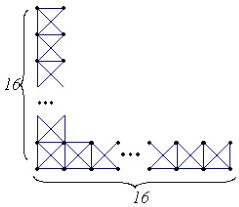
b) In this graph, we can assume it is the union of two types of graphs: one with a single graph and graphs. By the lemma, this graph has at most edges connecting opposite colored vertices.
Now, solve the problem. The table's graph is the union of graphs.
Consider the square graph. By the corollary part a), for graphs, the total number of edges connecting opposite colored vertices is less than .
Assume that the square's graph is the union of the graphs in the figure. Then, by corollary part b), we have:
Hence, the table's graph has at most edges connecting opposite colored vertices.
If we color the vertices in odd-numbered columns black and even-numbered columns white, then the number of edges connecting opposite colors is .
For example, we illustrate the table in the figure.
If a square has a ball, we color it black; if a square is empty, we color it white.
Then, the sum of the numbers in all empty squares is equal to the number of edges in the table's graph that connect vertices of opposite colors (i.e., edges between black and white vertices).
So, the problem reduces to coloring the table's graph with two colors to maximize the number of edges between vertices of opposite colors.
Lemma: In a graph of squares colored with two colors, the number of edges connecting vertices of opposite colors is less than per vertex for a certain type of graph, and less than per vertex for another type. (This lemma holds for square graphs.)
Proof. By coloring all possibilities for four vertices in the graph, we can verify the lemma. For the last graph, with only one type of coloring, the number of edges connecting opposite colors is exactly .
Corollary:
a) For a graph with vertices colored with two colors, the maximum number of edges connecting vertices of opposite colors is .
b) For another type of graph, the maximum number of edges connecting vertices of opposite colors is .
Proof a) In the above graph, we can assume it is the union of two types of graphs: one with a single square and squares. By the lemma, this graph has at most edges connecting opposite colored vertices.
b) In this graph, we can assume it is the union of two types of graphs: one with a single graph and graphs. By the lemma, this graph has at most edges connecting opposite colored vertices.
Now, solve the problem. The table's graph is the union of graphs.
Consider the square graph. By the corollary part a), for graphs, the total number of edges connecting opposite colored vertices is less than .
Assume that the square's graph is the union of the graphs in the figure. Then, by corollary part b), we have:
Hence, the table's graph has at most edges connecting opposite colored vertices.
If we color the vertices in odd-numbered columns black and even-numbered columns white, then the number of edges connecting opposite colors is .
Final answer
2009
Techniques
Coloring schemes, extremal argumentsCounting two waysOther